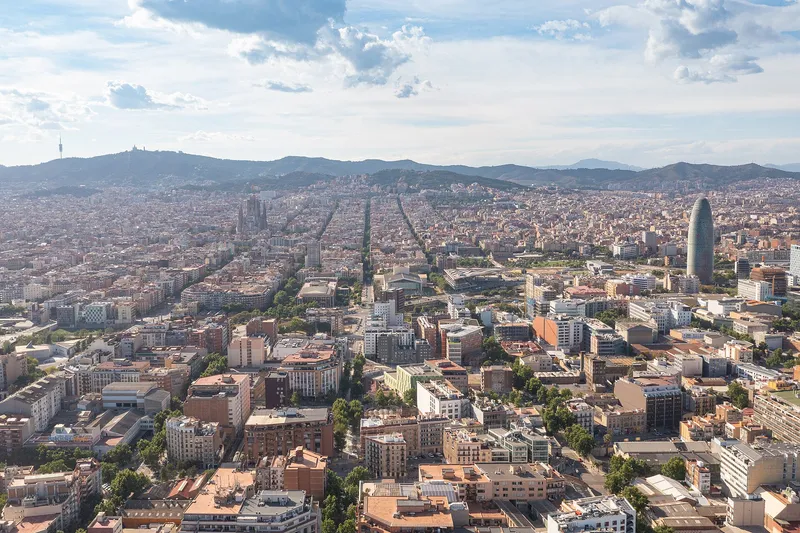
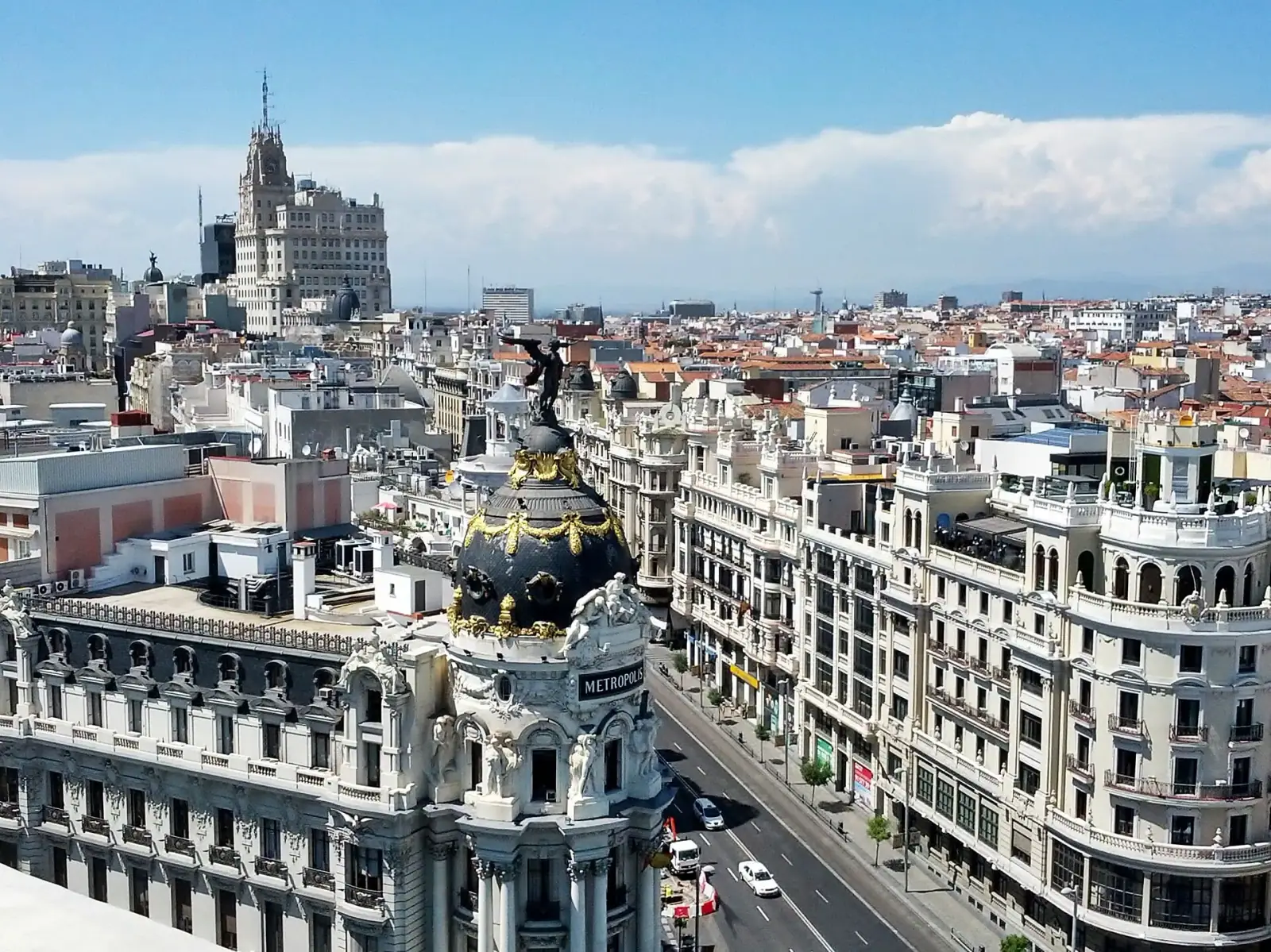
Aerial view of Madrid cityscape featuring the Metropolis Building and Gran Via boulevard
Photo: Justraveling.com / Wikimedia Commons (CC BY-SA 4.0)
Spain flag

Madrid

Spain

Experience tapas, art, and nightlife that never ends in Spain's capital.

€3.200
Monthly Budget
--
Current Weather
Mediterranean
Climate Type
80 Mbps
Avg. WiFi Speed
7/10
Safety Score
5,000+
Active Nomads
--
Time Difference
Scroll
0
Nomad Score

Madrid at a Glance for Remote Workers

Experience tapas, art, and nightlife that never ends in Spain's capital. Plan on roughly $3,200 a month. Its strengths are nightlife and culture, while cost is where it scores lower.

Compare Madrid vs Zaragoza →

Category Breakdown

How Madrid scores across all 13 factors

Weather in Madrid

Monthly averages from 2019-2023 (Open-Meteo), and the best time to visit

10°
Jan
15°
Feb
17°
Mar
19°
Apr
25°
12°
May
30°
16°
Jun
35°
20°
Jul
33°
20°
Aug
26°
15°
Sep
22°
11°
Oct
14°
Nov
11°
Dec
Daily high & low (°C)Rainfall (mm/month)Best months to visit

The best time to visit Madrid for comfortable weather is Jun, Jul, Aug. The warmest month is Jul (around 35°C by day), and the wettest is Sep (about 93mm of rain).

Chasing good weather? See other cities that are warm in Jun, or plan a multi-city route around the seasons. Staying a while in Madrid? Check visa options, your time-zone overlap and how far your budget stretches, or find it on the world map.

Historical monthly averages, not a forecast. Source: Open-Meteo.

Best Neighborhoods in Madrid

Where to base yourself for the perfect nomad experience

Malasaña

$$
Hipster & Alternative

Madrid's hipster heart with rebellious spirit

Malasaña is Madrid's countercultural epicenter - vintage shops, indie bars, and creative energy. Born from the Movida Madrileña, it remains the city's most alternative neighborhood with excellent cafes and nightlife.

Best for: Creatives, young professionals, and digital nomads seeking authentic Madrid culture
✓ Pros
  • Best cafe culture
  • Indie scene
  • Central location
  • Nightlife
✗ Cons
  • Noisy at night
  • Crowded weekends
  • Rising prices

Lavapiés

$
Multicultural & Bohemian

Madrid's multicultural melting pot

Lavapiés is Madrid's most diverse neighborhood - immigrant communities, street art, and affordable eats. The multicultural vibe creates unique fusion restaurants and a bohemian atmosphere.

Best for: Budget travelers, food lovers, artists, and those seeking authentic diversity
✓ Pros
  • Cheapest central area
  • Amazing ethnic food
  • Art galleries
  • Community feel
✗ Cons
  • Gritty streets
  • Some safety concerns
  • Less polished

Chueca

$$$
LGBTQ+ & Trendy

Madrid's vibrant LGBTQ+ neighborhood

Chueca is Madrid's LGBTQ+ heartland - trendy boutiques, excellent restaurants, and welcoming atmosphere. It's one of Europe's most inclusive neighborhoods with great nightlife and shopping.

Best for: LGBTQ+ travelers, shoppers, and those seeking open-minded community
✓ Pros
  • Inclusive atmosphere
  • Great shopping
  • Excellent dining
  • Central
✗ Cons
  • Expensive
  • Crowded
  • Tourist presence

La Latina

$$
Traditional & Historic

Traditional Madrid with tapas heritage

La Latina is historic Madrid - medieval streets, traditional tapas bars, and the famous El Rastro flea market. Sunday afternoons here are a Madrid tradition with cañas and crowds.

Best for: Food lovers, history buffs, and those seeking authentic Spanish culture
✓ Pros
  • Best tapas
  • El Rastro market
  • Historic charm
  • Local atmosphere
✗ Cons
  • Sunday crowds
  • Limited workspace
  • Old buildings

Salamanca

$$$$
Upscale & Elegant

Madrid's elegant upscale district

Salamanca is Madrid's poshest neighborhood - designer boutiques, Michelin restaurants, and beautiful architecture. Wide boulevards and sophisticated atmosphere for those seeking refinement.

Best for: Luxury travelers, business professionals, and those seeking refined atmosphere
✓ Pros
  • Beautiful architecture
  • High-end shopping
  • Fine dining
  • Safe
✗ Cons
  • Very expensive
  • Less character
  • Formal atmosphere

Cost of Living in Madrid

Madrid is not the bargain it was five years ago. Rents have climbed hard since 2022, and central one-bedroom flats now sit near the top of the Spanish market. Here is a realistic monthly budget for one person (USD figures use roughly 1.08 to the euro, so treat them as approximate).

  • Rent, one-bedroom in a central district (Centro, Salamanca, Chamberi, Malasana): €1,200 to €1,600 ($1,300 to $1,730). Furnished flats add roughly €100 to €200.
  • Rent, one-bedroom in a cheaper outer district (Usera, Vallecas, Villaverde, Carabanchel): €800 to €1,100 ($865 to $1,190).
  • Groceries: €200 to €300 ($215 to $325) if you cook most meals. Shopping at Mercadona or Lidl keeps you near the lower end.
  • Eating out: the weekday menu del dia (a fixed lunch with starter, main, dessert or coffee, and a drink) runs €12 to €18 ($13 to $19). A tapas dinner with drinks lands around €15 to €25 per person.
  • Coworking hot desk: €100 to €250 ($108 to $270) per month, or roughly €15 to €25 for a day pass.
  • Local transport: the monthly Zone A pass (abono) is €32.70 ($35), held flat by regional subsidies through 2026.

A single remote worker renting centrally should budget around €1,900 to €2,600 ($2,050 to $2,810) all in. Living in an outer district and cooking more can pull that under €1,500 ($1,620). Sharing a flat, which is very common, changes the math entirely.

Where to Work

Madrid has a deep coworking scene. Established names include Utopicus, Impact Hub, Spaces, WeWork, Talent Garden, and The Shed, spread across the center and business districts. For true short-stay flexibility, Nomad Coworking offers plans from a few days upward with 24/7 access on monthly memberships. Most spaces bundle fast WiFi, meeting rooms, printers, and free coffee.

Cafe-work culture exists but is softer than in some nomad hubs. Spanish cafe owners generally do not mind you nursing a coffee for an hour or two, though camping out all afternoon with a laptop is less welcome in busy central spots. WiFi in cafes is common but uneven, so keep a phone hotspot as backup. Home internet is genuinely strong: Spain has some of the best fiber coverage in Europe, and most flats come with fast, reliable connections.

Getting Around

The Madrid Metro is extensive, clean, and one of the easiest big-city systems in Europe to use. Single rides start around €1.50, and the €32.70 monthly abono covers Metro and buses across Zone A. If you are 26 or under, the Abono Joven costs about €10 per month for the entire region, airport included, which is one of the best transport deals in Europe.

Central Madrid is very walkable. Neighborhoods like Centro, Malasana, Chueca, and La Latina flow into each other on foot, and you can cross much of the core in half an hour. You will rarely need a car.

Getting to and from Adolfo Suarez Madrid-Barajas (MAD) is simple. Metro Line 8 connects the airport (stations at T1-T2-T3 and T4) to the city in roughly 15 to 30 minutes. There is a €3 airport supplement on single Metro tickets, but it is waived if you use a 30-day abono, an annual pass, or a tourist ticket. Airport buses and taxis are also available, with taxis running a fixed flat fare to and from the center.

Visas and Staying Long-Term

If you hold a US, UK, Canadian, Australian, or similar passport, you can enter Spain visa-free as a tourist under the Schengen 90/180 rule: up to 90 days within any rolling 180-day period across the whole Schengen Area. That cap covers time spent in other Schengen countries too, not just Spain.

To stay longer, Spain offers a digital nomad visa for non-EU citizens who work remotely for companies or clients outside Spain. As of 2026 the income threshold is around €2,850 net per month (roughly €34,000 per year) for a single applicant, with more required for accompanying family. You also need private health insurance valid in Spain. Applying from a consulate abroad typically grants up to one year, while applying from inside Spain can grant a residence authorization valid for up to three years, both renewable if you keep qualifying. EU and EEA citizens do not need any of this and can live and work in Spain freely.

Immigration rules and income figures change, so confirm the current requirements with an official source such as Spain's consulate or the Ministry of Foreign Affairs before you commit.

Best Time to Visit

Madrid has a real continental climate: hot, dry summers and genuinely cold winters. July and August regularly push past 35 C (95 F), the city empties out as locals leave, and midday becomes hard to work through without air conditioning. Winter nights drop near freezing, though days are often crisp and sunny.

The best windows for remote work are spring (April to June) and autumn (September to early November), when temperatures are mild, terraces are pleasant, and the city is fully alive. If you can only come in summer, make sure your flat and coworking space have solid air conditioning.

Pros and Cons

  • Pro: excellent, cheap public transport and a highly walkable center.
  • Pro: fast, reliable internet across the city and a mature coworking scene.
  • Pro: outstanding food, nightlife, and a clear path to legal long-term residency via the nomad visa.
  • Pro: safe, well connected to the rest of Europe, and welcoming to newcomers.
  • Con: rents have risen sharply and central flats are no longer cheap by Spanish standards.
  • Con: brutal summer heat and a genuinely cold winter make timing matter.
  • Con: the late local schedule (dinner at 9pm or later) can clash with early-morning client calls.
  • Con: less English than in some hubs, so a little Spanish goes a long way.

Who Madrid Is Best For

Madrid suits remote workers who want a real European capital rather than a beach town: big-city energy, deep culture, world-class food, and easy travel across Spain and Europe. It works well if you value walkability, nightlife, and a large expat and nomad community, and if your income comfortably clears the visa thresholds should you want to stay.

You should probably skip it if your budget is tight and you were expecting the low rents of a few years ago, if you can only visit in peak summer and hate heat, or if you want a quiet, slow, small-town pace. In those cases a smaller Spanish city like Valencia or Granada may fit better.
Where to Stay in Madrid

Top neighborhoods and accommodations for digital nomads

Bob W Madrid Atocha

Aparthotel
Lavapiés

Tech-enabled aparthotel with fast WiFi and kitchens, steps from Atocha station and walkable to Retiro Park.

Check availability →

Eric Vökel Boutique Apartments Madrid Suites

Serviced apartments
Malasaña

Spacious designer apartments in a restored building next to Gran Via, ideal for longer stays with full kitchens and fast WiFi.

Check availability →

Petit Palace Preciados

Boutique hotel
Sol

Centrally located boutique hotel one block from Puerta del Sol with reliable WiFi and easy metro access to the whole city.

Check availability →

Bastardo Hostel

Hostel
Malasaña

Upscale social hostel at the Malasaña and Chueca crossroads with coworking tables, shared kitchen, and a lively rooftop bar.

Check availability →

The Hat Madrid

Hostel
Centro

Stylish hostel steps from Plaza Mayor offering private rooms, strong WiFi, and communal spaces perfect for solo nomads.

Check availability →

Browse apartments, aparthotels and hotels across Madrid. Compare prices and book a base that suits a remote-work stay.

See available stays in Madrid →

Affiliate link. See our disclosure.

Best Coworking Spaces

Where nomads get work done in Madrid

Utopicus Castellana

Premium coworking
Paseo de la Castellana

Design-forward coworking with private offices, hot desks, and meeting rooms along Madrid's main business boulevard.

Visit website →
Interior of Impact Hub Madrid during a community lecture event, showing the industrial space with exposed concrete walls

Photo: Impact Hub (CC BY-SA 2.0)

Impact Hub Madrid

Community coworking
Lavapies

Mission-driven coworking hub focused on sustainability and social impact, with a strong international community.

Visit website →

Cloudworks Castellana

Flexible coworking
Paseo de la Castellana

Stylish flexible workspace in the heart of Madrid's business district, popular with startups and freelancers.

Visit website →

Federal Cafe

Specialty coffee cafe
Lavapies

Australian-inspired specialty coffee shop with reliable WiFi, Scandi decor, and a welcoming vibe for remote workers.

View on Maps →

Hola Coffee Fourquet

Specialty coffee cafe
Lavapies

Modern specialty coffee shop with single-origin beans, fast WiFi, communal tables, and bilingual staff.

View on Maps →

Toma Cafe

Laptop-friendly cafe
Malasana

Cult specialty coffee spot in Malasana with free WiFi on weekdays, favoured by the nomad and creative crowd.

View on Maps →

Where to Eat & Drink

Best food and drink spots in Madrid

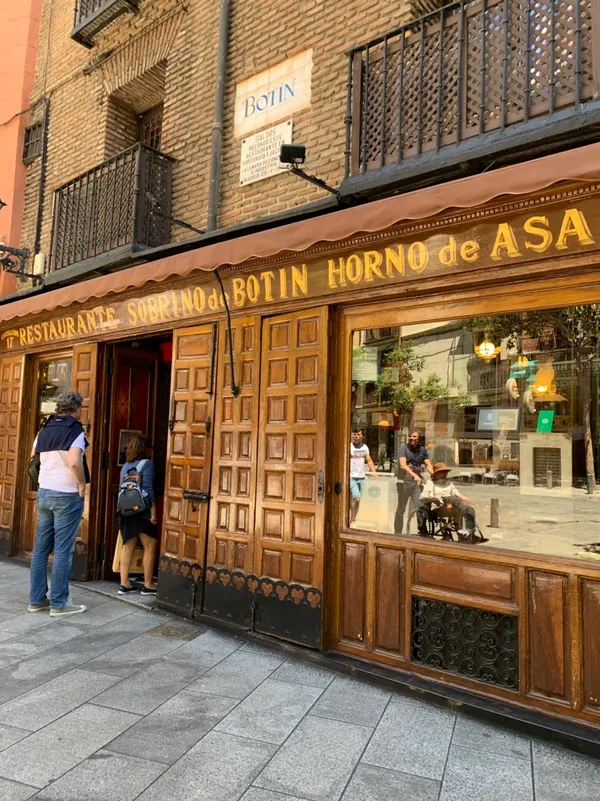
Facade of Sobrino de Botin restaurant in Madrid with historic wooden doors and golden lettering on the awning

Photo: Renek78 (CC BY-SA 4.0)

Sobrino de Botin

Traditional Castilian
La Latina

The world's oldest restaurant since 1725, famous for wood-fired roast suckling pig and lamb in a historic cellar setting.

Visit website →
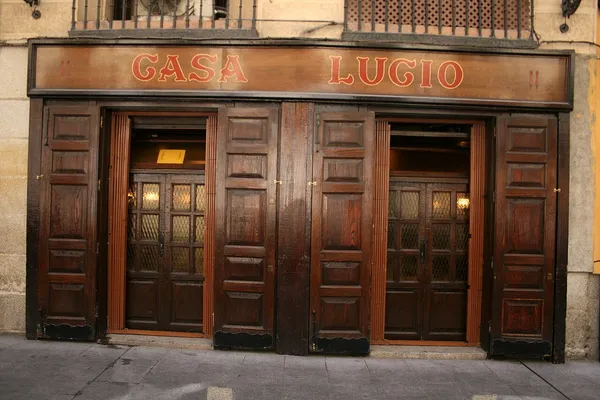
Facade of Casa Lucio restaurant in Madrid showing the classic wooden entrance doors and red Casa Lucio sign

Photo: Tamorlan (CC BY 3.0)

Casa Lucio

Classic Madrid tavern
La Latina

Legendary Madrid institution beloved by locals and royalty alike, best known for its iconic huevos rotos over crispy potatoes.

Visit website →

La Musa Malasana

Modern tapas
Malasana

Lively modern tapas bar with creative small plates, natural wines, and a young cosmopolitan crowd in bohemian Malasana.

View on Maps →
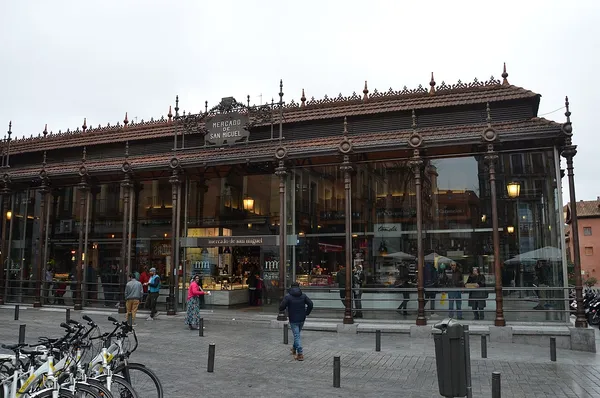
Exterior of Mercado de San Miguel in Madrid, a historic iron and glass market hall with ornate facade

Photo: Steven Lek (CC BY-SA 4.0)

Mercado de San Miguel

Gourmet market
Austrias

Beautifully restored 1916 iron market with premium Spanish food stalls: jamon, seafood, cheese, wine, and pintxos.

Visit website →

Bosco de Lobos

Italian bistro
Chueca

Charming Italian restaurant in Chueca with a garden terrace, library-style interior, and an open kitchen.

View on Maps →

Finnegans Irish Pub

Irish pub
Retiro

Well-established Irish pub near Retiro Park, a reliable meeting spot for English-speaking expats and sports fans.

Visit website →

What Do Nomads Say?

Vote on how accurate these scores are based on your experience

Cities with a Similar Vibe to Madrid

Different places that score alike across our 13 categories, if you like Madrid, these tend to feel similar.

Frequently Asked Questions About Madrid

How much does it cost to live in Madrid as a digital nomad?

Budget roughly $3,200 a month in Madrid for a furnished place, food, coworking, and transport. The most popular central areas cost more; suburbs and local spots cost noticeably less.

Is the internet fast enough for remote work in Madrid?

Madrid rates 8 out of 10 for WiFi in our scoring, so it handles video calls and daily remote work excellent. Carry a local SIM with data as a backup for cafes and travel days.

Is Madrid safe for digital nomads?

Our safety score for Madrid is 7/10, good for nomads. As anywhere, watch your belongings, favor busier streets after dark, and research neighborhoods before you book.

Is Madrid a good city for digital nomads overall?

Madrid stands out for nightlife and culture among remote workers. With a typical budget near $3,200 a month and a growing nomad scene, it suits anyone whose priorities line up with those strengths.