Cost of Living in Nagasaki
Where this figure comes from. No cost survey covers Nagasaki, so the $1,500 a month above is our own estimate rather than a measurement. On 416 of our 999 city guides the figure is built from a published Numbeo basket, a one-bedroom rent in the centre plus one person's monthly costs without rent, converted to USD; this city is not one of them. How we source everything.
Budget roughly $1,500 a month as a solo remote worker in Nagasaki, which is among the more affordable Japanese cities of its size. A one-bedroom apartment near the centre runs about $420 to $620, with the usual Japanese caveat that key money, deposits and a guarantor make the up-front cost substantially higher than the rent. Properties on the slopes are cheaper and involve a great many steps. Groceries land around $340 to $430. A champon or sara udon lunch, both Nagasaki dishes, is $7 to $10, a restaurant dinner $20 to $30, and castella sponge cake, the Portuguese import the city made its own, about $8 a box. A monthly transit pass is roughly $55. The up-front cost of a Japanese lease deserves its own line: a deposit, non-refundable key money in many buildings, a month to the agency and a fee to the guarantor company that stands behind a tenant with no Japanese co-signer. Together those can come to four or five months of rent before a key changes hands. National health insurance is charged by the city against the previous year's income, so a first year is cheap and a second is not. Hillside houses are the cheap ones because no vehicle can reach them, and the steps are the reason.
Where to Work in Nagasaki
Nagasaki has limited coworking, at roughly $120 to $200 a month, and most remote workers use their accommodation or the city's cafes, which are plentiful and relaxed about long stays as everywhere in Japan. Japanese internet is fast, cheap and dependable in fixed-line and mobile form alike. Nagasaki University and a number of smaller institutions keep a student population and a modest international presence, larger than most Japanese cities this size because of the city's long history of foreign contact. English remains limited in daily life. The topography matters practically: the city is built on steep slopes, and a flat with a good connection and a manageable walk is worth searching for. Japan keeps a single time zone set for Tokyo, and this city sits far enough west that the sun rises and sets noticeably later by the clock than the national schedule assumes, which quietly helps anyone working with Europe. Shipbuilding is still the industrial backbone and the cranes across the harbour belong to it. The university keeps an institute of tropical medicine whose research reputation reaches well beyond Kyushu, which is part of why the foreign academic presence is larger than the population would predict. Offices finish earlier than in Tokyo and the commute is measured in minutes.
Getting Around Nagasaki
Nagasaki is built around a deep harbour with hills rising steeply on three sides, and the flat strip along the water is where the trams run. The tram network, four lines with a flat fare of about a dollar, is the cheapest and most useful in Japan and covers essentially everything a visitor or resident needs. Beyond the flat, the city climbs by steps and narrow lanes, and several slope lifts and a ropeway up Mount Inasa help. Buses fill the rest. The railway connects to Fukuoka in about two hours, and the Nishi Kyushu Shinkansen has shortened part of that route. Nagasaki airport is on a reclaimed island about 40 minutes out. The high-speed line that reaches the city is not joined to the rest of the network, so a journey to Osaka means changing to a conventional express partway and the time saved is smaller than the word implies. Within the city the answer to the hills is a set of public slope elevators built into the residential terraces, free to use and treated as ordinary infrastructure by everyone living above them. A day pass on the trams costs about the price of three rides and pays for itself on any day with a plan.
Sorting transport? Book an airport transfer, or compare car rental on Auto Europe and QEEQ.
Visas for Nagasaki
Japan grants most Western passports 90 days visa-free. The digital nomad visa introduced in 2024 covers remote workers from eligible countries who meet a high annual income threshold and hold private health insurance, and grants six months without direct renewal. The Highly Skilled Professional points system, standard employer-sponsored work visas and working holiday agreements are the other routes. Japanese immigration procedure is exacting and paperwork-heavy but consistent, and the rules are published clearly. Nagasaki prefecture, like the rest of Japan, handles applications through the regional immigration bureau, and processing outside Tokyo is often faster.
Best Time to Visit Nagasaki
Spring and autumn are the best seasons in Nagasaki. Late March to May brings cherry blossom and mild, clear weather; October and November are warm, dry and comfortable, and are when the Nagasaki Kunchi festival fills the city in early October. Summer is hot and humid, into the low thirties, and June is the rainy season, which is pronounced in Kyushu. This is also typhoon country: Kyushu takes more Pacific storms than most of Japan and September is the peak month, which occasionally closes transport for a day. Winter is mild, rarely below freezing, and the Lantern Festival around Chinese New Year in February is the city's other landmark event. At two minutes past eleven on the ninth of August the city stops for the anniversary. The ceremony in the Peace Park is a civic occasion rather than a visitor attraction, and anyone planning to arrive that week should know it in advance. The rainy season here is not a drizzle: the flood of July 1982 killed close to three hundred people when the water came off the slopes in a single night, and heavy-rain warnings on the hillsides have been taken seriously ever since. Typhoon tracks cross this island most often in September.
Pros and Cons of Nagasaki
Nagasaki is the most internationally layered city in Japan, and it shows: a Chinatown, the Dutch trading post at Dejima, hidden Christian churches on the surrounding islands, and a Portuguese cake in every shop. It has an excellent tram network, a spectacular harbour setting, good food, and rents well below the big cities. The Peace Park and the Atomic Bomb Museum are among the most affecting sites anywhere. The hills are relentless and rule the city out for anyone with mobility limits. English is limited, and Japanese administration demands patience. There is no nomad community. Typhoon season is real, and the city is a fair way from anywhere else in Japan.
Who Nagasaki Is For
History is the draw, particularly the long entanglement of Japan with Portugal, the Netherlands, China and the Christian mission, in a striking, walkable, tram-served city at a moderate Japanese price. The six-month nomad visa fits the natural length of a stay here. Photographers get a setting that does most of the work for them, and Kyushu's hot springs and volcanoes are all within reach of a single free day. Solo workers and couples both do well, provided neither minds hills, because the city is built on them and there is no flat way across it. Japanese is required for daily life, the foreign community is small, the city is built on hillsides so flat ground barely exists, and Tokyo is a long way from this corner of Kyushu. Fukuoka is two hours away and is Kyushu's international city.
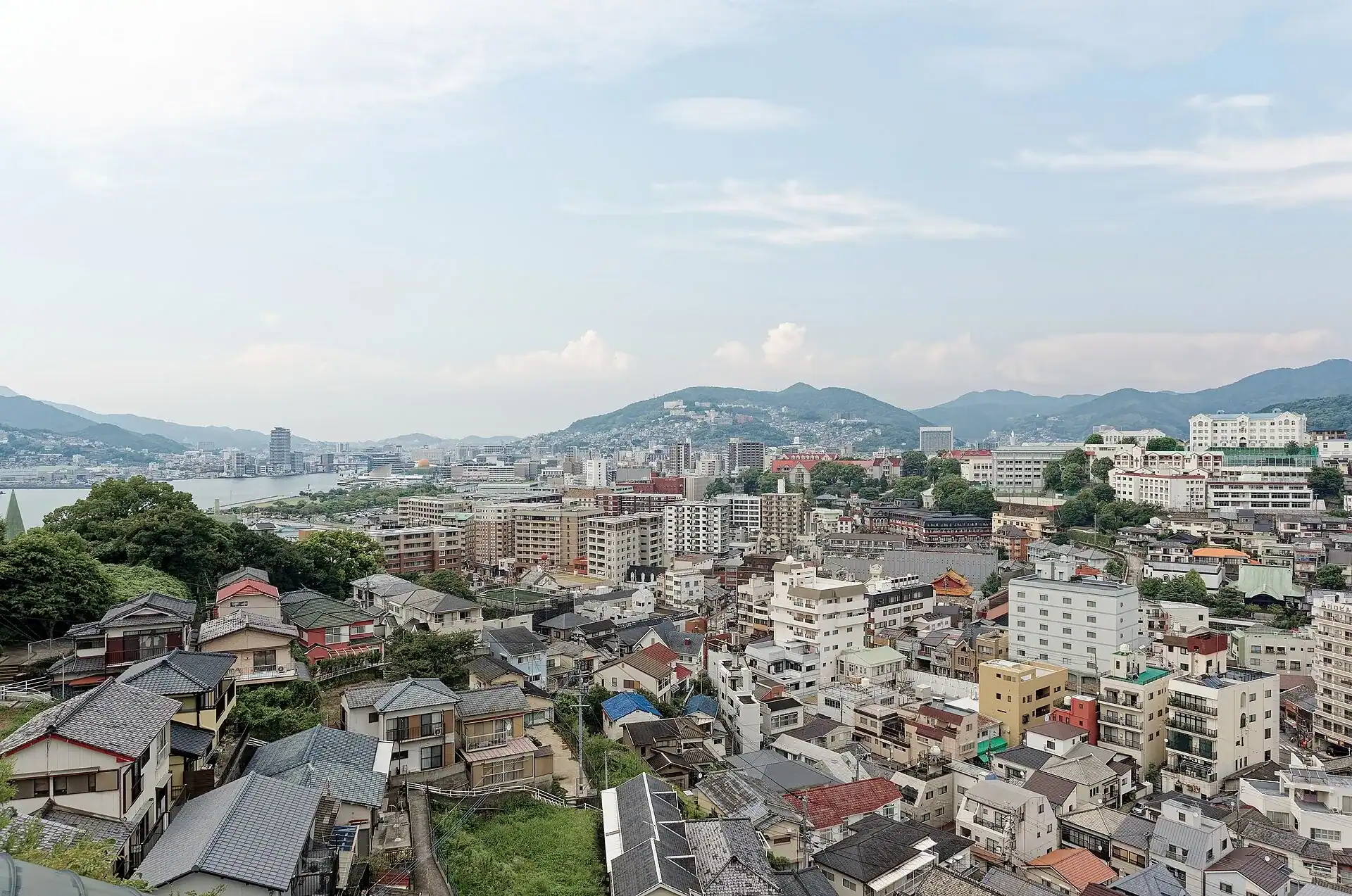 Photo: Jakub Hałun / Wikimedia Commons (CC BY 4.0)