Cost of Living in Matsuyama
Where this figure comes from. No cost survey covers Matsuyama, so the $1,300 a month above is our own estimate rather than a measurement. On 416 of our 999 city guides the figure is built from a published Numbeo basket, a one-bedroom rent in the centre plus one person's monthly costs without rent, converted to USD; this city is not one of them. How we source everything.
Budget around $1,300 a month, which makes Matsuyama noticeably cheaper than Tokyo or Osaka for a comparable standard of living. A one-bedroom runs roughly $400 to $700, with the areas near the castle and Dogo at the top. Groceries are reasonable and Ehime's citrus, particularly the mikan oranges, is a local point of pride. Eating out is inexpensive by Japanese standards and the local speciality, taimeshi, sea bream on rice, is worth the trip. Utilities are moderate. The yen's weakness against most currencies over recent years has made Japan considerably cheaper for foreign earners than it was. Fibre runs about $35 to $50 a month and is among the fastest anywhere. Dogo Onsen's public baths cost a few dollars for the basic entry, which makes a daily onsen a realistic habit rather than an indulgence. The larger financial consideration is administrative: Japanese rentals often demand key money, a deposit and a guarantor, which can mean several months up front, and short-term furnished apartments carry a premium precisely because they sidestep all of that.
Where to Work in Matsuyama
Connectivity is excellent, as it is everywhere in Japan: fibre is ubiquitous and fast, mobile coverage is complete, and power is entirely reliable. There is a small coworking market and the city has actively courted remote workers as part of a national effort to move people out of Tokyo. The time zone is nine hours ahead of GMT, which is difficult for European clients and impossible for American ones, and that is the main practical constraint. Anyone whose income comes from Europe should expect to work evenings. Japanese banking and paperwork remain the other friction. The national relocation push is concrete rather than rhetorical: Ehime and several other prefectures have offered relocation grants and subsidised trial stays to people moving from the Tokyo area, and while those target Japanese residents, the infrastructure they funded is what a visitor benefits from. A pocket wifi router or a data SIM remains the practical answer for a stay under a year, since fixed contracts assume residency and a Japanese bank account.
Getting Around Matsuyama
Matsuyama has a tram network, including the Botchan Ressha, a working replica of the nineteenth century steam train that Natsume Soseki's novel made famous, and it runs on ordinary tram lines through the city. Bicycles work well and the city is flat. The castle is reached by ropeway or on foot up the hill. Matsuyama Airport has flights to Tokyo, Osaka and Seoul. Ferries cross the Seto Inland Sea to Hiroshima in about three hours, and the Shimanami Kaido, the cycling route across six islands to Honshu, starts about an hour north at Imabari. The Shimanami Kaido is the reason a good number of people come to this part of Japan at all: seventy kilometres across six islands on dedicated cycle paths with rental bikes returnable at either end, and it is widely rated among the best cycle routes in the world. Ferries across the Inland Sea to Hiroshima are faster than the land route around through Okayama.
Sorting transport? Book an airport transfer, or compare car rental on Auto Europe and QEEQ.
Visas for Matsuyama
Japan grants visa-free entry of ninety days to citizens of around seventy countries including most of Europe, the United Kingdom, the United States, Canada and Australia, though a pre-travel electronic authorisation has been in development and should be checked. Remote workers do have a route of their own: since 2024 Japan has granted digital nomads a Designated Activities status (Notification 53), open only to nationals of listed countries and territories that have both visa-free entry and a tax treaty with Japan, and it covers work for employers or clients abroad, never for anyone in Japan. Working on a tourist entry is not permitted. The Japanese nomad visa's income threshold is ten million yen, about $63,080, a year, fixed in yen and therefore moving with the exchange rate, and it requires private health insurance covering the whole stay. It is six months, non-renewable, and needs a gap before reapplying, which makes it a season rather than a base for most people. The further ninety days is applied for at an immigration bureau before the first stretch runs out rather than after, and the nearest one is on this island rather than over on the mainland.
Best Time to Visit Matsuyama
Late March to early April for the cherry blossom around the castle, and October to November for the autumn colour, are the two best windows, both mild at around eighteen degrees. Summer from July to September is hot and humid at around thirty two degrees and is also typhoon season, though Shikoku's Seto Inland Sea coast is more sheltered than the Pacific side. Winter is mild by Japanese standards, rarely below five degrees and with little snow. The Dogo Onsen area is pleasant year round and is at its best in the cold months. That shelter is measurable rather than notional: this side of the island takes noticeably less rain than the Pacific coast, and the storms that do reach it have usually lost some of their force crossing over. The blossom around the castle is a week or so ahead of Tokyo's, which makes Matsuyama a good first stop for anyone chasing the front north.
Pros and Cons of Matsuyama
Dogo Onsen claims to be the oldest hot spring in Japan, with three thousand years of use behind it, and its 1894 bathhouse inspired the one in Spirited Away. Matsuyama Castle stands above the town on its own hill, visible from most of the streets below it. Costs are well below the big cities and the pace is slower. The time zone is punishing for anyone working with Europe or the Americas, English is limited outside the tourist sites, and there are so few other foreigners that you will usually be the only one in the room. Matsuyama Castle is one of only twelve keeps in Japan that survived both the Meiji demolitions and the war, and the walk up through the walls is as much of the experience as the keep itself. Dogo Onsen's main building closed for a long phased restoration and has been reopening in stages, so check what is accessible before planning a visit around it.
Who Matsuyama Is For
Anyone after Japan without Tokyo prices or crowds, particularly people working Asian or Australian hours. It suits cyclists, since the Shimanami Kaido is one of the great rides in the world and starts nearby. Onsen culture and Japanese literature both have a claim on the place. Soseki taught here and set a novel in it, and Masaoka Shiki was born in the city. Handling Japanese bureaucracy without some Japanese is close to impossible, and clients in Europe or North America sit far enough round the clock to turn a working day into a working night. It also suits pilgrims and walkers, since the Shikoku henro, the circuit of eighty eight temples around the island, passes through the city and eight of those temples are within the prefecture. It suits anyone who cares about original architecture, since the castle here is one of only twelve keeps in Japan that survived war, fire and the Meiji demolitions, and it stands on the hill in the middle of the city rather than out beyond it.
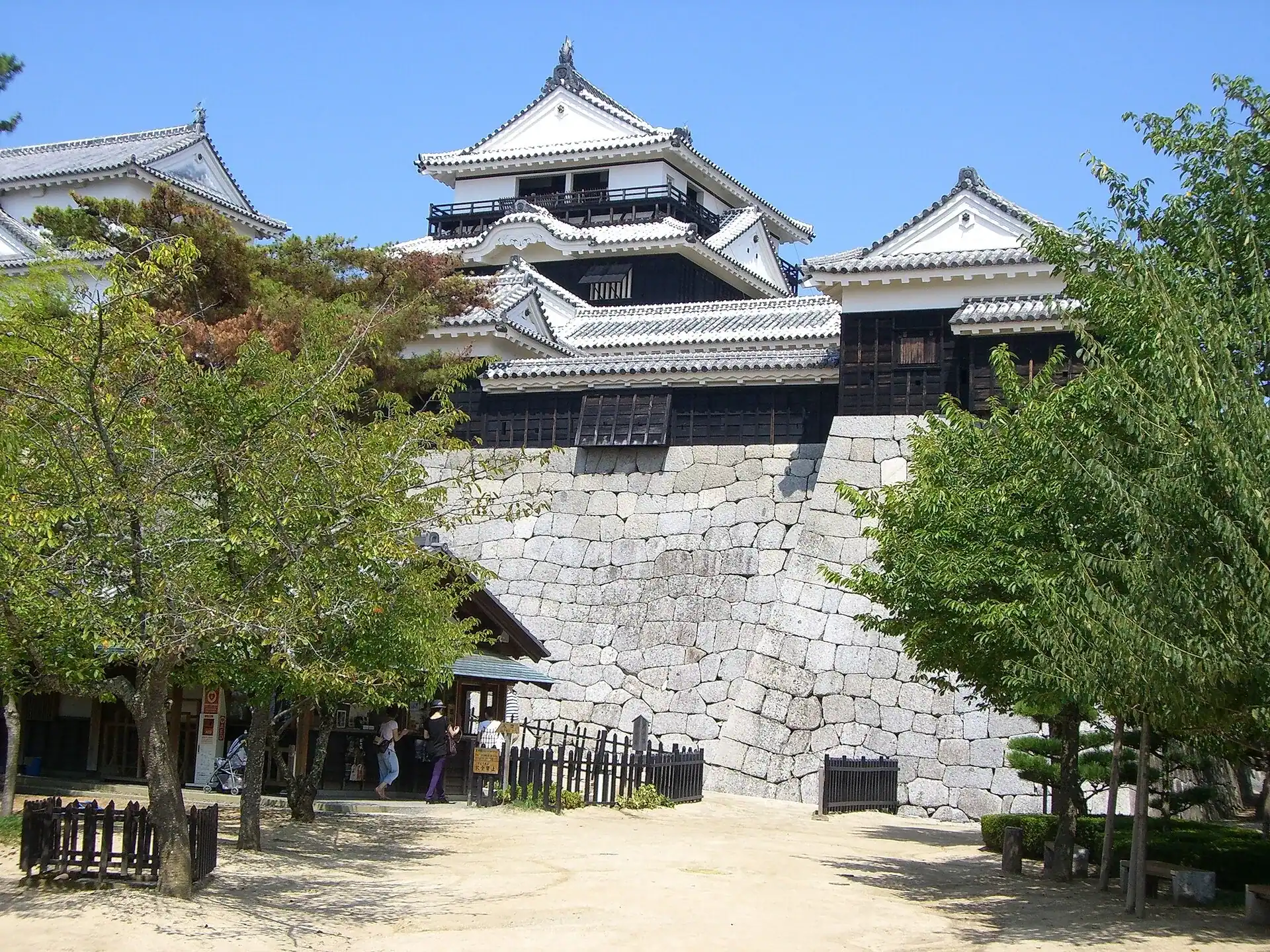 Photo: Jyo81 (ja: User) / Wikimedia Commons (CC BY 3.0)