Cost of Living in Okayama
Where this figure comes from. No cost survey covers Okayama, so the $1,550 a month above is our own estimate rather than a measurement. On 416 of our 999 city guides the figure is built from a published Numbeo basket, a one-bedroom rent in the centre plus one person's monthly costs without rent, converted to USD; this city is not one of them. How we source everything.
Budget roughly $1,550 a month as a solo remote worker in Okayama, which is well below Tokyo or Osaka for a city of 700,000 with full infrastructure. A one-bedroom apartment or 1K near the centre runs about $450 to $650, though Japanese leases traditionally involve key money, a deposit and a guarantor, so the up-front cost is higher than the monthly figure suggests and foreigner-friendly agencies charge for smoothing that. Groceries land around $350 to $450; Japanese fruit and imported goods are expensive and local vegetables and fish are not. A ramen or teishoku lunch is $6 to $9, a proper dinner $20 to $32. A monthly transit pass is roughly $60. The expensive fruit is a local industry rather than only a national quirk: the prefecture grows white peaches and Muscat of Alexandria as luxury goods, individually bagged on the tree and sold in boxes as gifts, and a single peach in season can run to twenty dollars. The everyday version of the same fruit turns up at roadside stands for a fraction of that, which is the difference between the gift market and the eating market.
Where to Work in Okayama
Okayama has a modest coworking supply at roughly $130 to $220 a month, and Japan's cafe culture makes up much of the difference: chains and independents alike are comfortable with long laptop sessions, and the density is high even in a mid-sized city. Japanese internet is fast, cheap and utterly reliable, fixed-line and mobile alike, and public wifi is widespread. Okayama University keeps a student population and some international presence. English is limited in daily life, as everywhere in Japan outside the biggest cities, and translation apps handle most transactions while anything administrative is considerably easier with a Japanese-speaking friend or a bilingual agent. Okayama has one contribution to the world that almost nobody attributes to it: the yellow tactile paving underfoot in stations everywhere was invented here in 1967 and first laid near the prefectural school for the blind, before spreading to the rest of Japan and then to most of the planet. It is a fair signal of the kind of place this is, a mid-sized city that builds carefully and does not advertise. For a working visitor the useful institutions are the university's medical faculty and the prefectural international exchange centre, which handles the administrative questions that defeat a translation app.
Getting Around Okayama
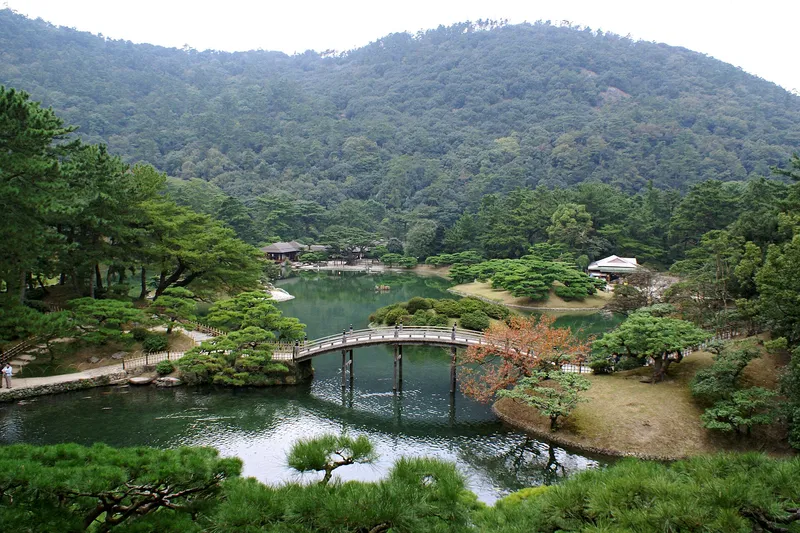
Okayama is flat and the centre, running from the station down Momotaro-dori to Korakuen garden and the castle, is walkable in half an hour. The city has a small tram network, two lines, plus buses, with an IC card covering everything. Cycling is popular and easy. The real advantage is the railway: Okayama is a Shinkansen hub where the San'yo line meets the route across the Seto Ohashi bridge to Shikoku, putting Osaka at 45 minutes, Hiroshima at 35 and Takamatsu at under an hour. That makes it one of the best-placed bases in western Japan. Okayama airport is 20km out with domestic and a few regional international routes. The Kibi plain west of the city carries a flat cycling route of about fifteen kilometres past burial mounds, an ancient shrine and rice fields, with rental bikes at one end and a return train at the other, which is the standard local day out. East of the city the line stops at Imbe, where Bizen pottery has been fired without glaze in the same way since the Kamakura period and the kiln chimneys are visible from the platform.
Sorting transport? Book an airport transfer, or compare car rental on Auto Europe and QEEQ.
Visas for Okayama
Japan grants most Western passports 90 days visa-free on arrival. In 2024 Japan introduced a digital nomad visa for remote workers from countries with which it has the relevant agreements, requiring an annual income above a substantial threshold and private health insurance; it grants six months and is not renewable directly, which limits it compared with schemes elsewhere. Other routes are the Highly Skilled Professional points system, the standard work visas tied to an employer, and the working holiday agreements available to young citizens of a number of countries. Japanese immigration is precise and document-heavy but predictable, which is more than can be said for many systems. The six month limit is the binding constraint rather than the income threshold, because the nomad route comes with no path onward: a holder cannot convert it into a work or residence status from inside the country and has to leave and reapply after a gap of the same length. Japan also issues no residence card with it, which sounds procedural and is not: without that card the ordinary machinery of settling in, banking included, stays shut.
Best Time to Visit Okayama
Okayama is known within Japan as the Land of Sunshine, recording the fewest rainy days of any prefecture, which is the single best reason to choose it. Spring, late March to May, is the outstanding season: cherry blossom at Korakuen and the castle, mild days and clear skies. Autumn, October and November, is the equal: warm, dry and with the garden's maples turning. Summer is hot and humid, into the low thirties with high humidity, and June brings the rainy season, though Okayama gets less of it than its neighbours. Winter is mild for Japan, rarely below freezing, and dry. Typhoons are less frequent here than on the Pacific coast. The sunshine figure has a mechanism behind it rather than luck: the Chugoku mountains to the north and Shikoku to the south block the seasonal fronts from both directions, which is why this city stays drier than places a short drive inland. Saidaiji Eyo in February is the one event that fills the calendar, and it is among the older and stranger things in Japan, several thousand men in loincloths competing in the dark for a pair of sacred wooden sticks thrown into the crowd at a temple just east of the city.
Pros and Cons of Okayama
Okayama combines Japanese infrastructure, safety and food with a Shinkansen hub position and the driest weather in the country, at rents around a third of central Tokyo. Korakuen is one of Japan's three great gardens and sits ten minutes from the station; the Seto Inland Sea, the art islands of Naoshima and Teshima, and Kurashiki's canal quarter are all close. English is genuinely limited, and Japan makes a foreigner work for the basics: opening an account, signing for a phone and renting a flat each carry their own paperwork, and a guarantor is often required. There is no foreign community of any size and no nomad scene. The city is pleasant rather than exciting. Kojima, half an hour southwest in Kurashiki, is where Japanese denim began: the first domestically made jeans came off a line there in the 1960s and the town still runs a street of mills and workshops selling direct. Kurashiki also holds the Ohara, the first museum in Japan built for Western art, opened in 1930 with El Greco and Monet bought before the war. Neither is what people expect to find in a prefecture best known for its weather.
Who Okayama Is For
Japan without the cost and intensity of Tokyo, for people willing to operate in a largely Japanese-language environment who value sunshine and rail connections. The new digital nomad visa covers a six-month stay, which is the natural length for a stay here. The Seto Inland Sea and its art islands are the draw, and the Shimanami Kaido puts one of the best cycling routes in Japan within reach. Solo workers and couples fare about the same here. Outside the campus almost nothing operates in English, the foreign community is small enough to meet in one evening, and the nightlife is a few streets rather than a scene. Osaka is 45 minutes away by Shinkansen and Fukuoka is the western city with the largest international presence. This is a base rather than a destination, and the value lies in what sits within an hour rather than in what sits in the city, which is an unusual thing to want. It suits a potter or anyone working in craft, since Bizen, Kurashiki and the denim mills are all within reach and all still working. Somebody who needs the day to contain a surprise will struggle, because this city is reliable in a way that reads as restful to some people and airless to others.
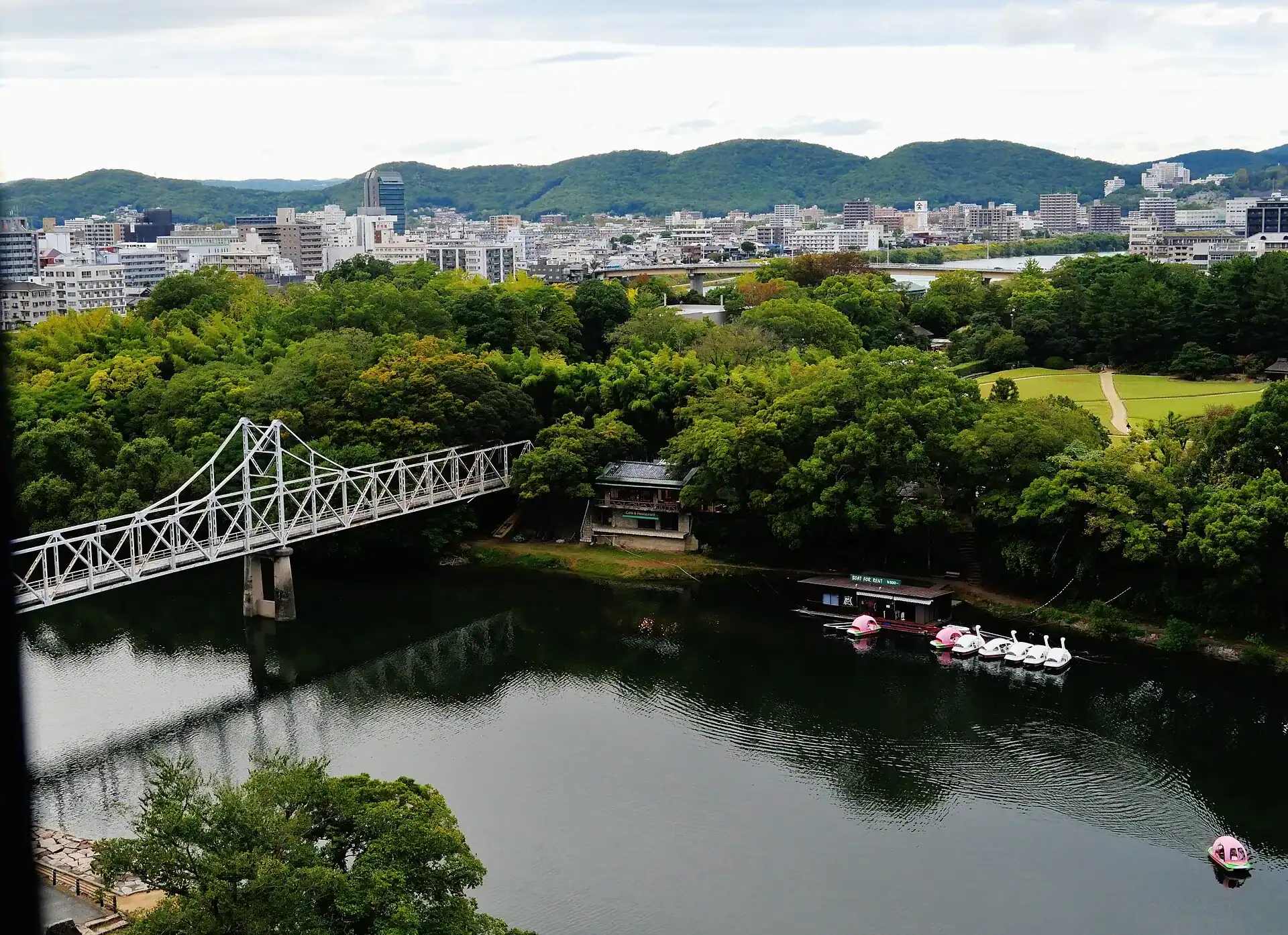 Photo: Zairon / Wikimedia Commons (CC BY 4.0)