Cost of Living in Las Palmas
Real market data
Source: Numbeo · August 2026
$1,580/moSolo nomad1-bed centre + living costs
$2,050/moCoupleshared 1-bed + costs
$1,380/moLean / localcheaper area + costs
- 1-bed rent, city centre$1,000€872
- 1-bed rent, outside centre$810€700
- Monthly costs excl. rent (1 person)$580€503
- Meal, inexpensive restaurant$14€12
- Monthly transit pass$16€14
- Buy price, per m² (centre)$3,250€2,824
Prices are from Numbeo (August 2026), converted to USD at $1 = €0.87 (01 Aug 2026). The monthly living-costs figure is our transparent one-person basket, groceries, a few meals out, utilities, phone, internet, transport and essentials, priced from those figures. Solo adds central rent; couple and lean are estimates from the same numbers.
Las Palmas is one of the better-value nomad hubs in the EU, partly because the Canary Islands run a separate tax system with a 7% IGIC sales tax instead of mainland Spain's 21% VAT, which quietly lowers everyday prices. Rents have climbed with the island's popularity, but you still get a full-size Atlantic city for less than Lisbon or Barcelona. Figures are in US dollars, converted from euro prices, so expect movement with the exchange rate. A realistic monthly breakdown for one person in 2025 to 2026:
- Rent, one-bedroom near Las Canteras or the center: roughly $1,040-1,500. City-wide asking rent runs around $16 per square meter, so an 80 sqm flat lands near $1,270.
- Rent, cheaper inland or edge neighborhoods: a studio away from the beach can start around $405-690, and a private room in a shared flat often runs $405-575.
- Groceries: around $230-345. Fresh bread is about $2, a coffee $2.50, a beer $3.50.
- Eating out: a main course is about $12 and a meal for two around $58. Budget $175-345 depending on how often you go out.
- Coworking hot-desk: roughly $23 per day, $92 per week, or $140-205 per month for a full membership.
- Local transport: around $23-35. Single fares are $1.50, dropping to about $0.50 per trip with a contactless Bono card.
- Utilities and internet: around $105 for a mid-size flat plus roughly $46 for fiber and mobile.
All in, a solo nomad renting a central one-bedroom lands around $1,580 a month on Numbeo-based figures, and about $1,380 living lean in a cheaper area; eating out often pushes the total higher.
Rent is the biggest line in that budget, and the district sets it. Our Las Palmas digital nomad guide compares Las Canteras, Guanarteme, Triana, Vegueta and Santa Catalina, and explains the Canary tax rules that make the islands different from the mainland.
Where to Work
Las Palmas has one of the deepest coworking scenes in the Canaries, and most spaces cluster in the Guanarteme and La Isleta neighborhoods within walking distance of Las Canteras beach. Well-known options include White Forest (a quiet, modern space about a minute from the beach with 24/7 access), The House (bright, with covered roof terraces, free coffee and breakfast, 24/7 access), Soppa de Azul and Fico Coworking in La Isleta, the industrial-flavored Talleres Palermo, and Sky Coworking. Repeople, a local operator, also runs coworking and coliving packages if you want housing and a desk bundled together.
Cafe-work culture exists but is more relaxed than in a dedicated remote-work capital. Plenty of beachfront and center cafes tolerate a laptop for the price of a coffee, though outlets and reliable seating are hit or miss at peak times, so a coworking membership is the sane default for calls and deadlines. WiFi is genuinely good here: fast fiber is widespread in the beach and central districts, mobile data along the coast is reliable, and coworking spaces advertise high-speed connections as standard. If your work depends on stable video calls, book a place with fiber and keep a mobile data plan as backup.
Getting Around
The local buses are called guaguas, and the yellow Guaguas Municipales run the city network while the blue Global buses cover the wider island. City buses are clean, air-conditioned, cheap, and frequent. A single ride is $1.50, but a contactless Bono card cuts the effective fare to around $0.50 per trip, so load one on arrival. Journeys can be slow with frequent stops, but coverage across the city is solid.
Honestly, most nomads barely use the bus day to day. Las Palmas is flat and very walkable along the coast: the strip from Santa Catalina down to Las Canteras and through Guanarteme covers most housing, coworking, cafes, and the beach on foot. You will want transport for trips to the old town of Vegueta, the south of the island, or hiking in the interior.
The airport is Gran Canaria (code LPA), about 25 km south of the city. The direct airport bus, line 60, runs roughly twice an hour, costs about $3.50, and reaches San Telmo station in the center in around 30 minutes (about 45 minutes to Santa Catalina). A taxi is faster but far pricier. There is no metro or tram on the island.
Sorting transport? Book an airport transfer, or compare car rental on Auto Europe and QEEQ.
Visas and Staying Long-Term
If you hold a US, UK, Canadian, Australian, or similar passport, you can enter Spain visa-free under the Schengen rule of 90 days within any rolling 180-day period. The Canary Islands are part of Spain and the Schengen area, so this window is not separate from the mainland; time spent anywhere in Schengen counts.
To stay longer, Spain offers a digital nomad visa for remote workers employed by or contracting with companies outside Spain. The income threshold is $3,280 a month, 200% of Spain's minimum wage over 12 payments (about $39,350 a year; some consulates state the same yearly floor as about $2,810 a month over 14 payments), for a single applicant, with extra required for dependents. Applied for at a consulate abroad it is typically issued for one year; applied for from inside Spain it can grant residence for up to three years, and it is renewable toward the five-year mark. A major draw of basing yourself here specifically is the Canary Islands' lower tax environment: the 7% IGIC sales tax instead of 21% VAT, and, for those who set up a qualifying company, the ZEC (Zona Especial Canaria) regime with a 4% corporate tax rate. The ZEC is aimed at businesses with real investment and hiring, not individual freelancers.
Best Time to Visit
This is the headline reason people come: Las Palmas has one of the most stable year-round climates anywhere, earning the Canaries their "eternal spring" reputation. The mean annual temperature sits around 19 C (66 F), and it rarely drops below 18 C or climbs above 30 C. Winters hover around 18-21 C, summers around 25-31 C, and the islands get around 3,000 hours of sunshine a year. Rain is scarce, especially in summer.
For remote work, there is no bad month, which is exactly the point: you can plan a long stay without gambling on the weather. If you want to swim comfortably at Las Canteras, the beach's calm, reef-sheltered water is warmest and most inviting from roughly June through October. If you prefer quieter, cheaper months with still-excellent working weather, aim for the shoulder seasons of spring and autumn. Note that it is genuinely windy here year-round, which keeps the heat pleasant but is worth knowing before you arrive.
Pros and Cons
The honest trade-offs:
- Pro: Reliable spring-like weather nearly every day of the year.
- Pro: Lower taxes than mainland Spain (7% IGIC) and solid value for an EU city.
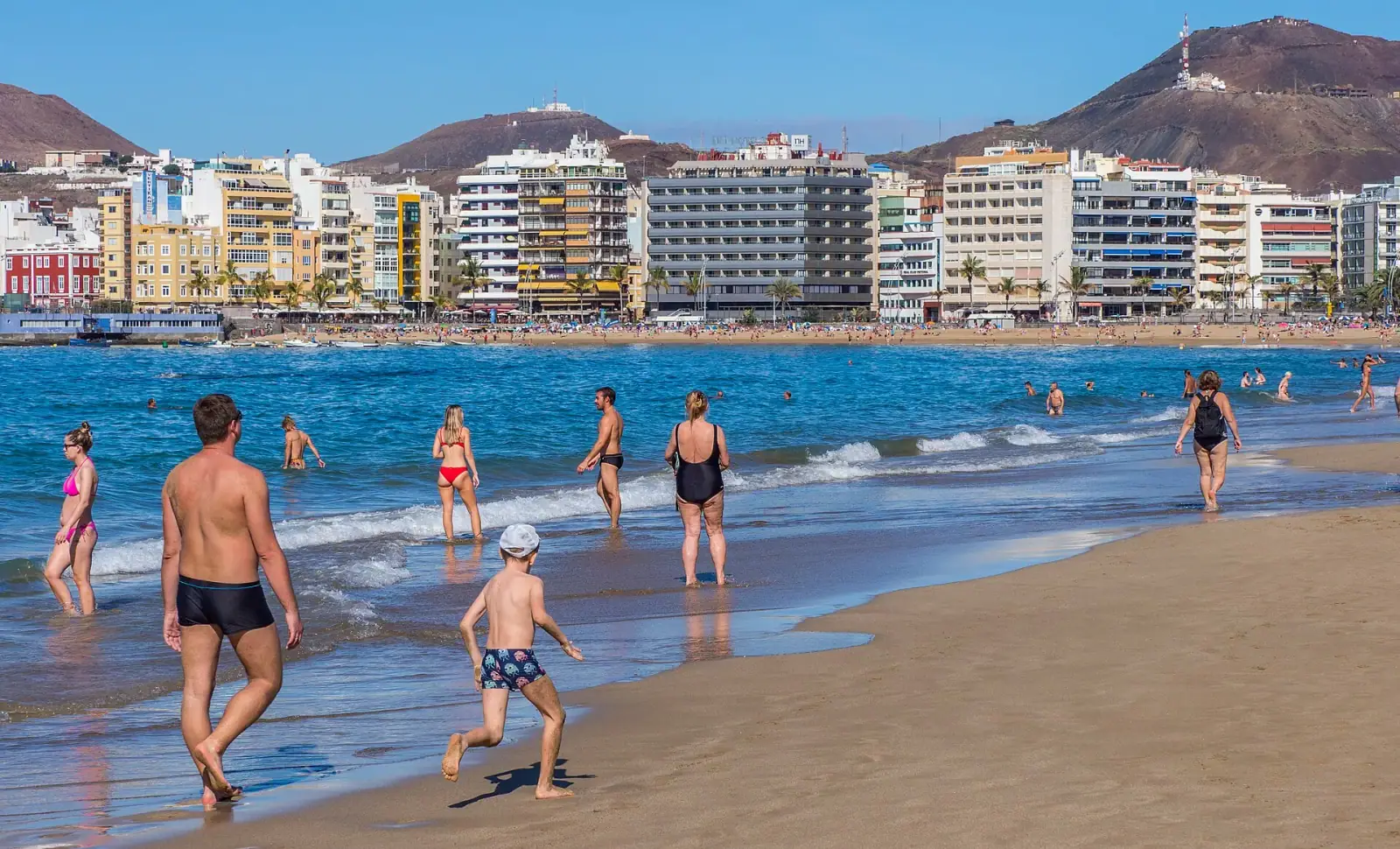
- Pro: Las Canteras, a long, calm, walkable city beach right where people live and work.
- Pro: Deep coworking scene, fast fiber, and an established nomad community.
- Pro: Real Spanish city life, not a resort bubble.
- Con: Island isolation: getting anywhere off the island means a flight, and travel time to mainland Europe adds up.
- Con: Persistent wind that some people love and others find wearing.
- Con: Limited nightlife and a fairly quiet after-hours scene compared with big mainland cities.
- Con: Rising rents and seasonal housing crunches driven by tourism and nomad demand.
- Con: Swimming season at the city beaches is really only comfortable from about June to October.
Who Las Palmas Is Best For
Las Palmas suits you if you want a warm, beach-adjacent base with genuine city amenities, dependable internet, a ready-made coworking and nomad community, and the tax and lifestyle upside of the Canaries. It is a strong pick for medium to long stays, for solo travelers and couples who value routine and mild weather over constant novelty, and for anyone who wants to live outdoors year-round without leaving the EU.
Skip it if you need a buzzing nightlife scene, hate wind, or want the fast, spontaneous travel of a well-connected mainland hub where the next country is a train ride away. Digital nomads chasing the cheapest possible cost of living will also find Southeast Asia or parts of Latin America notably cheaper. If your priority is quick access to the rest of Europe, a mainland base will frustrate you less than an Atlantic island.