Cost of Living in Taghazout
Where this figure comes from. No cost survey covers Taghazout, so the $1,100 a month above is our own estimate rather than a measurement. On 416 of our 999 city guides the figure is built from a published Numbeo basket, a one-bedroom rent in the centre plus one person's monthly costs without rent, converted to USD; this city is not one of them. How we source everything.
Taghazout is affordable by European standards, though it is not as cheap as many nomads expect before arriving. Your biggest variable is housing. Unlike the Mediterranean resorts, the expensive season here is winter, when the surf is best and the European long-stayers arrive, and landlords price October to April accordingly. Aourir, the inland village nicknamed Banana Village on the road to Agadir, is where rents drop furthest for anyone who can live without a sea view. For surfers the other recurring cost is the board, and renting by the week instead of the day cuts it by roughly a third.
- Rent, village center: $320-535/month for a basic furnished room or studio. Apartments with ocean views command a premium.
- Rent, Tamraght or outskirts: $160-265/month if you are willing to be 10-15 minutes from the main strip.
- Groceries: $130-190/month shopping at local markets and the small supermarkets on the main road.
- Eating out: A meal at a local spot costs $4.50-8.50. Budget $85-160/month if you eat out regularly.
- Coworking hot desk: Around $11/day. SunDesk and Coworksurf offer monthly packages bundled with accommodation starting from roughly $150/month for coworking-only access.
- Local transport: Bus to Agadir costs $0.50-1 each way. Grand taxi is $2-3.
- Total monthly range: A frugal nomad in shared housing can manage on $640-855. A more comfortable setup with a private apartment and daily coworking runs $1,070-1,600.
Where to Work
Taghazout has a surprisingly solid coworking infrastructure for a village of its size, largely because it has been a nomad destination for over a decade.
SunDesk is the most established option, with fiber internet, ergonomic desks, indoor and outdoor areas, a rooftop with power outlets, and private call booths. It is genuinely well-run, and the crowd it draws is the closest this coast has to a year-round community. Coworksurf (also listed as Adventurekeys) occupies a full floor near the main street with ocean views, a fiber connection, and up to 30 desks. Atlas Wonders offers a mix of outdoor ocean-view desks and indoor focus space and is popular with surfer-nomads.
Cafe work culture is limited compared to a city like Lisbon or Chiang Mai. The Teapot Cafe has a small upstairs coworking area free with a minimum $5.50 spend. Most other cafes tolerate laptops but are not set up for full workdays.
WiFi reliability is the honest caveat here. Fixed broadband in the village can drop during busy periods. The coworking spaces with dedicated fiber are consistently reliable, but cafe or Airbnb WiFi is hit or miss. Picking up a local SIM from Maroc Telecom, Inwi, or Orange and using mobile data as a backup is strongly recommended. Maroc Telecom has the strongest 4G coverage in this region.
Getting Around
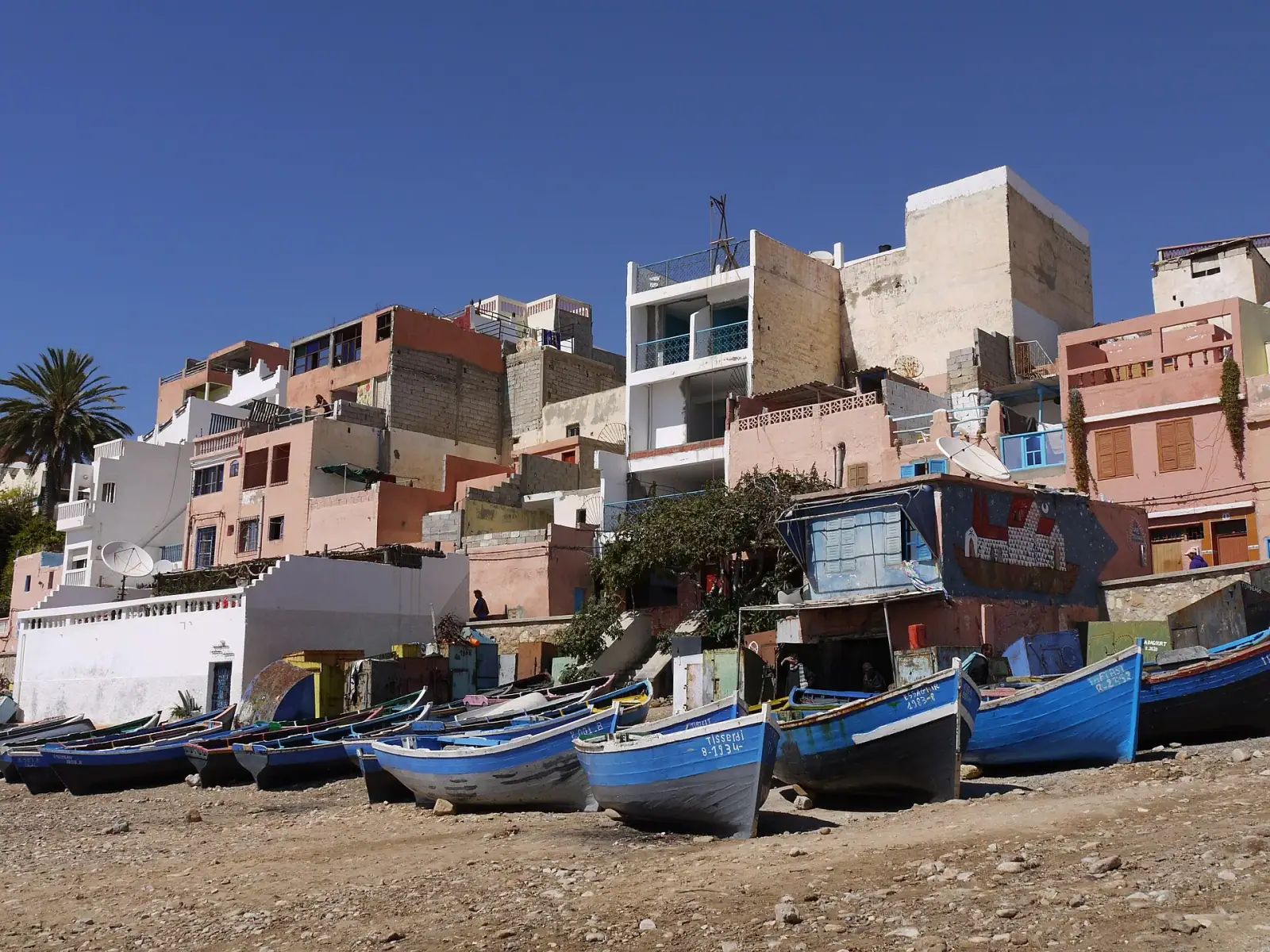
Taghazout village is small and entirely walkable. The main strip runs along one road, and you can cover the whole center on foot in under 15 minutes. Alleys and staircases connect the upper and lower parts of the village, and the beach is always close.
For getting to Agadir (the nearest city, about 20 km south), local bus lines 32 and 33 run regularly from early morning until around 9-10 PM, costing $0.50-1 per trip. Shared grand taxis run the same route for $2-3 per person. Both options drop you in Agadir center in 30-40 minutes depending on traffic.
Getting to/from Agadir Al Massira Airport (AGA): The airport is roughly 45 km from Taghazout. A private taxi costs around $32 for the whole car. The Souk to Surf shuttle runs once daily for around $11 but only operates daytime hours. For flexibility, a private transfer booked in advance is the most reliable option.
There is no need to rent a car to live in the village itself, but having one opens up day trips to Agadir, the Paradise Valley gorge, and other Atlantic surf spots further north.
Sorting transport? Book an airport transfer, or compare car rental on Auto Europe and QEEQ.
Visas and Staying Long-Term
Morocco is visa-free for passport holders from the US, Canada, the UK, the EU, Australia, New Zealand, and approximately 70 other countries. On arrival you receive a 90-day tourist stamp. If you want to extend, you can apply at the nearest police station before your 90 days expire for an additional 90 days, though the process is informal and not guaranteed.
Morocco does not currently offer a formal digital nomad visa. Most long-stay nomads do border runs to the Canary Islands or mainland Europe and re-enter. Overstaying is an offence rather than a formality: Morocco's 2003 law on foreigners sets a fine of roughly $200 to $2,000 for it, and people who overstay are commonly sent before a judge before the airport police will let them leave the country.
Best Time to Visit
Taghazout has a mild Atlantic climate year-round, with around 300 sunny days per year and modest rainfall mostly in brief winter showers.
October to March is the sweet spot for most nomads. Daytime temperatures sit between 18-25°C (64-77°F), the surf is at its most consistent and powerful, and the nomad community is at its largest. November through February brings the best waves but also the most rain, which is still quite limited.
April and May offer a quieter village, pleasant warmth, and good weather without peak-season crowds. Good for focused work with fewer distractions.
June to September is summer: temperatures reach 26-27°C (79-81°F), the sea is calmer, and the village gets busy with European package tourists. Surf conditions are less reliable in summer, and the village can feel crowded around the main beach. If you want pure sun and beach time alongside work, it is fine, but it is a different atmosphere.
For the best combination of good surf culture, a strong nomad community, manageable crowds, and comfortable working weather, October through April is the recommended window.
Pros and Cons
- Pro: Dedicated coworking infrastructure built specifically for nomads, with fast fiber connections
- Pro: Consistently mild Atlantic climate with almost no extreme heat or cold
- Pro: Tight, welcoming nomad and surfer community, especially October to April
- Pro: Genuinely affordable for Western nomads, particularly on local prices
- Pro: Incredible natural setting: Atlantic coast, sunsets, nearby gorges and mountains
- Pro: Easy visa-free access for most Western passport holders
- Con: Very small village with limited nightlife, dining variety, and urban amenities
- Con: WiFi outside dedicated coworking spaces is unreliable; mobile backup is essential
- Con: Alcohol is available but not prominent; mostly in tourist-facing spots
- Con: Getting to the airport requires planning: no direct public transit link
- Con: Tourism pressure has pushed rents up; advance hunting for good local deals takes time
- Con: Summer crowds change the village character significantly
Who Taghazout Is Best For
Taghazout is an excellent fit for nomads who want to combine a productive work base with an active outdoor lifestyle. If you surf, or want to learn, it is one of the best places in the world to do both at once. The village suits people who thrive in small, community-oriented settings where you will see the same faces at the coworking space, the cafe, and the beach within the same day.
It also works well for nomads wanting a warm, affordable Atlantic escape from November through April, especially those coming from Europe looking for a short flight and no culture shock on the cost side.
You should probably skip Taghazout if you need fast-paced urban energy, a wide restaurant and nightlife scene, or if reliable home WiFi is non-negotiable for your work. It is also not ideal if you are sensitive to being a visible outsider in a conservative Moroccan coastal community. Those who want the Moroccan city experience are better served by Marrakech or Casablanca.