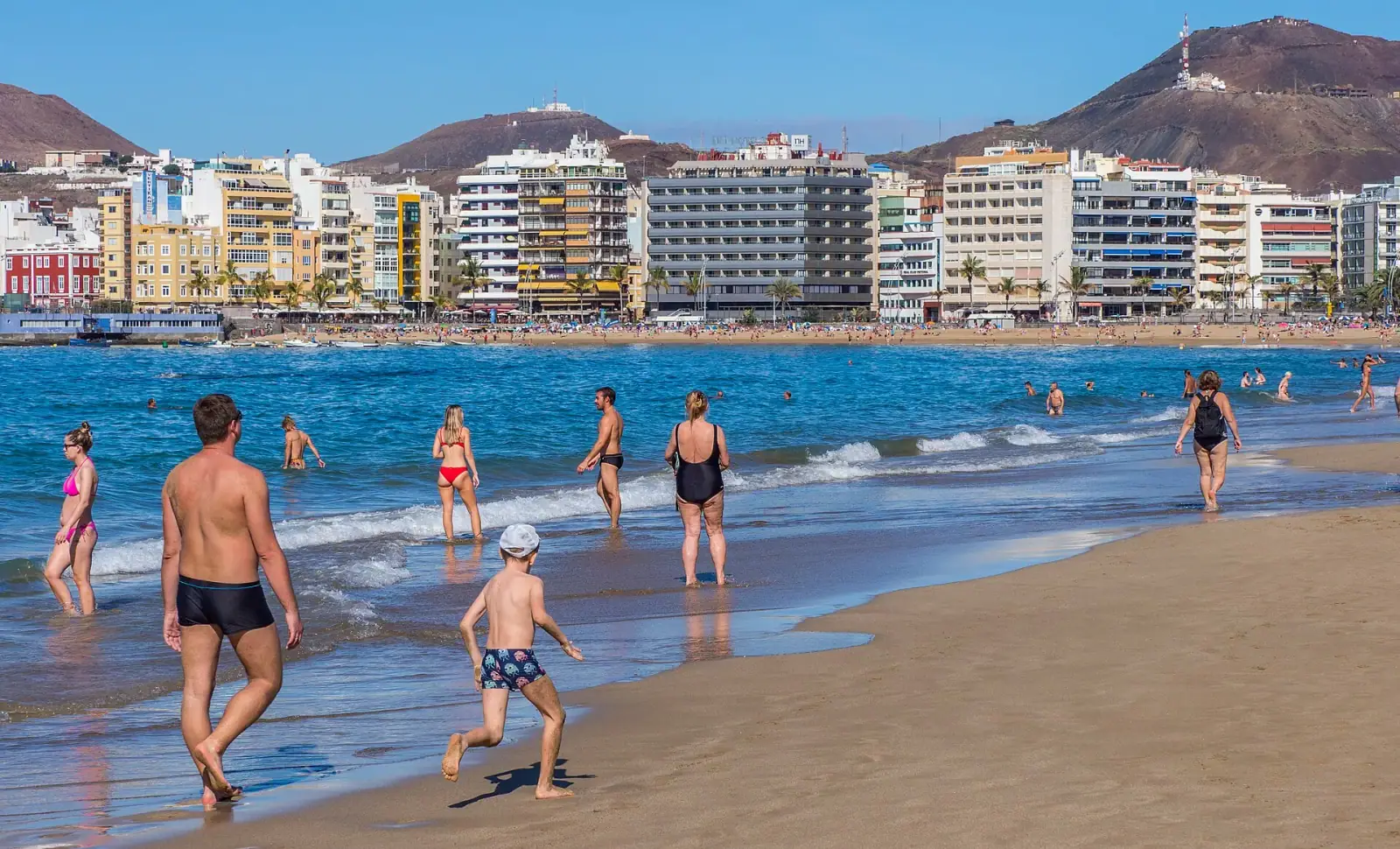

Stand on the promenade at Las Canteras on a clear evening and look west across the water. On most days you can make out the neighbouring island of Tenerife, and above it the cone of Mount Teide. A digital nomad guide to Las Palmas has to start with that view, because the question most people bring to the Canaries is not which street to live on. It is which island.
Tenerife has the fame. It is the largest and most populous of the Canary Islands, with about 974,000 people, and Teide, at 3,715 metres, is the highest point in Spain and a World Heritage Site. It has two airports, a cooler, greener north around La Laguna and a dry, sunny south lined with the resorts of Costa Adeje, Los Cristianos and Playa de las Américas.
Gran Canaria has the city. Las Palmas is home to about 384,000 people, making it the ninth-largest city in Spain and the largest in the Canaries, with a university and a port that ranks among the busiest in Spain. Santa Cruz, Tenerife's capital, has about 212,000. Gran Canaria is often called a miniature continent, and a third of the island is a UNESCO biosphere reserve.
For a remote worker, that settles it in most cases. Choose Las Palmas if you want a real city with a beach in the middle, an existing nomad community and London's clock, at about $1,580 a month on our one-person budget. Choose Tenerife if you want the mountain on your doorstep or the guaranteed sun of the southern resorts, and expect to drive more.
| Las Palmas | Tenerife | |
|---|---|---|
| Monthly budget, one person | about $1,580 | about $2,400 (estimate) |
| One-bedroom, centre or beach area | $1,000 | $1,040 to $1,500 |
| Average high, January | 20.8°C | 16.0°C north, 21.7°C south |
| Days with rain a year | 22 | 64 north, 15 south |
| Main city | 384,000 people | Santa Cruz, 212,000 |
| Airports | 1 | 2 |
| Highest point | 1,956 m | 3,715 m |
| Time zone | UTC+0, +1 in summer | UTC+0, +1 in summer |
Las Palmas budget and rent: the Numbeo figures on our Las Palmas page (August 2026). Tenerife budget and rent: our Tenerife page, which is our own estimate because no cost survey covers the island. Weather: AEMET normals for 1981 to 2010 at Gran Canaria, Tenerife North and Tenerife South airports. We convert prices to US dollars at the exchange rate of 1 August 2026.
Las Canteras, the beach that decides it
What makes Las Palmas different from almost any other island city is one beach. Las Canteras runs for about three kilometres along the city's western shore, from the Alfredo Kraus Auditorium at its southern end to La Puntilla in the north, with a pedestrian promenade along the whole length. Offshore, La Barra, a limestone reef more than 100,000 years old, breaks the Atlantic swell, so most of the beach is calm enough to swim in before work.
The beach changes character along its length. The southern end, at La Cícer, is where surfing arrived in Gran Canaria in 1970 and where the boards still are; the middle is for swimming inside the reef; the northern end curves towards the port. Restaurants line the promenade from breakfast until after dark, and in the evening the walk along it is the city's living room, with Teide on the horizon when the air is clear.
Where should you live?
The city stretches north to south along a narrow isthmus, and most of what a remote worker needs sits in a handful of districts. On the figures in our Las Palmas city profile, a central one-bedroom rents for about $1,000 a month and one further out for about $810; the beach premium is real but smaller than in most resort towns.
Las Canteras: the promenade
The streets right on the beach are the default first landing: you pay for the view and the sunset swim after work. It is the easiest month one, and the most expensive.
Guanarteme: one street back
Guanarteme is the grid of streets behind the southern half of the beach, near La Cícer. It is quieter and cheaper than the promenade, and it is where the coworking clusters: White Forest, for example, sits on Calle Simancas about 150 metres from the sand. For a second month, or a first month with no local knowledge, this is where to look.
Santa Catalina and La Isleta: the port side
Around Santa Catalina park, between the beach and the port, the city is busier and more mixed, with cafés around the square and the best transport links in the area, plus some of the lower rents. Just north, La Isleta, the peninsula at the end of the isthmus, has more of the city's coworking spaces.
Triana and Vegueta: the old city
Further south, Triana is the old commercial district. Next to it, Vegueta is where the city began on 24 June 1478: cobbled streets, the cathedral on Plaza de Santa Ana, the Casa de Colón and the best-preserved historic centre in the Canaries. It is beautiful to walk and further from the beach, so it suits a longer stay in which the sea is a bus ride away rather than outside the door.
Spring all year, with two exceptions
The Gran Canaria normals explain why people come. Highs run from about 21°C in January to 27°C in August, and rain falls on only about 22 days a year. Tenerife's northern side sees nearly three times as many rainy days and a cooler winter, which explains why Tenerife's nomads mostly live in the south.
Las Palmas has its own grey season, though, and it comes in summer. In July and August the trade winds push low cloud against the north of the island, a layer Canarians call the panza de burro, the donkey's belly, which screens the sun over Las Palmas while keeping the air warm and muggy. If you need blue sky every day in summer, plan your beach days in the south.
The other exception is the calima, Saharan dust carried over the islands, most often in winter. It hangs like a fog, cuts visibility and leaves a layer of dust on everything; a heavy one has closed airports. On a calima day, keep the windows shut and avoid planning a flight around a tight connection.
A working day on London's clock
The Canaries run on Western European Time, the same as London and one hour behind Madrid. For anyone working British or Irish hours that is ideal; for continental Europe you gain a morning hour, which most people spend in the sea. US East Coast teams are five hours behind for most of the year, so your afternoon becomes the overlap. Our time zone planner checks your own calendar against it.
For a desk, the coworking spaces cluster near the beach. Sky Coworking, a rooftop office near Santa Catalina park, sells a day pass for about $23 and a month for about $276; White Forest in Guanarteme has 24-hour access and prices on request. Our city page lists more, from La Isleta to the old town.
Picture a Thursday in February. A swim inside the reef at eight, calls with London from nine, lunch on the promenade, an afternoon of focused work while the US wakes up, and at sunset a walk north along Las Canteras with Teide on the horizon. That rhythm is the reason people stay for months rather than weeks.
Need a doctor or a lawyer in Las Palmas?
Our Las Palmas directory lists doctors, lawyers, translators and more by the language they work in, each with the source for that claim.
Browse the Las Palmas directory →The Canary tax rules, and what they change
The Canaries are part of Spain and of the EU, but they sit outside the EU's VAT territory. Instead of mainland Spain's 21 percent VAT, the islands charge their own sales tax, IGIC, at a general rate of 7 percent, which shows most on electronics and services.
The flip side is customs. For VAT purposes, goods sent to the Canaries count as leaving the EU, so an order from a mainland or German online shop goes through export formalities and can arrive with local tax to pay. Buy the laptop before you fly, or buy it on the island.
Income tax is a different matter: the islands follow Spain's rules, and spending more than 183 days a year in Spain usually makes you tax resident here. Our guide to how digital nomads are taxed explains what that means for the return you file at home.
Can you stay longer than 90 days?
With an EU or EEA passport, yes. On an American, British, Canadian or Australian passport you get 90 days in any 180 across the Schengen area, enough for a winter but not a base.
For longer, Spain's digital nomad visa needs an income of twice Spain's minimum wage, about $3,280 a month when the 2026 wage is spread over twelve months; some consulates count it over fourteen payments and state about $2,810.
You also need a degree or three years of experience, health insurance without co-payments, and, if you are self-employed, no more than 20 percent of your work for Spanish clients. The visa runs for up to a year, and a residence permit applied for inside Spain for up to three. Our comparison of digital nomad visas sets Spain against the other countries that offer one.
Weekends, and the other island
Gran Canaria rewards a car. The interior climbs to Roque Nublo, an 80-metre monolith above the ravines, and the south ends in the Maspalomas dunes. And if you want to see Teide up close, the fast ferry from Agaete to Santa Cruz de Tenerife takes about 80 minutes, short enough for a weekend on the other island without giving up your flat.
Who should choose Las Palmas?
Las Palmas is for people who want a city first and an island second: walkable districts, a port, an old town, a beach you can swim at before a standup, and enough other remote workers that arriving alone does not stay lonely for long. On our budgets it is also cheaper than Tenerife, though Tenerife's figure is an estimate rather than a survey.
Tenerife is for people who want the mountain, the hiking and the reliable sun of the south, and who are happy to drive. If you want Spain without the island at all, our ranking of the best Spanish cities for remote workers covers the mainland. And if you do choose Las Palmas: book your first month in Guanarteme before you arrive, and take the longer lease once you know the streets.
See the whole picture for Las Palmas
The full cost table, neighbourhood notes, coworking spaces and all 13 of our category ratings, on our Las Palmas city profile.
Open the Las Palmas city guide →Frequently Asked Questions
Is Gran Canaria or Tenerife better for digital nomads?
For most remote workers, Gran Canaria, because Las Palmas is a real city with a beach, a nomad community and lower costs on our figures. Tenerife suits those who want Teide, mountain hiking and the sunny southern resorts, and do not mind driving.
How much does a digital nomad need per month in Las Palmas?
About $1,580 a month for one person with a central one-bedroom. A central one-bedroom rents for about $1,000 and one further out for about $810.
What is the best neighbourhood in Las Palmas for digital nomads?
Guanarteme, one street back from Las Canteras beach and close to the coworking spaces. The promenade is the easiest first month, Santa Catalina has the best transport, and Triana and Vegueta are the old city.
What time zone is Las Palmas in?
Western European Time: UTC+0 in winter and UTC+1 in summer, the same as London and one hour behind mainland Spain.
How are the Canary Islands different for tax?
They sit outside the EU's VAT territory and charge IGIC at a general rate of 7 percent instead of mainland Spain's 21 percent VAT. Income tax follows Spain's normal rules.
Do digital nomads need a visa for Las Palmas?
EU and EEA citizens do not. Others get 90 days in any 180 under Schengen rules, or can apply for Spain's digital nomad visa, which needs an income of about $3,280 a month.
What is a calima?
A haze of Saharan dust carried over the Canaries, most often in winter. It hangs like a fog, cuts visibility and leaves dust on everything; a heavy one has closed airports.


