Cost of Living in Bari
Real market data
Source: Numbeo · August 2026
$1,700/moSolo nomad1-bed centre + living costs
$2,320/moCoupleshared 1-bed + costs
$1,470/moLean / localcheaper area + costs
- 1-bed rent, city centre$920€800
- 1-bed rent, outside centre$690€598
- Monthly costs excl. rent (1 person)$780€677
- Meal, inexpensive restaurant$17€15
- Monthly transit pass$40€35
- Buy price, per m² (centre)$3,870€3,358
Prices are from Numbeo (August 2026), converted to USD at $1 = €0.87 (01 Aug 2026). The monthly living-costs figure is our transparent one-person basket, groceries, a few meals out, utilities, phone, internet, transport and essentials, priced from those figures. Solo adds central rent; couple and lean are estimates from the same numbers.
Bari is one of the most affordable cities in Italy for remote workers. Your biggest expense is housing: a one-bedroom apartment in the central Murattiano district or the historic Bari Vecchia runs around $520-750/month, while quieter residential neighborhoods like Libertà or Japigia drop to $405-520. Utilities add roughly $69-105.
Groceries at local markets cost around $35-52 per week, especially if you lean into the abundant fresh produce, fish, and cheese. Eating out is genuinely cheap: a sit-down trattoria lunch runs $10-15, and street food (focaccia, panzerotti) costs $2.50-6 a pop. Coworking hot-desks run about $9 per day or $140-205 per month. A monthly public transit pass is just $29, and the city is walkable enough that many nomads skip it entirely.
A realistic total monthly budget: $1,380-1,840 for a comfortable lifestyle including housing, food, coworking, and some entertainment. Budget-focused nomads can get by on under $1,270.
Where to Work
The dedicated coworking scene is small but functional. Impact Hub Bari, near the Fiera del Levante seafront district, is the longest-established coworking community in the city and part of the international Impact Hub network, which is what gets a visiting member a desk without a negotiation. It offers networking events and a genuinely collaborative atmosphere, though the location is a 20-minute bus ride from the old town. MeetingRoomBari on Corso Italia, steps from Bari Centrale train station, is a more professional meeting-room-style space rated 5.0 on Google and praised for fast internet and reliable amenities. Regus on Corso Alcide de Gasperi covers the Murattiano district for those who want a predictable multinational setup.
Cafe work culture exists but is not as developed as in northern European cities. Traditional bars expect you to drink your espresso at the counter and leave. However, a handful of specialty coffee shops actively welcome laptop workers. Cosmico on Via Melo da Bari and Il Caffettaio on Via Calefati are the best bets, with decent seating and solid WiFi. Expect fiber-optic connections in modern buildings and coworking spaces. Older accommodation and some cafes can be patchier, so a local SIM with 50-100 GB of 4G data costs $17-35 per month and is a sensible backup.
Getting Around
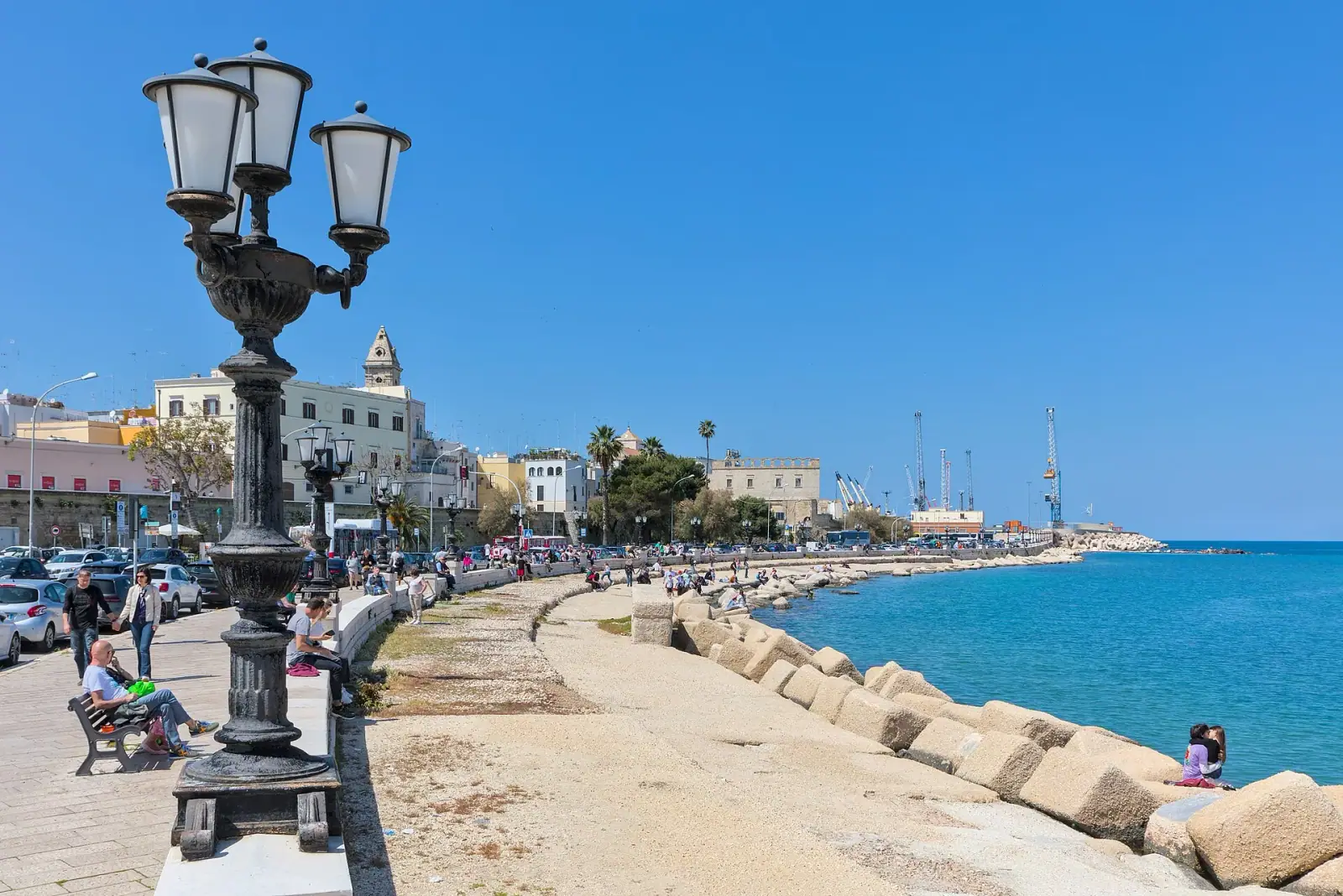
Bari's city center is compact and mostly walkable. The old town, the Murattiano grid, and the lungomare are all within 15-20 minutes on foot of each other. The public transit network covers buses, trams, and a metro line, with a monthly pass at $29. Cycling is practical on the flat terrain, and secondhand bikes run $58-115.
Getting to and from the airport is straightforward. Bari Karol Wojtyla Airport (BRI) is about 8 km northwest of the city center. The Tempesta shuttle bus runs regularly and costs around $4.50-6. A taxi is roughly $23-29. Ryanair, Wizz Air, and easyJet connect Bari to major European cities for $46-115. Train connections to nearby cities are solid: Lecce is about one hour by regional train ($12-17). The faster airport link is the train: Ferrotramviaria's FR2 runs from Bari Centrale to a station at the terminal in under twenty minutes, every twenty to thirty minutes from early morning until about 11pm, for about $6. Bari Centrale is also where the private regional lines begin, so the Sud Est trains toward Alberobello and the FAL toward Matera leave from beside the main platforms.
Sorting transport? Book an airport transfer, or compare car rental on Auto Europe and QEEQ.
Visas and Staying Long-Term
EU/EEA citizens can live and work in Italy indefinitely with no visa required. Most other nationalities, including US, UK, Canadian, and Australian passport holders, can enter Italy visa-free under the Schengen agreement for up to 90 days in any 180-day period. This covers short-to-medium stays but is not a long-term solution.
Italy launched a dedicated Digital Nomad Visa (National Type D) for non-EU remote workers. Key requirements: a minimum annual income of $28,540, health insurance covering at least $34,530 valid in Schengen countries, proof of remote work for a company based outside Italy, and either a university degree or 6 months of verifiable remote work experience. That floor is three times Italy's income threshold for exemption from health charges, so it moves when that threshold does. The visa is valid for 12 months and renewable. It allows travel throughout the Schengen Area. Applications are made through an Italian consulate in your home country before arrival. The port is where the Balkans begin: Albania sits outside Schengen, so the eight-hour sailing to Durrës is a true exit, logged by the Entry/Exit System at the Bari terminal both ways, and days spent across the water come off nothing. Americans may stay up to a year in Albania, which makes it the obvious place to wait out the rest of a half-year window.
Best Time to Visit
Spring (April to mid-June) is the sweet spot for remote work in Bari. Temperatures sit between 18-25 C, the city is not yet overrun with tourists, and outdoor cafe work is pleasant. Autumn (September to November) is equally good, with warm evenings and fewer crowds than summer.
July and August are challenging. Temperatures regularly exceed 32 C, humidity is high, and many local businesses close for ferragosto in August. Older apartments often lack air conditioning. Some nomads adjust by working early mornings and late evenings, but productivity takes a hit. Winter (December to February) is mild by northern European standards, around 8-14 C, and very affordable, but the city feels quieter and the beach lifestyle disappears. Early May has a reason of its own: from 7 to 9 May the city celebrates the arrival of Saint Nicholas's relics, with a costumed procession through Bari Vecchia and the saint's statue carried out to sea by boat, and the old town is at its fullest. It is a fine week to watch and an awkward one to house-hunt.
Pros and Cons
- Genuinely low cost of living by Italian standards, especially for housing
- Outstanding food culture: fresh seafood, burrata, focaccia Barese, and excellent local wine
- Authentic Italian city life without the tourist saturation of Rome or Florence
- Great transport links: budget flights to major European cities and trains through Puglia
- Mild winters and a walkable, Mediterranean seafront city
- Growing startup and coworking ecosystem with genuine community events
- Limited English outside tourist areas and coworking spaces; Pugliese dialect adds an extra layer
- Small coworking scene compared to major Italian cities; cafe laptop culture is underdeveloped
- Brutal summer heat with inadequate A/C in many older buildings
- Small expat and nomad community: social connections take more effort to build
- Administrative tasks like banking or residency registration can be slow and require Italian
Who Bari Is Best For
Bari suits nomads who prioritize cost efficiency and genuine cultural immersion over a polished expat infrastructure. If you enjoy food-led travel, Mediterranean pace, and can get by with limited English support, Bari will feel like a discovery. It works well for solo workers who are self-sufficient with their setup (good laptop, reliable SIM, coworking membership), and for anyone who wants a southern Italian base to explore Puglia, the Adriatic coast, and beyond.
It is less suited for nomads who rely on a dense community of English-speaking peers, need a wide choice of coworking spaces, or plan to work through the peak of summer without climate-controlled accommodation. Those accustomed to the coworking density of Lisbon, Berlin, or even Milan may find Bari's options thin. Couples and those planning a 3-6 month stay on the Digital Nomad Visa will get more value out of the city than pure fly-in, fly-out short-timers.