Cost of Living in Ancona
Where this figure comes from. No cost survey covers Ancona, so the $1,300 a month above is our own estimate rather than a measurement. On 416 of our 999 city guides the figure is built from a published Numbeo basket, a one-bedroom rent in the centre plus one person's monthly costs without rent, converted to USD; this city is not one of them. How we source everything.
Budget around $1,300 a month. A one-bedroom runs roughly $500 to $800, considerably cheaper than the Adriatic resorts to the north and a fraction of Bologna two hours inland. Market produce is good and cheap, and the Marche produces excellent wine, olive oil and the seafood that comes off the boats here daily. Eating out is inexpensive and the brodetto, the local fish stew, is the regional dish. Utilities are moderate. Ancona is a working port rather than a resort, which is the main reason the prices are what they are. The port keeps the prices down and also shapes them. This is a city of dockers, ferry crews and university students rather than holidaymakers, so the rental stock is ordinary flats rather than seasonal lets and the rates hold steady through the summer. Compare that with Rimini or Pesaro up the coast, where the same money buys far less between June and September. Student demand tightens things each autumn instead. Winter utilities are the line that bites, since the older blocks shed heat quickly and the bora finds every gap in them.
Where to Work in Ancona
Connectivity is good. Fibre reaches most of Ancona at reasonable speeds, mobile coverage is comprehensive and power is reliable. There is a small coworking presence helped by the Marche Polytechnic University. The time zone is central European. The practical friction is Italian administration rather than infrastructure: a codice fiscale gates everything, banking is slow and the permesso di soggiorno process for non-Europeans takes months. The port brings a certain amount of international business traffic, which means the city is more used to foreigners than its size suggests. Anyone planning a stay should get a codice fiscale on arrival, since it gates the bank account, the phone contract and the lease, and it is straightforward to obtain. The working economy here is maritime before it is anything else. Shipbuilding, ferry operations, freight forwarding and the customs trade around them employ a large share of the city, and the polytechnic's engineering faculty feeds directly into it. For a remote worker that means an unglamorous but functional support network: couriers, notaries and accountants who handle international paperwork as routine, which is not true of every Italian city this size.
Getting Around Ancona
Ancona is built on a headland and is steep in parts, with the historic centre walkable and the outer districts spread along the coast. Buses cover the rest. The railway station is on the main Adriatic line, with Bologna about two hours away, Rome three and Bari four. Ancona Falconara airport is fifteen kilometres west with limited flights. The port is the real connection: ferries run to Split, Zadar, Igoumenitsa, Patras and Durres, which makes this one of the best places in Italy from which to reach the Balkans and Greece by sea. Ferry sailings thin considerably outside the summer, and the Greek routes in particular drop to a reduced winter timetable, so the sea connection is seasonal rather than constant. The passenger terminal sits at the edge of the historic centre, which is unusual and means arriving by ship puts you in the middle of the city rather than in an industrial zone. The headland makes cycling harder work than a coastal position suggests, and the buses out to the Conero beaches run mainly in summer.
Sorting transport? Book an airport transfer, or compare car rental on Auto Europe and QEEQ.
Visas for Ancona
Italy is in the European Union and the Schengen area, so European Union and EEA citizens may live and work here without a permit. Everyone else needs a Schengen visa for short stays or a permesso di soggiorno for longer ones, and Italy's 2024 digital nomad visa applies for highly skilled remote workers meeting income and insurance thresholds. Anyone using the ferries to Croatia, Greece or Albania should note that Croatia and Greece are in Schengen and Albania is not, so the crossings are treated differently. Anyone taking the Albania ferry should note that Albania is outside Schengen, so the crossing to Durres is an external border and the stamps matter for a Schengen count. The port's own status repays attention if the ferries are part of the plan. This is a designated external Schengen crossing, so sailings to Albania are checked and logged in the bloc's biometric Entry/Exit System much as an airport would, while the Croatian and Greek routes are internal and generally are not. That asymmetry decides whether a given crossing lands on a Schengen count, and travellers who assume every ferry is treated alike get it wrong in both directions.
Best Time to Visit Ancona
May, June and September are the best months, warm at around twenty four degrees with the sea swimmable and the Conero coast at its best. July and August are hot and busy with Italian holidaymakers. Winter from December to February is cool at around eight degrees and wet, with the bora wind occasionally reaching down the Adriatic. The Conero regional park south of the city, where limestone cliffs drop into the sea, is walkable in every season and is the best thing within reach of Ancona. Anyone visiting the Conero beaches should know that Due Sorelle is reachable only by boat or a difficult descent, and that the boats run from Numana in summer. The sea holds its warmth into early October, so the weeks after the Italian holidays end deliver the warmest water of the year at the lowest prices. Inland, autumn is truffle season across the Marche hills and the small towns run festivals around it through October and November. Avoid the Ferragosto week outright: the coast fills, and half the city's businesses shut on the same day.
Pros and Cons of Ancona
Ancona is an underrated Adriatic city, with a Roman arch standing on the quay, a Romanesque cathedral on the headland, and the Conero park just south where white cliffs fall straight into clear water at Portonovo and Due Sorelle. Ferry connections to Croatia, Greece and Albania make it an unusually good base for the eastern Mediterranean. Costs are low for Italy. The port is a working one, the war took most of the old city, the rebuilding was hurried, and what stands now is patchy rather than lovely to look at. The Marche around the city compensates for what the bombing took, with Urbino, Ascoli Piceno and a dozen hill towns within an easy drive, and it remains one of the least visited regions in Italy relative to what it holds. Central Italy is seismically active and the region was badly affected by the 2016 sequence further inland, which is a fact about building stock rather than a reason to stay away. Healthcare is good and the regional system among the better regarded in Italy, which matters more over a long stay than the architecture does.
Who Ancona Is For
An Italian base with sea connections to the Balkans and Greece, which is a genuinely unusual combination, along with walkers and swimmers drawn to the Conero coast. Adriatic Italy at working prices rather than at resort ones is the whole proposition. Much of this city was bombed in the war and rebuilt plainly, so anybody expecting a beautiful Italian port will be disappointed. Reaching the Conero beaches regularly also needs a car, because the bus service runs on a summer timetable and stops when the season does. Le Marche's hill towns are the argument for staying a while. Urbino, a Renaissance ducal capital with a UNESCO listing of its own, is ninety minutes northwest by road, and it is not the only one worth the drive. Set against the other Adriatic options, Trieste is handsomer and better connected to central Europe, Bari is larger and cheaper with ferries of its own to Greece and Albania, and this city sits between them with the best access to the Conero and the Marche. Italian is close to necessary, more so than in the tourist cities, which some people will count as the reason to come. The city is small and safe with the sea at the end of the street, which suits a family.
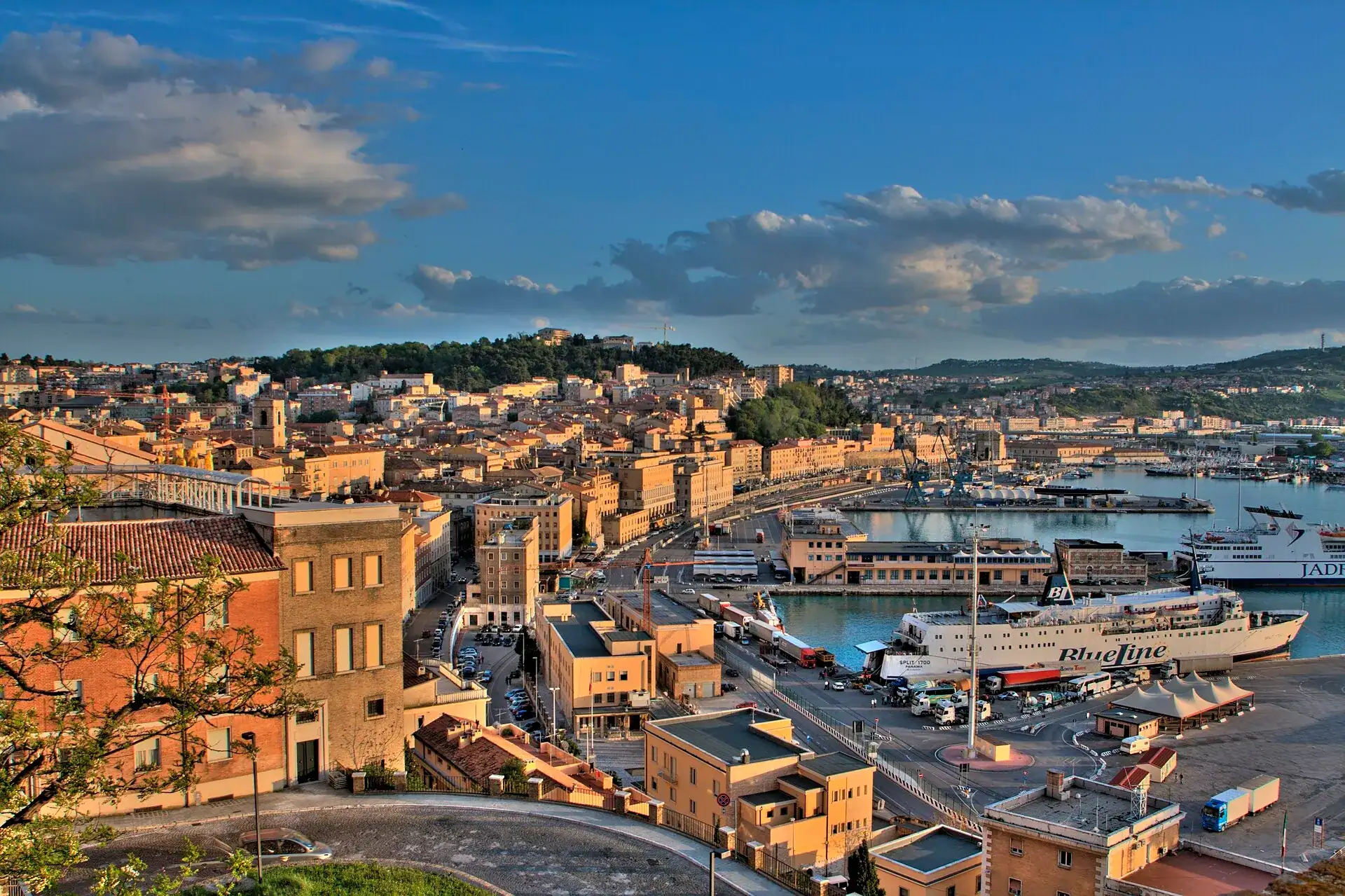 Photo: Enrico Matteucci from Camerano, Ancona / Wikimedia Commons (CC BY 2.0)