Cost of Living in San Marino
Where this figure comes from. No cost survey covers San Marino, so the $1,900 a month above is our own estimate rather than a measurement. On 416 of our 999 city guides the figure is built from a published Numbeo basket, a one-bedroom rent in the centre plus one person's monthly costs without rent, converted to USD; this city is not one of them. How we source everything.
Budget around $1,900 a month as a solo remote worker in San Marino, which is broadly similar to the surrounding Italian region and slightly cheaper on some things because the republic sets its own indirect taxes. A one-bedroom flat runs roughly $600 to $1,000, and much of the affordable housing is in the lower towns of Borgo Maggiore and Dogana rather than on the mountain itself. Groceries are Italian-priced, which is to say reasonable. The euro is the currency although San Marino is not in the European Union. This is our own estimate rather than measured data. The republic levies a single-stage import tax called the monofase instead of value added tax, which is why fuel, tobacco and some electronics come out below Italian shelf prices while most other things do not. Property purchase by non-residents is restricted, so buying is not the shortcut into the country that it is in some small states. Renting is done through local agencies and word of mouth, and the stock is small enough that anything decent moves before it is advertised widely.
Where to Work in San Marino
San Marino's connectivity is good: fibre reaches the populated areas at solid speeds and mobile coverage is comprehensive, with the surrounding Italian networks also reaching most of the republic. Power is reliable. There is very little coworking, since the republic has almost no visiting professional population. Italian is the only language of daily life and administration; English is limited outside the tourism economy on the mountain. The republic sits in central European time and functions economically as part of Emilia-Romagna. Anyone working with the rest of Europe will find no offset at all, since the republic keeps central European time like the country entirely surrounding it. The economy is more industrial than the tourist shops on the ridge suggest, with ceramics, furniture, packaging and precision engineering employing a large share of residents, and thousands of Italians crossing in each morning to work in it. The banking sector went through a serious crisis and restructuring in the 2010s and is much diminished. The republic passed blockchain and tokenisation legislation to attract digital business, which has produced more announcements than companies so far.
Getting Around San Marino
San Marino is built on and around Monte Titano, and the historic city on top is entirely pedestrian, reached by road, by a cable car from Borgo Maggiore below, or on foot up a serious climb. The republic has no airport and no railway; the old electric line from Rimini closed in 1944 and its tunnels are still visible. Buses run to Rimini in about fifty minutes, which is where the nearest station and the coast are. Bologna airport is around two hours away. Rimini's beaches are close enough that a great many Sammarinese treat the Adriatic coast as their summer, and the bus runs frequently in season. Getting up the mountain is the daily logistics question, and the answer most residents use is the chain of public lifts and escalators built into the rock beside the multi-storey car parks, which turns a hard climb into a two-minute ride. Parking on the ridge itself is limited and priced accordingly. The bus to Rimini is cheap and frequent, and it is the connection that makes the republic function, since the coast holds the station, the hospital specialists and the airport link.
Sorting transport? Book an airport transfer, or compare car rental on Auto Europe and QEEQ.
Visas for San Marino
San Marino is not in the European Union and not formally in Schengen, but it has open borders with Italy on every side and no border controls at all, so in practice reaching it means entering Schengen through Italy and the day count applies there. There is no remote work visa. Residence in San Marino is tightly controlled and generally requires either substantial investment or a genuine employment relationship with a Sammarinese company, and the process is slow. Anyone counting Schengen days should treat time in San Marino as time in Italy, since there is no border and no separate record of entry. The republic negotiated an association agreement with the European Union alongside Andorra and Monaco, which has been years in the making and would change movement and market access if it is ratified, so anyone planning around the current arrangement should watch it. Citizenship comes through descent or, for a spouse, after a long qualifying period measured in decades rather than years. Ordinary residence permits are granted sparingly and are attached to employment or family rather than to means.
Best Time to Visit San Marino
May, June, September and October are the best months, with warm dry weather, clear views across to the Adriatic and fewer of the day-trippers who come up from the Rimini beaches in summer. July and August are hot and the mountain is busy. Winter is cold and often in cloud at this altitude, with the city on the ridge frequently sitting above or inside a bank of fog while the plain below is clear, which is either atmospheric or oppressive depending on the day. The Medieval Days festival at the end of July fills the old city with re-enactment and crossbow competitions, which is the republic's largest event. The third of September is the Feast of Saint Marinus and the republic's national day, marking a founding in the year 301 and observed with a formality that a state of thirty thousand people carries off surprisingly well. The Rimini beach season pulls the working population downhill at weekends through July and August, which is precisely when the mountain fills with visitors going the other way, so the two flows pass each other on the same road.
Pros and Cons of San Marino
San Marino claims to be the oldest surviving sovereign state and the oldest constitutional republic in the world, founded by a stonemason in the fourth century, and its three towers on the ridge of Monte Titano are visible for fifty kilometres. It is safe, cheap by Western European standards, and the views across to the Adriatic are exceptional. It is tiny, Italian is essential here, the historic centre is largely given over to duty-free shops and tourist retail now, and there is no airport or railway. The republic also issues its own stamps and coins, minted in euro but with Sammarinese designs, which are collected far beyond the country itself. Healthcare is the republic's own service, small but well regarded, with an agreement covering treatment in Italy for anything it cannot handle, which in practice means Rimini or Bologna. San Marino keeps no standing army beyond a ceremonial militia and has never been at war in any modern sense, having stayed neutral through both world wars and sheltered a refugee population many times its own size in 1944, which is the fact that most repays looking into.
Who San Marino Is For
An Italian speaker after a very quiet hilltop base within an hour of the Adriatic coast and two of Bologna, spending a Schengen allowance rather than trying to settle. The republic is more pleasant out of season than its reputation suggests, once the day-trippers have gone. Italian is required, there is no community of foreigners to join in a republic of thirty thousand, and the sovereignty does not translate into an easier residence route than Italy's. If anything the route is narrower, because the numbers admitted are smaller. Cyclists working Emilia-Romagna should build this into the week. The climb up Monte Titano is a serious piece of work, and the descent runs thirty kilometres to the sea without much pedalling. The honest comparison is not with other microstates but with the coast below: Rimini is cheaper, larger, better connected and thirty minutes away, and most of what makes this region worth a stay is down there rather than up here. The mountain earns a stay for the silence and the view, which are real, and for anyone whose work benefits from being somewhere with almost nothing to do in the evening.
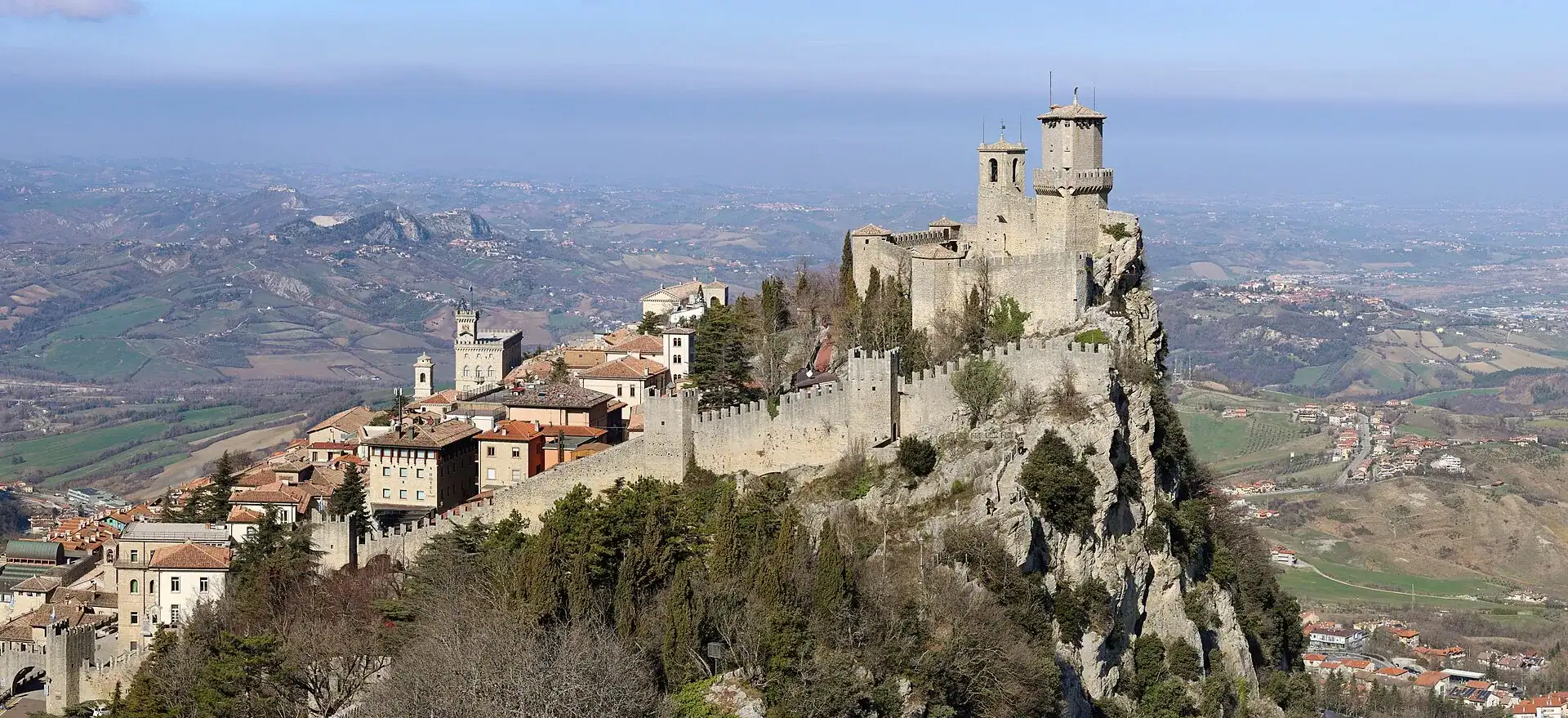 Photo: Terragio67 / Wikimedia Commons (CC BY-SA 4.0)