Cost of Living in Uyuni
Where this figure comes from. No cost survey covers Uyuni, so the $700 a month above is our own estimate rather than a measurement. On 416 of our 999 city guides the figure is built from a published Numbeo basket, a one-bedroom rent in the centre plus one person's monthly costs without rent, converted to USD; this city is not one of them. How we source everything.
Uyuni is genuinely cheap, though most travellers only stay a few nights, so think of it as a short-stay budget rather than a monthly base. A realistic solo monthly range runs roughly $600 to $1,100 depending on how much you rely on tours and heated rooms. Basic guesthouses and hostels are inexpensive, meals in local comedores cost only a few dollars, and the town itself has little to spend money on. The biggest line item is the multi-day 4x4 salt-flat and lagoon tour, which is a one-off splurge rather than a recurring cost. Heating, hot water, and warmer private rooms carry a premium here because of the harsh altiplano climate. Budget separately for park fees, since the lagoon circuit runs through the Eduardo Avaroa reserve, whose entry charge is paid in cash bolivianos at the ranger post and is left out of most tour prices, and the cactus island of Incahuasi out on the salt flat charges its own.
- Hostel dorm or basic private room: roughly $8 to $30 per night
- Local set lunch (almuerzo): around $2 to $5
- Multi-day Salar de Uyuni 4x4 tour: roughly $130 to $250 all-in
- Entel or Tigo SIM with data: a few dollars to top up
Where to Work in Uyuni
Plan any work here around one plain fact: Uyuni is a windswept frontier tourist town rather than a digital-nomad base, and its connectivity reflects that. Wifi in hostels and cafes is basic, often slow, and can drop out entirely, especially during tour season or bad weather. There is no true coworking space. If you need to stay online, buy a local Entel or Tigo SIM at the terminal or a phone shop and use mobile data as your primary connection, keeping expectations low for video calls or large uploads. A handful of laptop-friendly cafes and pizzerias on and around Avenida Ferroviaria will let you nurse a coffee while you work. Download anything important before you arrive, and treat Uyuni as a place to disconnect between deadlines rather than power through them.
- Buy an Entel or Tigo SIM and rely on mobile data over cafe wifi
- Expect slow speeds and intermittent drops, especially in peak season
- Work offline where possible and sync when the connection is stable
- Cafes and pizzerias near Avenida Ferroviaria are the most laptop-tolerant spots
Getting Around Uyuni
The town itself is small, flat, and easily walkable, with most hostels, tour agencies, and restaurants clustered within a few blocks of Avenida Ferroviaria and the clock tower. For the salt flat and the coloured altiplano lagoons you go by 4x4 tour jeep, which is the whole point of coming here. Taxis and minibuses cover short local hops, while long-distance buses connect Uyuni to Oruro, La Paz, Potosi, and the Argentine border at Villazon. The historic train line also runs to Oruro and Villazon, a slower but memorable ride. The small Joya Andina airport (UYU) has flights to La Paz. At 3,650m the altitude is real, so take your first day slowly.
- The town center is walkable in ten to fifteen minutes end to end
- 4x4 jeep tours are the only practical way to reach the salar and lagoons
- Buses and trains link Oruro, La Paz, Potosi, and Villazon
- Flights from Joya Andina airport (UYU) reach La Paz
- Acclimatize, hydrate, and rest on arrival to manage the altitude
Sorting transport? Book an airport transfer, or compare car rental on Auto Europe and QEEQ.
Visas for Uyuni
Uyuni follows Bolivia's national entry rules, so there is nothing town-specific to arrange. Many nationalities, including most Europeans, can enter as tourists without a visa in advance and are commonly granted stays of up to 90 days per calendar year, sometimes issued in shorter increments that you extend at a migration office. Americans now arrive on the same footing as most Western visitors, since Bolivia scrapped the reciprocity visa for US passports when it moved them to its visa-free list in December 2025. Keep your passport, entry stamp, and any tour paperwork handy, since remote checkpoints on multi-day lagoon tours near the Chilean and Argentine borders occasionally ask to see documents. Tours that finish in San Pedro de Atacama cross into Chile at the Hito Cajón post, and the bag of coca leaves bought for the altitude has to be finished or thrown away before it: coca is legal in Bolivia but prohibited in Chile, and the agricultural inspection on the far side is thorough.
- Many visitors get up to 90 days per year, often stamped in shorter blocks
- Some nationalities still need a visa before travelling, though US citizens no longer do since December 2025
- Carry your passport on cross-border lagoon tours near Chile and Argentina
Best Time to Visit Uyuni
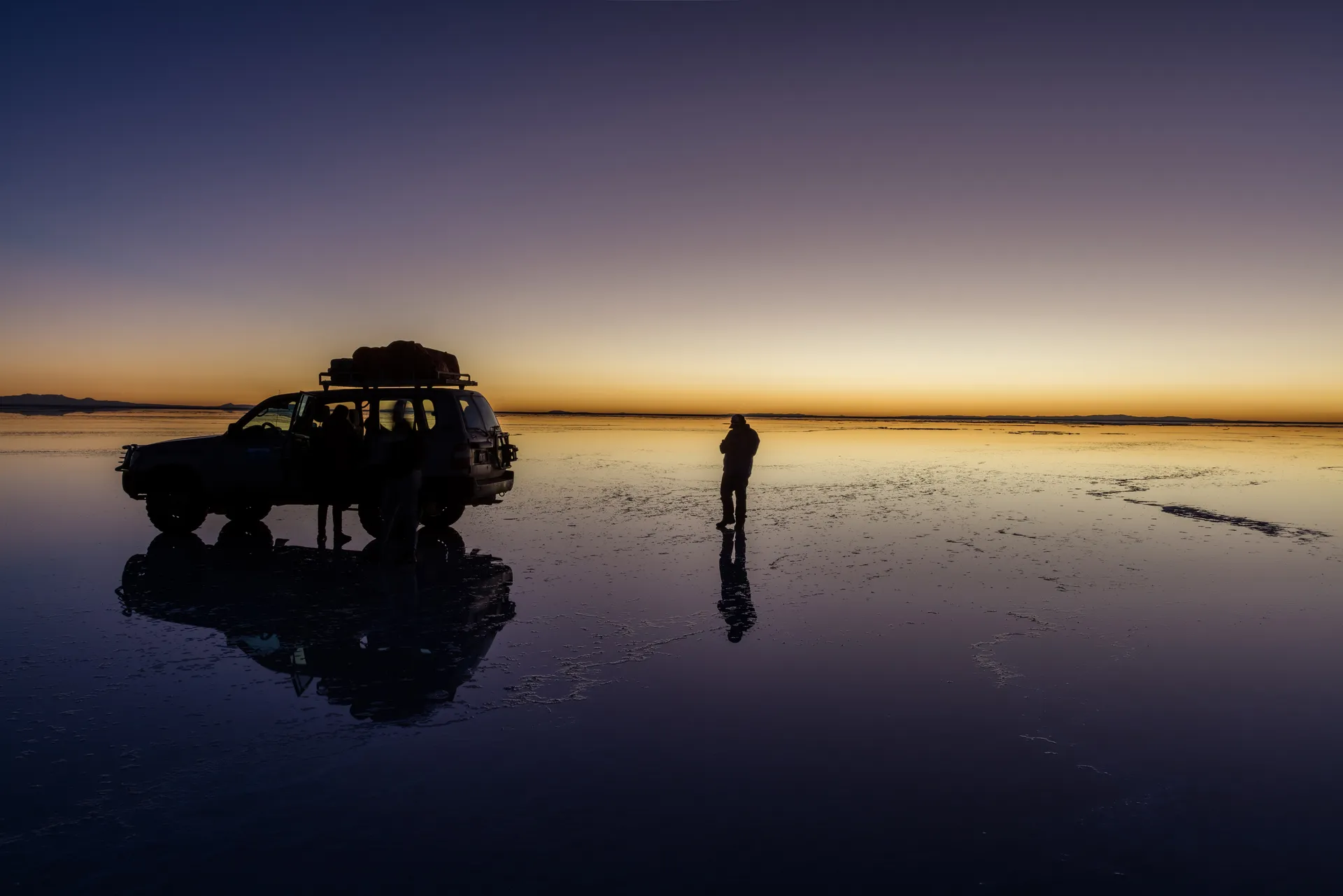
Uyuni has two very different seasons, and which you choose depends on the experience you want. The dry season, roughly May to October, gives you solid, drivable salt, wide-open blue skies, and reliable access to the distant lagoons and geysers, at the cost of bitterly cold nights that can drop well below freezing. The wet season, roughly December to March, brings a thin sheen of water that turns the salar into the famous mirror reflecting the sky, but rain also floods and closes parts of the flat and can make the far lagoon routes impassable. Whichever you pick, days can be sunny while nights are brutally cold, so pack serious layers and prepare for strong altiplano wind and intense high-altitude sun.
- May to October: firm salt, clear skies, easy tour access, very cold nights
- December to March: the mirror effect, but flooding can close routes
- Shoulder months can mix both looks with less predictable conditions
- Pack heavy layers, sun protection, and wind-proof gear year-round
Pros and Cons of Uyuni
Uyuni delivers one of the most surreal landscapes on the planet, and that is precisely why people come. The upside is enormous natural spectacle at a very low cost: the endless white salt flat, the mirror after rain, red and green lagoons, flamingos, geysers, and the eerie Train Cemetery at the edge of town. The downside is everything else. This is a cold, dusty, functional frontier town with basic infrastructure, slow wifi, little nightlife, simple food, and a small local scene that empties out around the tour cycle. Altitude affects many visitors on arrival. Come for a short, awe-inspiring stop, manage your expectations about comfort and connectivity, and you will leave delighted rather than disappointed. The salt is also an industry. At Colchani, on the edge of the flat, families still rake and dry it by hand, and beneath the crust lies one of the largest lithium deposits on earth, which the state has spent years trying to develop, so the landscape is a workplace as much as a view.
- Pro: a genuinely once-in-a-lifetime landscape at bargain prices
- Pro: clean, dry high-altitude air and vast, empty horizons
- Con: harsh cold, wind, basic wifi, and limited comforts
- Con: minimal nightlife, simple food, and a tiny transient community
Who Uyuni Is For
Uyuni is for the traveller chasing a landscape, not a lifestyle. It rewards photographers, adventure seekers, and curious wanderers who want to stand in the middle of the world's largest salt flat and watch the horizon dissolve into sky. It fits neatly into an overland route through Bolivia, Chile, or Argentina as a two-to-four-night highlight. It is not for anyone who needs reliable internet, a comfortable work rhythm, warmth, or a social scene, and it is a poor choice as a long-term nomad base. If you can embrace the cold, the altitude, and the rough edges for a few unforgettable days, Uyuni will give you one of the most extraordinary experiences in South America.
- Great for photographers, overlanders, and bucket-list adventurers
- Ideal as a short two-to-four-night stop on a longer regional route
- Poor fit for remote workers needing stable wifi and daily comfort
- Best for those who can handle cold, altitude, and basic infrastructure