Cost of Living in Merzouga
Where this figure comes from. No cost survey covers Merzouga, so the $800 a month above is our own estimate rather than a measurement. On 416 of our 999 city guides the figure is built from a published Numbeo basket, a one-bedroom rent in the centre plus one person's monthly costs without rent, converted to USD; this city is not one of them. How we source everything.
Merzouga is inexpensive by any measure, though it is a short-stay destination rather than a place to settle. Because the whole village runs on desert tourism, your budget depends heavily on the lodge you choose and how many camel treks or 4x4 excursions you book. A modest but comfortable month, staying in a simple kasbah or guesthouse and eating local tagine and bread, lands in the affordable range. Splurge on a luxury desert camp and costs climb quickly. Expect a realistic monthly range of roughly $600 to $1,200 for one person, with meals and rooms cheap but activities adding up. In 2019 the authorities closed the unlicensed camps in the dunes over waste and pollution, so the very cheapest overnight offer in the village deserves a direct question about its licence.
- Guesthouse or kasbah room: roughly $15 to $50 per night, less on longer stays.
- Local meal (tagine, couscous, Berber pizza): about $4 to $9.
- Camel trek or overnight desert camp: roughly $30 to $120 per person.
- Bottled water and groceries: cheap, but selection is very limited.
Where to Work in Merzouga
Coming here to work means accepting from the start that this is a remote desert village with only basic, limited infrastructure and no nomad scene at all. Wifi exists at most kasbahs and desert lodges, but it is often slow, shared, and prone to dropping out, especially during peak heat or busy evenings. There is no coworking space. The most reliable setup is a local SIM with a mobile data plan, used as your primary connection. If you have deadlines, plan around unreliable bandwidth and treat any working stretch here as light-touch rather than a genuine remote-work base.
- Buy a Maroc Telecom, Orange, or Inwi SIM (get it in Rissani, Erfoud, or a larger town) for mobile data.
- Choose a lodge that explicitly advertises wifi, and ask about real speeds before booking.
- Work in the cooler morning hours when networks are less congested.
- Download anything essential in advance; do not rely on stable video calls.
Getting Around Merzouga
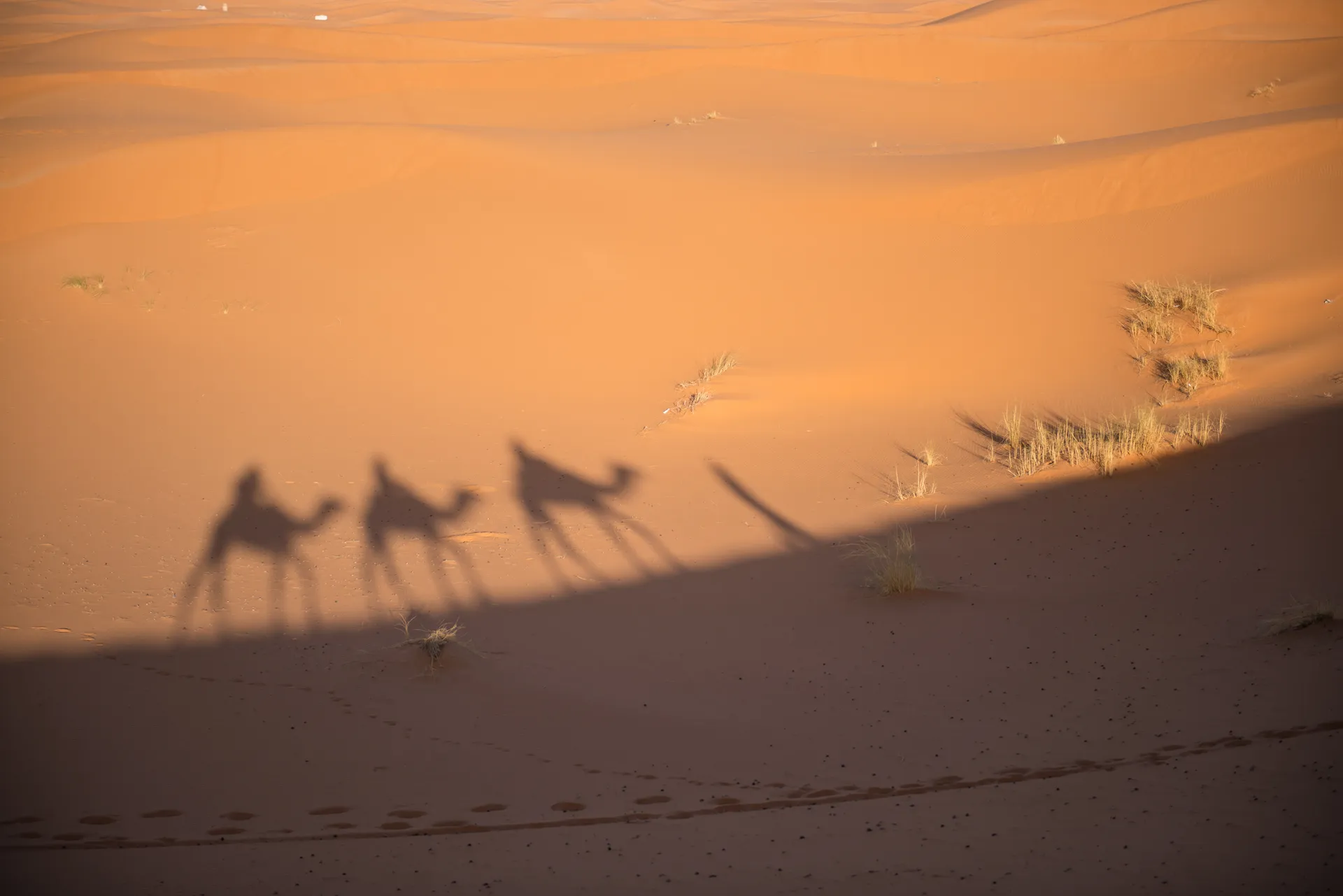
The village itself is small and easily walkable, with lodges strung along the sandy edge of the Erg Chebbi dunes. To go into the dunes you travel by camel or 4x4, usually arranged through your lodge. Reaching Merzouga in the first place is the real journey: it sits at the end of the classic route from Marrakech over the Atlas via the Dades and Todra gorges. Grand taxis and buses connect the village to the nearby towns of Rissani and Erfoud, and long-distance coaches run onward to bigger cities. Drives are long, so build in generous travel time. Without a car, the Supratours bus from Fès is the usual way in, an overnight run of roughly eight hours that pulls in around dawn, while the daytime coach over the mountains takes closer to twelve. The market town 35 km back up the road is where the region actually shops: its souk runs on Tuesdays, Thursdays and Sundays, Sunday being the busiest, with a car park for donkeys at one end.
- Camel treks and 4x4 tours are the way into Erg Chebbi and the desert camps.
- Supratours and CTM buses serve the region; grand taxis link Rissani and Erfoud.
- Onward coaches to Marrakech or Fes are all-day journeys.
- The nearest small airport is at Errachidia, a couple of hours away by road.
Sorting transport? Book an airport transfer, or compare car rental on Auto Europe and QEEQ.
Visas for Merzouga
Merzouga follows Morocco's national entry rules, and Morocco is straightforward for many travelers. Citizens of numerous countries, including the US, Canada, the UK, the EU, and Australia, can enter visa-free for stays of up to 90 days, which comfortably covers any Sahara trip. There is no special permit for the desert region. If you plan to stay longer than 90 days, look into extension procedures well ahead of time, as they can be slow and bureaucratic. The Algerian border lies about 50 km beyond the dunes, and the land frontier between Morocco and Algeria has been closed since 1994, so there is no crossing east and no quick exit nearby: leaving Morocco from Merzouga means a long drive north to a port or an international airport.
- Many nationalities: visa-free entry for up to 90 days.
- No separate permit is needed to visit the Erg Chebbi desert.
- Check your passport has ample remaining validity before arrival.
Best Time to Visit Merzouga
Timing matters enormously in the Sahara. Spring, from March to May, and autumn, from September to November, are ideal: warm days, cool clear nights, and comfortable conditions for camel treks and dune camping. Summer is brutally hot, with daytime temperatures that can make the dunes genuinely dangerous in the middle of the day. Winter brings pleasant daytime warmth but surprisingly cold desert nights, so pack layers if you come between December and February. Whenever you visit, remember this is a conservative rural area, and dressing modestly is respectful and appreciated by the local Berber community. Rain is rare but not harmless. In September 2024 two days of storms dropped more than four times the month's normal rainfall and left lakes standing between the dunes, and a flash flood in 2006 displaced about 1,200 villagers, so a wet forecast is a good reason to ask your camp how high it sits.
- March to May and September to November: the sweet spots.
- Summer (June to August): extreme heat, best avoided for desert activity.
- Winter nights are cold in the desert; bring warm layers.
- Dress modestly out of respect for the conservative rural setting.
Pros and Cons of Merzouga
Merzouga trades comfort and connectivity for something rare: a genuine, awe-inspiring corner of the Sahara. The dunes of Erg Chebbi, nights under a blazing star field, and warm Berber and Gnaoua hospitality make it unforgettable. But it is remote, tiny, and hot, geared entirely to short desert tourism, with thin infrastructure and no community for anyone hoping to linger and work. Weigh it as a magical few-day escape rather than a base. If you arrive with the right expectations, the trade-offs feel more than worth it for the experience the desert delivers.
- Pros: extraordinary dune scenery, clear desert nights, rich Berber culture, low cost, strong safety.
- Pros: unforgettable camel treks, desert camps, and sandboarding.
- Cons: limited and unreliable wifi, extreme summer heat, tiny remote village.
- Cons: no nomad scene, basic infrastructure, and total dependence on tourism.
Who Merzouga Is For
Merzouga is for travelers chasing a short, magical Sahara experience, not for remote workers seeking a productive base. If you want to ride a camel over towering orange dunes, sleep in a desert camp beneath the stars, hear Gnaoua music in Khamlia, and watch the sunrise paint Erg Chebbi, this village delivers something few places on earth can match. It suits adventurers, photographers, honeymooners, and anyone routing across southern Morocco. It does not suit digital nomads needing fast wifi, a community, or long-term comfort. Come for a few unforgettable days, keep your expectations grounded, and let the desert do the rest.
- Great for: short-stay adventurers, photographers, and desert romantics.
- Great for: travelers on the Marrakech-to-Sahara overland route.
- Not for: nomads needing reliable wifi or a work base.
- Not for: anyone seeking nightlife or a lingering community scene.