Cost of Living in Stanley
Where this figure comes from. No cost survey covers Stanley, so the $2,000 a month above is our own estimate rather than a measurement. On 416 of our 999 city guides the figure is built from a published Numbeo basket, a one-bedroom rent in the centre plus one person's monthly costs without rent, converted to USD; this city is not one of them. How we source everything.
Budget around $2,000 a month. A one-bedroom runs roughly $700 to $1,100 and the rental market is very small, with most housing tied to employment or government. Groceries arrive by ship from Britain roughly monthly and by air, so the shelves depend on when the last delivery came and prices are high. Local lamb and fish are cheap and excellent. Heating is a substantial cost given the wind and the cold. Eating out is limited to a few pubs and restaurants. The Falkland Islands pound is pegged to sterling at par and British notes circulate alongside it. Housing is allocated more than it is rented. Most of the decent stock belongs to the government or to employers and comes with a post, so arriving without a job attached means competing for a very small private market where listings circulate by noticeboard and word of mouth rather than online. Wool and fisheries are what the private economy actually runs on, and the squid season sets the rhythm of the year. Anything ordered from Britain arrives with freight attached and on the ship's timetable, so households buy in quantity when something is available.
Where to Work in Stanley
Connectivity is the weakest thing about the islands. There is no submarine cable, so all bandwidth arrives by satellite, which makes it slow, expensive and metered in a way that shapes daily life. Data allowances are a normal topic of conversation here. Mobile coverage exists in Stanley and thins to nothing in Camp, the term for everywhere outside the town. Power is reliable and increasingly wind-generated. Anyone with bandwidth-dependent work should treat the Falklands as genuinely difficult rather than merely slow. Anyone planning an extended stay should price the data allowance carefully, since exceeding it is expensive and video calls consume it far faster than most people expect. Satellite bandwidth is shared rather than dedicated, which means the speed you get depends partly on what everyone else in Stanley is doing at that moment, and evenings are noticeably worse than mornings. Plan anything heavy for early. The professional world is government, fisheries administration, farming and the military support economy, and it is small enough that a newcomer meets most of it within a fortnight. There is no scenario in which this works as a base for someone whose income depends on being reliably reachable by video.
Getting Around Stanley
Stanley is small and walkable along its waterfront. Beyond the town, Camp is reached by unsealed roads and four-wheel drive, or by the Falkland Islands Government Air Service, which flies small aircraft to the settlements and outer islands on a schedule published the evening before. Mount Pleasant airport, about fifty kilometres west, handles the military airbridge from Britain and the weekly LATAM flight from Santiago via Punta Arenas, which is the only commercial connection to South America. Anyone flying to the outer islands should expect the schedule to be confirmed by radio the night before, and to be reshuffled by weather without much notice. Distances in Camp are deceptive because the tracks, not the map, decide the time: a settlement forty kilometres away can take three hours across peat and stone, and getting stuck is common enough that nobody travels without telling someone the route. Vehicles here are almost universally four-wheel drive for that reason. Within Stanley everything is close enough to walk, and the harbour front takes fifteen minutes end to end.
Sorting transport? Book an airport transfer, or compare car rental on Auto Europe and QEEQ.
Visas for Stanley
The Falkland Islands are a British Overseas Territory with their own immigration rules. Citizens of the United Kingdom, the European Union, the United States and most Commonwealth countries receive a visitor permit of up to one month on arrival, subject to proof of onward travel, accommodation and sufficient funds, all of which are genuinely checked. Permits of up to six months have to be applied for before travelling, and no visitor can hold permits for more than nine months in any twelve. Working requires a work permit arranged by an employer in advance. There is no remote work visa. Anyone arriving on the South America route needs to satisfy Chilean transit requirements as well. Anyone arriving on the military airbridge from Brize Norton should note that seats are limited, that priority goes to service personnel, and that civilian bookings are made well in advance. The sovereignty dispute has practical consequences for travel rather than merely political ones. Argentina does not recognise the islands' administration, the air links across South America have been restricted and renegotiated repeatedly, and the single weekly commercial flight is therefore a genuine chokepoint rather than one option among several. Anyone building an itinerary should treat that flight as the fixed point and everything else as flexible, and should hold insurance that covers a long unplanned wait.
Best Time to Visit Stanley
October to March is the southern summer and the only realistic window, with temperatures around thirteen degrees, long daylight and the wildlife at its most active. Penguin colonies are busiest from October to February, black-browed albatross nest through the summer, and elephant seals haul out in spring. Winter from May to August is cold, dark and windy with limited flights. The wind is the constant here rather than the temperature: it blows hard in every season and is what makes thirteen degrees feel considerably colder. Anyone hoping to see king penguins at Volunteer Point should allow a full day, since the drive across Camp takes several hours each way in a four-wheel drive. Weather here is a scheduling problem more than a comfort one. Flights to the outer islands, boat crossings and even the road to Volunteer Point are all cancelled by wind rather than by rain, and a fortnight in the islands should assume at least one day lost to it. Daylight in December runs to seventeen hours, which is what makes the summer trip worth the effort, while June gives barely seven and the town turns inward for the winter.
Pros and Cons of Stanley
Wildlife here comes on a scale that is hard to convey, with five penguin species, enormous albatross colonies, elephant seals and sea lions, all of it approachable and almost entirely unvisited outside the short cruise season. The islands are safe, English-speaking and orderly. The internet arrives by satellite, the costs are high, the wind is constant, the isolation is real, and the 1982 war and the continuing sovereignty dispute with Argentina shape the place in ways a visitor notices within days. Landmines were only fully cleared in 2020. The islands also run one of the most valuable fisheries in the South Atlantic, and the squid licences it sells fund most of the government's budget. Medical care is the constraint that shapes a long stay: one hospital serves the whole territory, and anything it cannot handle means an evacuation flight to Chile or Britain, which is expensive and weather-dependent in equal measure. Around three and a half thousand people live here, a number at which anonymity simply does not exist, and residents are candid that the arrangement suits some temperaments and defeats others entirely.
Who Stanley Is For
The Falklands suit wildlife photographers, biologists and anyone whose priority is birds and marine mammals rather than comfort. They suit people with a working reason to be here in fisheries, government or the military. They do not suit anyone with bandwidth-dependent work, because satellite internet cannot support it, and they do not suit anyone who wants warmth, shelter from the wind, or the option of leaving on short notice. The 1982 conflict has not been tidied away into a museum. Goose Green, Tumbledown and Mount Longdon are all reachable, marked and explained on the ground where the fighting actually happened. The comparison worth making is with South Georgia and the Antarctic gateway ports, since anyone drawn here for the wildlife is usually weighing those too: Ushuaia and Punta Arenas are cheaper, better connected and have the ships, while these islands have the colonies you can walk to without booking a voyage. A month is a realistic stay for a photographer or a researcher, and anything longer generally means a job.
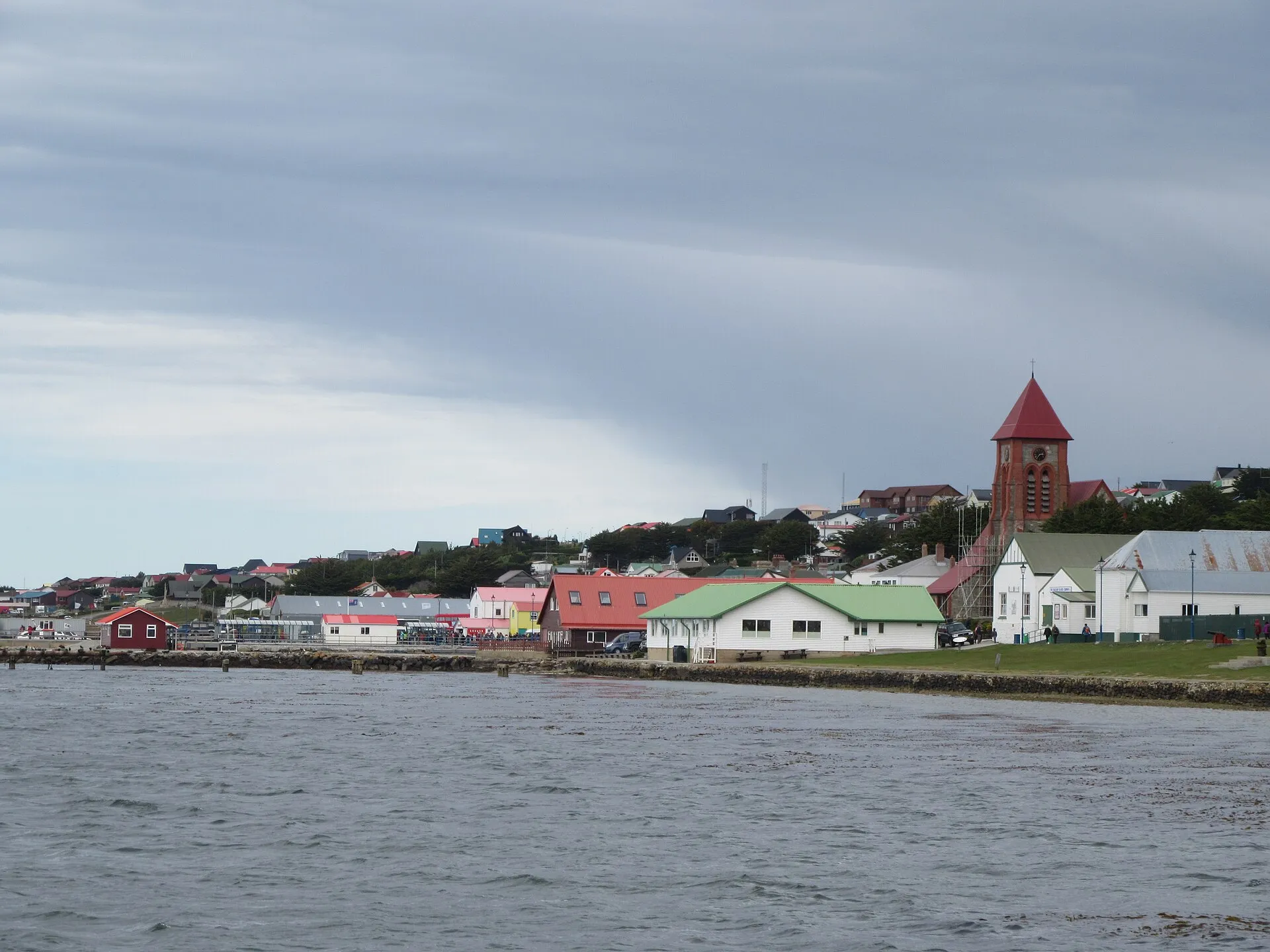 Photo: amanderson2 / Wikimedia Commons (CC BY 2.0)