Cost of Living in Rijeka
Where this figure comes from. No cost survey covers Rijeka, so the $1,300 a month above is our own estimate rather than a measurement. On 416 of our 999 city guides the figure is built from a published Numbeo basket, a one-bedroom rent in the centre plus one person's monthly costs without rent, converted to USD; this city is not one of them. How we source everything.
Budget roughly $1,300 a month as a solo remote worker in Rijeka, which makes it markedly cheaper than Split or Dubrovnik for a city with better year-round infrastructure. A one-bedroom apartment near the centre runs about $500 to $700, and the hillside districts above the port drop that to $400 to $550. Because Rijeka is a working city rather than a resort, long leases are available on normal terms and do not vanish in summer, which is a real advantage over the Dalmatian coast. Groceries land around $250 to $320. A konoba lunch is $10 to $14, a restaurant dinner $22 to $32, and coffee about $2. A monthly transit pass is roughly $30. Utilities add $110 to $190, higher in the damp winter months. The changeover to the euro a couple of years ago rounded a great many prices upward and residents will tell you so at length, which is worth understanding when comparing figures written before it. Flats carry a monthly contribution to the building's reserve fund on top of the rent, small but separate. A tenancy registered with the tax office is what a residence application needs, and a landlord who would rather not register one is a landlord to walk away from.
Where to Work in Rijeka
Rijeka has a modest coworking scene, with a few spaces in and around the centre charging roughly $110 to $180 a month, and the city's designation as European Capital of Culture in 2020 left behind some renovated cultural venues that double as working space. The Korzo, the main pedestrian street, and the streets running off it have plenty of cafes where a laptop is unremarkable, and Croatian coffee culture is famously unhurried, so nobody will move you along. Fixed-line internet is fast and mobile data is good and cheap within the EU roaming area. The practical advantage over the tourist coast is that all of this works in February as well as in August, when Split's cafes are full of visitors and its rents have tripled. The self-propelled torpedo was invented in this city in the eighteen sixties and the factory that built it still stands derelict by the water, which is the sort of industrial history the place has in quantity and has not yet decided what to do with. The shipyard up the coast has been in slow crisis for years. What that leaves is a city with cheap space and a great many unused buildings, which is why the cultural sector took root here rather than elsewhere.
Getting Around Rijeka
Rijeka is built on a narrow shelf between the Kvarner gulf and the hills, which makes it long, thin and steep. The centre is walkable end to end along the waterfront and the Korzo, but anything uphill is a serious climb and the city has stairs where other places have streets. An extensive bus network covers the rest, with a monthly pass at about $30. The main railway station connects to Zagreb in around four hours, which is slower than the bus at two and a half. Rijeka airport is on the island of Krk, 30km away, seasonal and small; Zagreb, Pula, Trieste and Ljubljana are all realistic alternatives within a few hours. Ferries run along the coast and to the Kvarner islands in season. A stone stairway of several hundred steps climbs from the river to the castle above the city, built as a pilgrims' route in the sixteenth century and still the most direct way up, which tells you something about how the place is arranged. The bridge out to the nearest island carries the airport traffic and is tolled. Buses to the villages along the coast run hourly through the summer and a good deal less often once the season ends.
Sorting transport? Book an airport transfer, or compare car rental on Auto Europe and QEEQ.
Visas for Rijeka
Croatia is in the European Union, the Schengen area since January 2023, and the eurozone since the same date, so EU and EEA citizens may live and work here freely. Most other Western passports get 90 days in any 180-day Schengen period. Croatia was an early mover on remote work and its digital nomad residence permit, available since 2021, grants up to 18 months for non-EU nationals working for foreign employers, with an income threshold and proof of accommodation and health insurance required. It is not renewable directly, requiring a gap before reapplying. Notably, income earned under it is not subject to Croatian income tax, which is unusual among such schemes and one reason the permit has been popular. Years spent on the remote work permit leave no credit at all towards settlement, so it buys a year rather than a foothold, and the compulsory gap before reapplying means planning where to spend the months in between. A personal identification number is issued early in the process and is then asked for by every counter in the country. The criminal record certificate has to be apostilled where it was issued, which is the step people start too late. The passport desk at Krk airport is Rijeka's external border, where the EES enrols non-EU arrivals on flights from outside the bloc.
Best Time to Visit Rijeka
May, June, September and October are the best months in Rijeka: warm, bright and free of the July and August crowds that fill the Kvarner coast. Summer is hot, into the low thirties, and the city empties towards the islands and beaches at Opatija and Lovran along the coast. Winter is mild by continental standards, around 10 degrees, but wet, and Rijeka is known for the bura, a fierce dry wind off the mountains that can blow for days and closes the coastal road. February brings the Rijeka Carnival, one of the largest in Europe and the single most distinctive thing in the local calendar. Because the city works year-round rather than seasonally, rents and services stay stable in a way the Dalmatian resorts do not manage.
Pros and Cons of Rijeka
Rijeka gives you the Croatian coast without the resort economy: real neighbourhoods, year-round rents, a working port, a university, and a cultural scene that outlasted its Capital of Culture year. It is cheaper than Split, better connected to central Europe, and has the Kvarner islands and the Ucka mountains within half an hour. The digital nomad permit is one of the better ones in the EU. It is not conventionally pretty: the centre is handsome Habsburg but the surroundings are industrial and socialist-era in equal measure. The bura wind is genuinely unpleasant. Beaches are pebbly and mostly a bus ride away. The nomad community is small, with most of Croatia's remote workers in Split, Zagreb or Zadar, and winters are wet.
Who Rijeka Is For
Living on the Adriatic year-round, rather than visiting it in summer, is the point, and a functioning city rather than a postcard is what you get in return for it. Croatia's digital nomad permit paired with rent that holds still is the core case. Beyond that, Slovenia, Italy and Austria are all close, and the sailing, the hiking and the island ferries are reachable without paying resort prices for the privilege. It works for couples and solo workers who make their own social plans. A large nomad scene, guaranteed sunshine, sandy beaches and the postcard Dalmatia of Split and Dubrovnik are all a few hours south of here, and all of them considerably more expensive once you arrive.
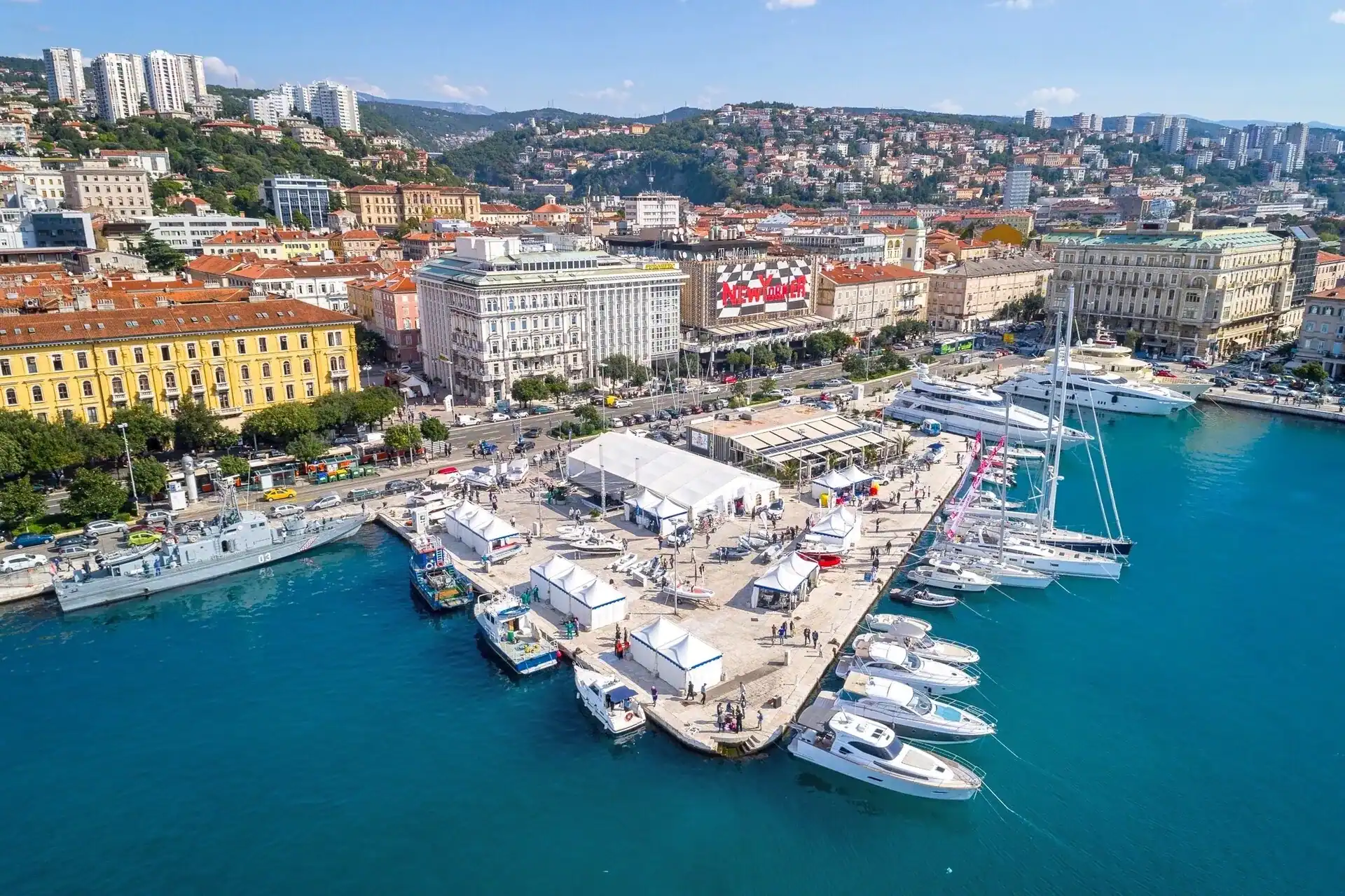 Photo: Antonio199cro / Wikimedia Commons (CC BY-SA 4.0)