Cost of Living in Girona
Real market data
Source: Numbeo · August 2026
$2,150/moSolo nomad1-bed centre + living costs
$2,790/moCoupleshared 1-bed + costs
$1,750/moLean / localcheaper area + costs
- 1-bed rent, city centre$1,360€1,179
- 1-bed rent, outside centre$950€829
- Monthly costs excl. rent (1 person)$800€691
- Meal, inexpensive restaurant$18€16
- Monthly transit pass$39€34
- Buy price, per m² (centre)$5,330€4,632
Prices are from Numbeo (August 2026), converted to USD at $1 = €0.87 (01 Aug 2026). The monthly living-costs figure is our transparent one-person basket, groceries, a few meals out, utilities, phone, internet, transport and essentials, priced from those figures. Solo adds central rent; couple and lean are estimates from the same numbers.
Girona sits in a comfortable middle ground: noticeably cheaper than Barcelona, but not as cheap as smaller inland Spanish cities. Expect to spend roughly $1,960 to $2,760 per month as a solo remote worker, depending on your habits and where you live.
- Rent, city center (Barri Vell / Eixample): $1,270 to $1,730/month for a 1-bedroom
- Rent, outer neighborhoods (Pont Major, Domeny): $750 to $1,040/month for a 1-bedroom
- Groceries: $230 to $345/month if you cook regularly at home
- Eating out, inexpensive meal: $16 to $21 per person; a mid-range dinner for two runs $69 to $92
- Coffee: $2.50 to $3 for a cappuccino
- Coworking, hot-desk: $105 to $175/month (part-time to full-time desk)
- Local transport (monthly bus pass): $39
- Utilities (electricity, water, heating for 85m2): $230 to $290/month
- Home internet (60+ Mbps unlimited): $40 to $52/month
Note that Girona's rental market has tightened considerably, with asking prices up sharply since 2024. Central apartments at the lower end of the range move quickly. Outer neighborhoods like Pont Major offer significantly lower rents but require a bus or bike commute into the old town.
Where to Work
Girona has a small but functional coworking scene. Cossi Coworking on Carrer Nou occupies a 19th-century building in the heart of the city, with high ceilings and a quiet atmosphere; full-time desks run $175/month, with daily drop-ins at $16. Giworking on Carrer Manel Bonmati, near the train station, is larger and more corporate in feel, offering 1 GB fiber and 24/7 card access. B&Co Working Place on Carrer Santa Coloma is a 1,800m2 facility on an industrial estate, better suited to those who don't need to be in the old town daily.
Cafe culture in Girona leans toward leisure over laptop work. La Fabrica on Carrer de la Llebre (old town) is the city's iconic cyclist cafe, busy and welcoming, but it gets crowded. Federal on Carrer de la Forca and Le Bistrot near Sant Domenec are both quiet enough for a morning of focused work with a coffee in hand. Expect a genuine Catalan cafe culture: no one will rush you, but you also won't find power strips at every table.
WiFi in coworking spaces is reliable with fiber speeds common. Cafes are more variable. Mobile data coverage (4G/5G) is solid throughout the city as a backup.
Getting Around
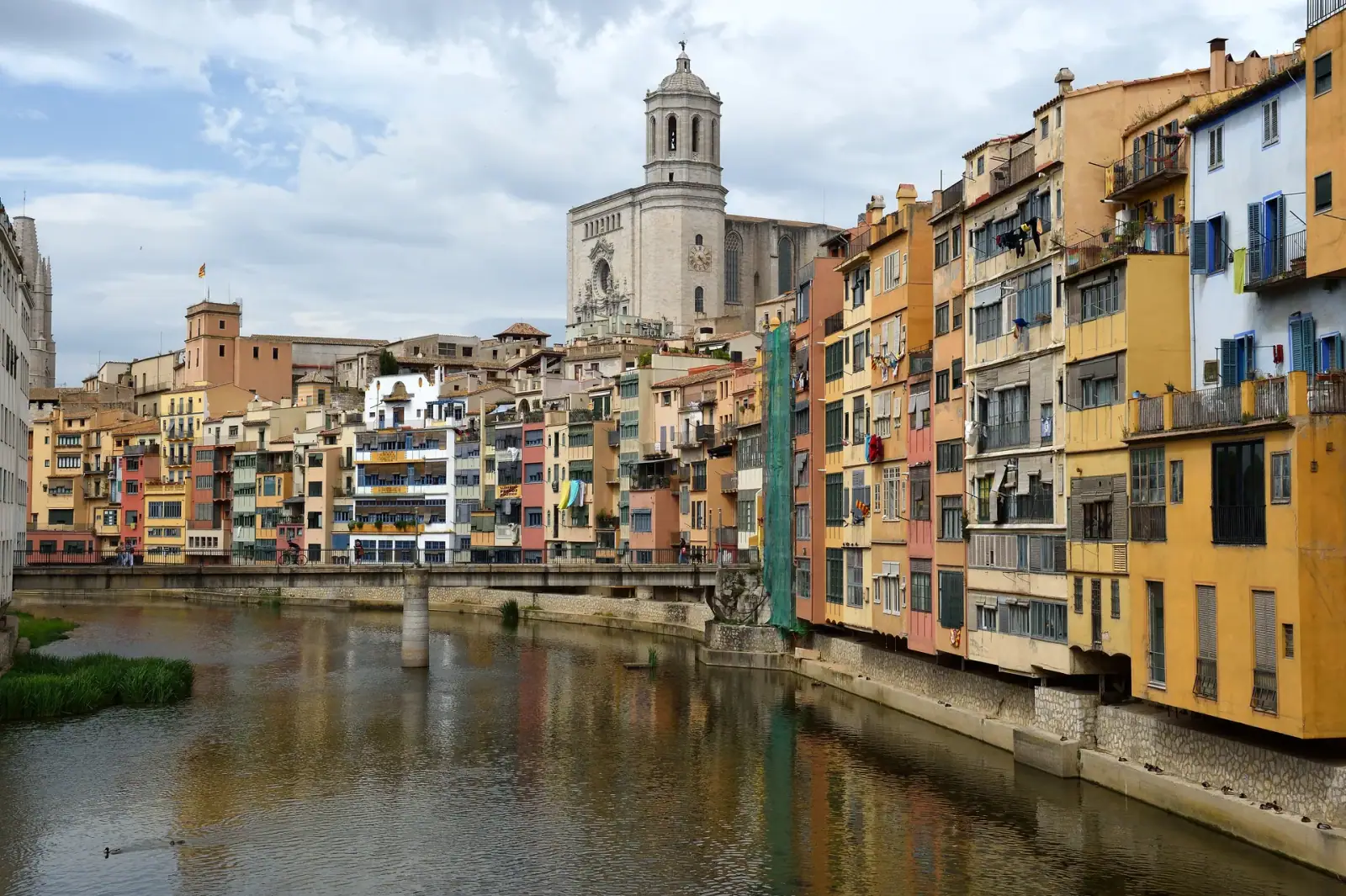
Girona's historic center is compact and best explored on foot. The old town sits on a small hill above the Onyar River and most of what you need as a day-to-day resident is within a 20-minute walk. The city has an expanding network of cycle lanes and a public bike scheme called Girocleta, with 35+ stations across town, making cycling one of the most practical ways to commute between neighborhoods.
The city bus network runs 13 lines from around 7:00 to 21:30, with a single ticket at $2 and a monthly pass at $39. Frequency on main routes is every 15 minutes; secondary routes run every 30 to 60 minutes.
Getting to Barcelona is straightforward: the Renfe Avant high-speed train covers the 38-minute journey for as little as $8 to $14, with around 25 daily departures. This makes day trips or co-working weeks in Barcelona entirely practical.
Girona Costa Brava Airport (GRO) is 13 km south of the city and served mainly by Ryanair. A direct bus connects it to Barcelona's Estacio Nord in around 75 minutes (roughly $23). For most flights, Barcelona's El Prat airport (BCN) is the better option, reachable by train from Girona in under an hour and a half total.
Sorting transport? Book an airport transfer, or compare car rental on Auto Europe and QEEQ.
Visas and Staying Long-Term
EU/EEA passport holders can live and work in Spain indefinitely. Citizens of the US, Canada, UK, Australia, and most other Western countries can enter Spain visa-free for up to 90 days within any 180-day period under the Schengen rules.
For longer stays, Spain's Digital Nomad Visa (launched 2023) is the main route for remote workers. It requires proof of remote employment or freelance income of at least $3,280/month (200% of Spain's minimum wage), health insurance, a clean criminal record, and an application at your nearest Spanish consulate before arrival. The initial permit lasts one year, renewable for up to five years, with a pathway to permanent residency. A notable perk is eligibility for the Beckham Law flat 24% income tax rate on earnings up to $690,690.
Spain also offers Non-Lucrative Visas for those with sufficient passive income. The Golden Visa (real estate investment route) was abolished in April 2025.
Best Time to Visit
Girona has a transitional Mediterranean climate: hot and dry in summer, mild and wet in autumn and spring, with cool but rarely harsh winters.
Best windows for remote work: mid-April to mid-June and September to October. Temperatures are comfortable (15 to 25C / 59 to 77F), the city is active without being overwhelmed by tourists, and daylight hours are generous. Spring can bring some rain, but nothing disruptive.
July and August are hot (regularly above 30C / 86F) and the old town fills with tourists. It is not unworkable, but expect noise, higher short-term rental prices, and a city running at a different pace.
November through February is quiet, cheaper, and genuinely mild by northern European standards (8 to 15C / 46 to 59F), with crisp air and uncrowded streets. This is an underrated period for focused work, though some smaller cafes and restaurants reduce their hours.
Pros and Cons
- Fast train to Barcelona in 38 minutes, giving you big-city access without big-city costs
- Compact, walkable old town with genuinely beautiful medieval architecture along the Onyar River
- Safe and clean, with a notably low crime rate compared to larger Spanish cities
- Strong cycling culture and easy access to Pyrenees trails and Costa Brava beaches within an hour
- Excellent food scene out of proportion to the city's size, including a Michelin-starred restaurant within walking distance of most apartments
- Cooler summers than southern Spain, making afternoon work more bearable
- Small English-speaking nomad community; you will mostly be navigating life in Catalan and Spanish
- Limited coworking supply; the best spaces are small and can fill up, especially in high season
- Rental market is tight and prices have risen sharply; finding central housing at reasonable rates takes time
- No international airport hub; most long-haul travel requires getting to Barcelona first
- Catalan-first culture means some locals prefer Catalan over Spanish, which can be an adjustment
- Quieter nightlife than Barcelona or Madrid; the city goes to bed earlier
Who Girona Is Best For
Girona rewards people who want the quality of a smaller European city without sacrificing access to a major hub. If you do focused solo work, cycle or hike on weekends, and do not need a large co-working community around you, it is close to ideal. The Barcelona train connection means you are never more than 40 minutes from a major airport, international clients, or a livelier social scene whenever you need it.
It suits those who already have some Spanish (and ideally some Catalan curiosity), appreciate food culture, and prefer cobblestone-and-river-views over beach-town energy. Writers, designers, developers, and consultants who thrive on quiet, beauty, and routine tend to do well here.
Consider somewhere else if you need a large nomad meetup scene, a buzzing co-working campus, or affordable central housing without a long search. It is also not the right fit if you need frequent long-haul flights and resent the extra leg to Barcelona El Prat. And if extreme heat in summer bothers you, plan your stay between September and June.