Cost of Living in Ljubljana
Real market data
Source: Numbeo · Jul 2026
$2,100/moSolo nomad1-bed centre + living costs
$2,910/moCoupleshared 1-bed + costs
$1,900/moLean / localcheaper area + costs
- 1-bed rent, city centre$1,090€948
- 1-bed rent, outside centre$900€779
- Monthly costs excl. rent (1 person)$1,010€875
- Meal, inexpensive restaurant$17€15
- Monthly transit pass$43€37
- Buy price, per m² (centre)$6,410€5,572
Prices are from Numbeo (Jul 2026), converted to USD at $1 = €0.87 (01 Aug 2026). The monthly living-costs figure is our transparent one-person basket, groceries, a few meals out, utilities, phone, internet, transport and essentials, priced from those figures. Solo adds central rent; couple and lean are estimates from the same numbers. The guide below quotes its own monthly range, which is a different measurement rather than a competing one: this table prices a defined basket at the figures above, while that range is a judgement about how somebody actually lives here.
Ljubljana sits in a comfortable middle ground for European capitals: cheaper than Vienna or Zurich, but noticeably pricier than Warsaw or Tbilisi. Your biggest variable is rent.
- Rent, city center (1-bedroom): $920-1,380/month
- Rent, outer neighborhoods like Bežigrad or Šiška (1-bedroom): $575-865/month
- Groceries: $230-345/month shopping at Hofer, Lidl, or Mercator
- Eating out: A sit-down lunch at a local gostilna runs $9-14; dinner at a mid-range restaurant $17-29 per person. Budget $290-460/month if you eat out regularly.
- Coworking hot-desk: $110-265/month depending on space and included perks
- Local transport (monthly bus pass): ~$35/month; single rides cost about $1.50
- Total realistic range: $1,610-2,530/month including rent, food, transport, and a coworking membership
Apartment hunting is competitive in summer when short-term rates spike. Longer stays of three months or more often unlock better rates directly with landlords. WiFi and utilities typically add $58-115 on top of rent.
Where to Work
Ljubljana has a small but solid coworking scene and a genuinely cafe-friendly culture. You will not struggle to find a table with an outlet and decent WiFi, though the city is compact enough that options are fewer than in a major European hub.
Coworking Spaces
Impact Hub Ljubljana on Slovenska cesta 56 is the most community-oriented option, housed in the former Ljubljana Stock Exchange near Tivoli Park. Hot-desk memberships run around $140-175/month. S Hub Coworking on Pivovarniška ulica, opposite Tivoli Park, is a modern air-conditioned space with free parking, a tea kitchen, and a relaxation room, with hot-desk access from around $110/month. MP Hub in the Šiška district is billed as the most modern purpose-built coworking space in Slovenia, popular with local startups.
Cafe Work Culture
Cafes in Ljubljana are genuinely welcoming to laptop workers, especially outside of breakfast and lunch rushes. Stow Coffee Roasters on Gosposka ulica is a compact specialty cafe with reliable WiFi inside the city museum building. Kavarna Moderna at the Museum of Modern Art on Cankarjeva cesta offers a calm, light-filled environment. Pritličje on Mestni trg is a bookshop bar that works well for quieter afternoon sessions.
WiFi quality is generally reliable in cafes and coworking spaces. Apartment internet can be inconsistent, so testing before committing to a longer rental is wise. Mobile data on local SIM cards (A1, Telekom Slovenia, T-2) is fast and affordable as a backup.
Getting Around
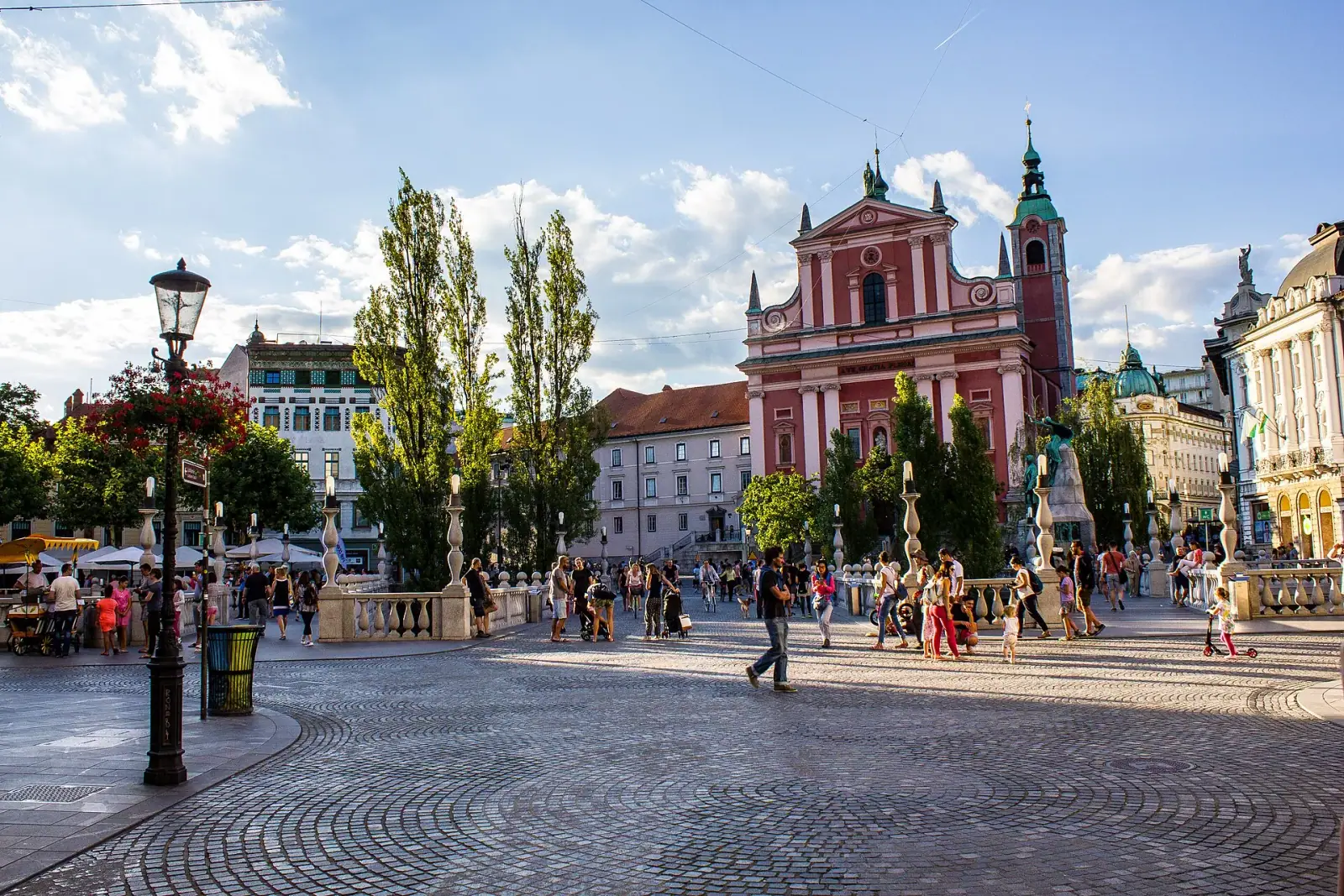
Ljubljana's Old Town and most daily-use destinations are within a 20-30 minute walk of each other. The city is one of the most walkable small capitals in Europe, and a large car-free zone covers the historic center.
Cycling is extremely common. The BicikeLJ public bike-share network operates across the city with over 30 stations; annual membership costs around $12 and the first hour of each ride is free. Dedicated bike lanes connect most neighborhoods.
Public buses cover the wider city reliably. Buy an Urbana card ($2.50 deposit) and load credit; single rides cost $1.50, a 30-day pass around $35. Buses run until roughly midnight.
Getting to and from the Airport
Ljubljana Jože Pučnik Airport sits 26 km north of the city center. Your options are: the Arriva urban Bus 28 ($4.50, around 50 minutes, stops en route), the Nomago shuttle ($14 per person, 40 minutes, book online in advance), or a taxi or pre-booked transfer ($29-48, 30-40 minutes). Avoid unbooked curbside taxis at the airport, as walk-up fares are unregulated and can be significantly higher.
Sorting transport? Book an airport transfer, or compare car rental on Auto Europe and QEEQ.
Visas and Staying Long-Term
Slovenia is part of the Schengen Area. Most Western passport holders (US, UK, Canada, Australia) can enter visa-free for up to 90 days in any 180-day window across the entire Schengen zone, not just Slovenia. This is a shared allowance, so time spent in other Schengen countries counts against your 90 days.
Slovenia launched a dedicated Digital Nomad Visa in November 2025. It is a 12-month temporary residence permit for non-EU/EEA remote workers who work exclusively for clients or employers outside Slovenia. The income requirement is approximately $3,680/month (twice the average Slovenian net salary). The permit is not renewable: after 12 months you must leave and wait at least 6 months before reapplying. Applications go through Slovenian consulates abroad or local administrative units inside Slovenia.
There is no simple Schengen extension mechanism. Visa runs to non-Schengen countries (Croatia, Serbia, the UK) are a common workaround for nomads on tourist entry, but carry legal risk.
Best Time to Visit
Ljubljana has four distinct seasons. Summers (June-August) are warm and lively, with temperatures reaching 27-30 degrees C (80-86 F), outdoor terrace culture in full swing, and a busy events calendar. The downside is peak accommodation prices, more tourists in the already-compact Old Town, and occasional heavy afternoon thunderstorms.
The best window for remote work is May and September. Temperatures are pleasant (15-22 degrees C / 59-72 F), crowds thin out, prices drop, and the city retains much of its summer energy without the congestion. Autumn color along the Ljubljanica river and in Tivoli Park is genuinely beautiful.
Spring (March-April) is mild but rainy, and Easter brings short tourist surges. Winter (November-February) is cold with frequent fog, some snow, and reduced outdoor life, though Christmas markets make December worth considering for a short stay. Cafes and coworking spaces stay open year-round, so productivity does not suffer seasonally.
Pros and Cons
Pros
- Very high safety: consistently ranked among the safest cities in Europe
- Compact and walkable with excellent cycling infrastructure
- Clean, green, and well-maintained; designated European Green Capital
- Strong English proficiency, especially among younger locals
- Gateway to exceptional nature: Lake Bled, Triglav National Park, and the Adriatic coast are all within two hours
- Schengen access from a politically stable EU/NATO member
- Dedicated Digital Nomad Visa launched in 2025 for longer stays
Cons
- Small city: the social scene and nomad community are modest compared to Lisbon or Berlin
- Coworking options are limited; most spaces are small and book up
- Rent has risen sharply and central apartments are no longer cheap
- Winters are grey, foggy, and damp for extended stretches
- Digital Nomad Visa income threshold ($3,680/month) is high relative to the local cost of living
- Summer tourist pressure is significant for a city this size
Who Ljubljana Is Best For
Ljubljana works well for nomads who want a clean, safe, manageable European base without the overwhelming scale of a major capital. If you value walkability, easy access to nature, and a low-stress daily environment over a packed social calendar, this city delivers. It suits people on 30-to-90-day Schengen stints who plan to pair Ljubljana with day trips or weekend travel across Slovenia and neighboring countries.
It is also a good fit for those who qualify for and want to use the new Digital Nomad Visa, especially if you prefer a quiet, high-quality-of-life setting over a buzzing nomad hub. Couples or solo workers with an outdoor focus will find the balance of city convenience and mountain or lake access hard to beat in Central Europe.
Skip Ljubljana if you need a large coworking community, thrive on a dense social nomad scene, or are working to a tight budget. Those looking for the cheapest Schengen option, or a city with a large established expat network, will find better value in cities like Krakow, Tbilisi, or Porto.