Cost of Living in Zadar
Real market data
Source: Numbeo · August 2026
$1,660/moSolo nomad1-bed centre + living costs
$2,250/moCoupleshared 1-bed + costs
$1,450/moLean / localcheaper area + costs
- 1-bed rent, city centre$920€796
- 1-bed rent, outside centre$710€614
- Monthly costs excl. rent (1 person)$740€643
- Meal, inexpensive restaurant$16€14
- Monthly transit pass$46€40
- Buy price, per m² (centre)$4,700€4,080
Prices are from Numbeo (August 2026), converted to USD at $1 = €0.87 (01 Aug 2026). The monthly living-costs figure is our transparent one-person basket, groceries, a few meals out, utilities, phone, internet, transport and essentials, priced from those figures. Solo adds central rent; couple and lean are estimates from the same numbers. The guide below quotes its own monthly range, which is a different measurement rather than a competing one: this table prices a defined basket at the figures above, while that range is a judgement about how somebody actually lives here.
Zadar sits comfortably below Split and Dubrovnik on price, though it is not the rock-bottom bargain it was a decade ago. Outside peak summer, a single nomad can live reasonably well on $1,270-1,840 per month.
- Rent, central Old Town 1-bedroom: $635-865/month. Prices spike 30-50% in July and August, and landlords frequently prefer three-month minimums in shoulder season.
- Rent, outer neighborhoods (Vostanica, Bili Brig): $460-635/month. Quieter, a short bus or bike ride from the peninsula, and far more available year-round.
- Groceries: $230-320/month. The Trznica market on the waterfront has excellent local produce, cheese, and cured meats at prices well below supermarket level.
- Eating out: A sit-down lunch at a konoba runs $12-18; a pizza or pasta dinner, $9-16. Budget $175-290/month depending on how often you cook.
- Coworking hot-desk (COIN): roughly $140/month, or $17/day.
- Local transport: City buses cost around $1.50-2.50 per ride; a monthly bus pass is approximately $29. Many people use bikes for much of the year.
- Total realistic range: $1,270-1,960/month, depending on your rent situation and dining habits.
Croatia uses the euro (EUR) since joining the eurozone in January 2023, which removes the currency friction that used to complicate budgeting here.
Where to Work
COIN Coworking (Put Murvice 16) is the main dedicated space in the city, with about 370 square meters of open desks, private offices, meeting rooms, and reliable fiber internet. Day passes run around $17; a monthly hot-desk is about $140. It operates Monday through Friday, 8:00-18:00, which works fine for European time zones but limits flexibility if you keep odd hours.
Cafe-working is genuinely viable here. U Apocefal in the Old Town is the most consistently cited spot for focused work: good specialty coffee, calm atmosphere, a bookish local crowd, and reliable WiFi. Deja Brew and Cogito Coffee (a Zagreb roaster's Zadar outpost) offer better espresso quality than the average Dalmatian bar, with decent connectivity. Caffe Bar Maestral on the waterfront promenade has a view but more variable WiFi. Order a new drink every hour or so and staff will not rush you.
The real WiFi situation: apartment connections in Zadar are dependable, and fiber-optic builds are spreading. You are very unlikely to have connectivity issues for standard remote work. Mobile data on Hrvatski Telekom, A1, or Telemach is solid throughout the city, and a tourist SIM with a useful data allowance costs $12-17 per week.
Getting Around
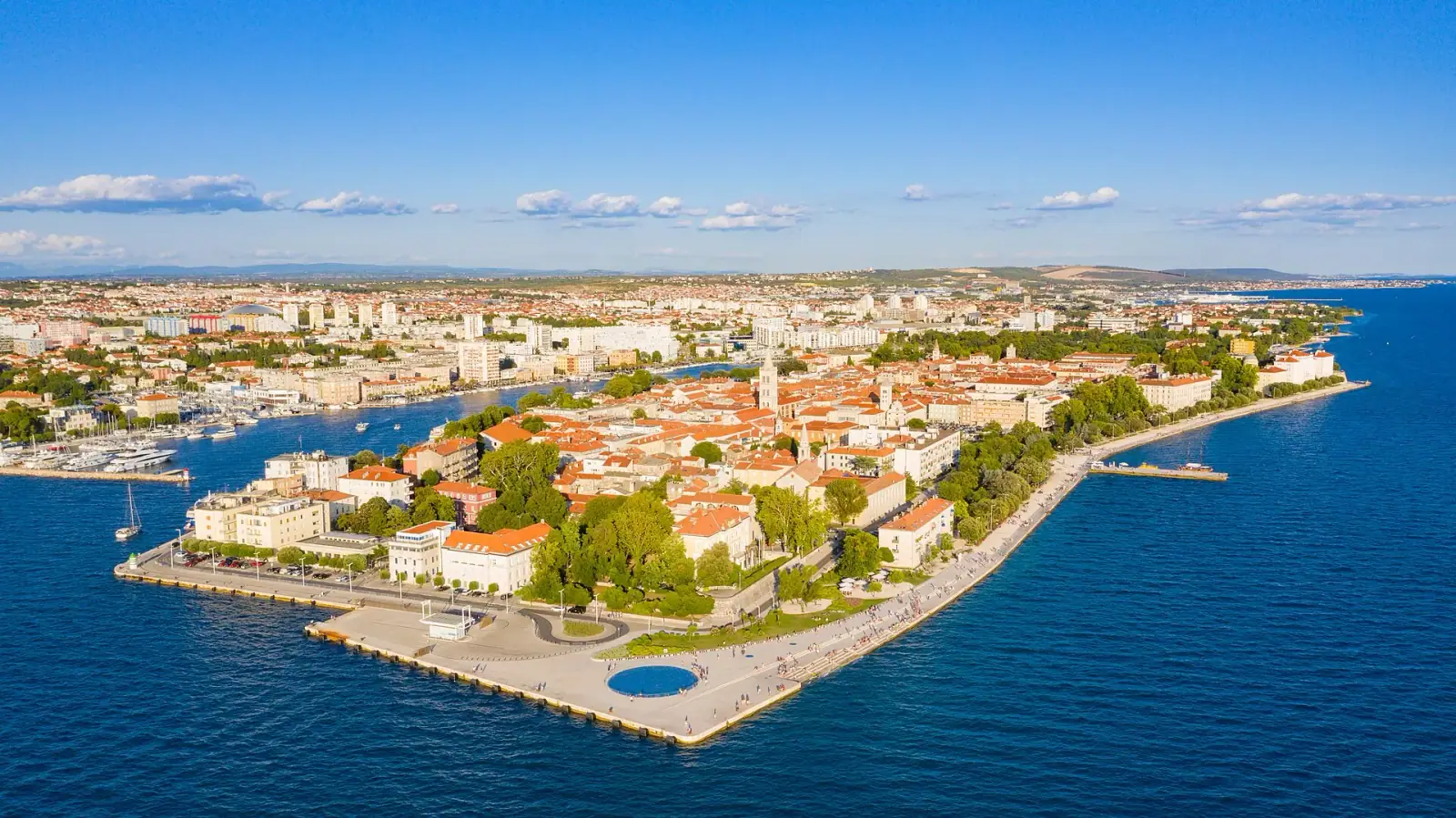
The Old Town peninsula is dense and almost entirely pedestrianized, so you will walk almost everywhere within the historic core. It takes about 15 minutes on foot to cross from one end to the other. The wider city stretches north and east, and for those areas, city buses run by Liburnija are reliable, frequent, and cheap at around $1.50-2.50 per trip. Lines 2 and 4 connect the main bus station to the Old Town peninsula.
Bikes are well-suited to Zadar's flat coastal path (the Riva) and the seafront route north toward Borik. Rentals are easy to find and monthly rates from local shops are reasonable. Ride-hailing via Uber and Bolt is available but sparse compared to larger Croatian cities; taxis fill the gap.
Zadar Airport (ZAD) is about 8 kilometers east of the city center in Zemunik Donji. A dedicated airport shuttle bus runs to the Old Town for $6 one-way, with a journey time of roughly 20 minutes in normal traffic. The timetable follows the flight schedule, so check current departure times on the Liburnija or airport website before you plan. Uber and Bolt from the airport to the center typically cost $14-21; official taxis run slightly higher. The airport has good seasonal connectivity across Europe, with a useful selection of direct routes especially in summer.
Sorting transport? Book an airport transfer, or compare car rental on Auto Europe and QEEQ.
Visas and Staying Long-Term
Croatia is an EU and Schengen Area member. Citizens of the US, Canada, UK, Australia, and most other Western passports can enter visa-free for up to 90 days within any 180-day period across the entire Schengen zone. Track your days carefully since Croatia's entry into Schengen in January 2023 means your days there count against your broader Schengen allowance.
Croatia has a dedicated digital nomad residence permit (sometimes called the digital nomad visa), introduced in 2021 and updated in March 2025. It allows non-EU remote workers who earn income from outside Croatia to live in the country for up to 18 months, with full exemption from Croatian income tax on foreign-sourced earnings. The income threshold as of early 2026 is approximately $4,170/month (or equivalent savings). You will need proof of remote employment or self-employment income from outside Croatia, health insurance valid in Croatia, a Croatian address, a clean criminal record, and six months of bank statements or payslips. After the permit expires, you must leave Croatia for 180 days before reapplying.
Best Time to Visit
For remote work, May, early June, September, and October are the sweet spot. Temperatures are comfortable (18-26°C), the Adriatic is warm enough to swim in from June onward, crowds are manageable, and accommodation prices are 30-50% below peak-summer rates. The Old Town is genuinely pleasant rather than gridlocked, and cafes have seats available.
July and August are spectacular weather-wise, with long sunny days and sea temperatures above 25°C, but the city fills with tourists. Accommodation prices spike, coworking spot demand rises, and cafe noise levels make focused work harder. If you must visit in peak season, book accommodation at least two months in advance.
Winter (November through March) is mild by northern European standards, averaging 8-12°C, but expect rainy stretches, the occasional biting Bora wind, and a noticeably quieter city with some restaurants closed for the season. Long-term rentals become much more available and affordable, and you will have the Roman ruins and sea organ essentially to yourself. It can be a productive but socially quiet period.
Pros and Cons
Pros
- Genuinely affordable relative to Split and Dubrovnik, with a euro economy that simplifies budgeting
- Old Town walkability is excellent: dense, beautiful, and entirely on foot
- Safe city with low crime; solo travelers and women traveling alone report feeling very comfortable
- English widely spoken, especially among people under 50 and in hospitality
- Outstanding food culture: fresh seafood, Pag cheese, local olive oils, and good Croatian wine at fair prices
- Unique sights (the Sea Organ, Greeting to the Sun) without the Dubrovnik-level saturation
- Easy day trips to Plitvice Lakes, Kornati National Park, and the islands of Dugi Otok and Ugljan
- Croatia's digital nomad permit offers an 18-month legal stay with tax exemption
Cons
- Coworking infrastructure is thin: one real dedicated space (COIN), limited to weekday business hours
- July-August crowds push up rent, lower cafe availability, and create noise in the Old Town
- Nomad community is small and not especially organized compared to Lisbon, Split, or Tbilisi
- Winter social life is quiet; many restaurants and bars close or cut hours significantly
- Ferry and transport connections to islands are reduced outside summer, limiting weekend exploration
- The 90-day Schengen cap hits fast if you do not obtain the digital nomad permit
Who Zadar Is Best For
Zadar suits nomads who want the beauty of the Dalmatian coast without paying Split or Dubrovnik prices for it, and who prefer a quieter, locally-oriented city over a heavily-touristed scene. If you value walkable access to good food, history, and the sea, and you can work independently without needing a large coworking community around you, Zadar delivers strongly from May through June and again in September through October.
It also works well for anyone pursuing Croatia's digital nomad permit: Zadar has the administrative infrastructure to support applications, costs less than Split for the required months of accommodation, and the Digital Nomad Valley in the Borik area even provides a structured community option with housing and coworking bundled together.
Skip Zadar if you rely on a large, active nomad community for social and professional connection, if you need coworking access on weekends or outside standard office hours, or if you want a city with serious nightlife. It also rewards patience with Croatian bureaucracy: the nomad permit process has paperwork requirements that some find frustrating. And if you are visiting only in July or August without planning well ahead on accommodation, the crowds and prices may undercut the appeal entirely.