Cost of Living in Monemvasia
Where this figure comes from. No cost survey covers Monemvasia, so the $1,000 a month above is our own estimate rather than a measurement. On 416 of our 999 city guides the figure is built from a published Numbeo basket, a one-bedroom rent in the centre plus one person's monthly costs without rent, converted to USD; this city is not one of them. How we source everything.
Monemvasia is a small, spectacular place, and its walled Kastro carries a premium that reflects its rarity rather than any nomad economy. A realistic solo budget runs from roughly $900 to $1,600 per month, with the wide swing driven mostly by where you sleep. A stone room inside the medieval town, often a converted guesthouse with sea views, is a splurge in high season, while the modern town of Gefyra across the causeway offers plainer, cheaper studios and better value for a longer stay. Groceries, tavernas and the local Malvasia wine are moderately priced by Greek standards, though the captive tourist setting nudges restaurant bills upward. Because this is a slow-travel destination and not a work hub, factor in a car or bus fares for supplies and day trips.
- Kastro (walled town) stays: highest cost, atmospheric, book far ahead in summer.
- Gefyra studios and apartments: noticeably cheaper for weekly or monthly stays.
- Tavernas: moderate, with a tourist markup inside the walls.
- Add transport costs, since services and a supermarket sit in Gefyra.
Where to Work in Monemvasia
What Monemvasia offers a remote worker is a walled medieval town of a few lanes, without a single coworking desk or any nomad crowd, and accepting that before the booking beats discovering it after. That said, day to day remote work is workable. Many guesthouses and apartments now advertise decent wifi, and a handful of cafes in both the Kastro and Gefyra will happily let you nurse a coffee over a few hours of email. Mobile 4G and 5G coverage from the Greek carriers is generally reliable, so a phone hotspot is a sensible backup for video calls. For anything demanding, plan around a stay with confirmed fast wifi rather than assuming the cafe will carry you. The modern town of Gefyra has more shops, a pharmacy and services, so practical errands are easier there than inside the atmospheric but service-light medieval streets.
- Kastro cafes suit short sessions and views, not full workdays.
- Gefyra has more amenities, shops and a steadier place to sit and work.
- Keep a mobile data hotspot as a backup for calls.
Getting Around Monemvasia
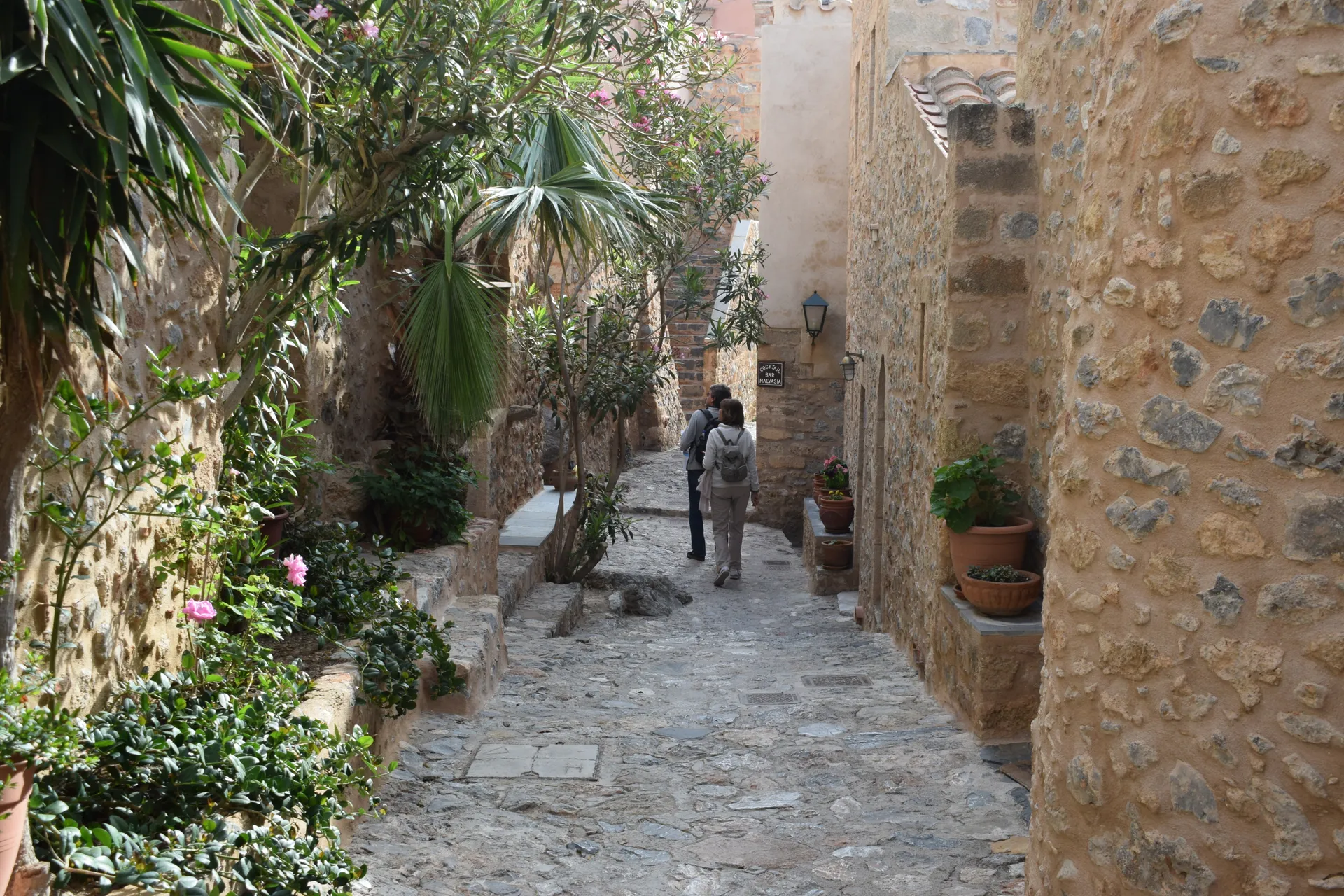
The walled town is entirely car-free and experienced on foot. You enter through a single gate, hence the name Monemvasia, meaning single entrance, and everything beyond is cobbled lanes, arches and steps where no vehicle can go. Cars are left in lots outside the walls, and you either walk the causeway from Gefyra or take the small seasonal shuttle that shuttles visitors back and forth. Bring sensible shoes, because the stones are uneven and the climb to the upper town is steep. For the wider Peloponnese you will want a rental car, which opens up Sparta, Mystras, Gythio and Nafplio at your own pace. KTEL buses connect the area to Sparta and Athens but run infrequently, so plan ahead. The nearest airports are Kalamata and Athens, both a long drive away.
- Inside the Kastro: walk only, on cobbles and steps, no cars.
- Causeway to Gefyra: a short walk or the seasonal shuttle.
- Park outside the walls, since no vehicles enter the old town.
- A rental car is best for Sparta, Gythio, Mystras and Nafplio.
- Airports: Kalamata and Athens, each a long drive.
Sorting transport? Book an airport transfer, or compare car rental on Auto Europe and QEEQ.
Visas for Monemvasia
Monemvasia sits in Greece, an EU and Schengen member, so the standard rules apply. Many visitors from the United States, United Kingdom, Canada, Australia and similar countries enter visa free for up to 90 days within any rolling 180 day period, which comfortably covers a romantic slow-travel stint. If you want longer, Greece offers a digital nomad visa aimed at remote workers employed or contracted outside the country, typically requiring proof of stable monthly income, health insurance and remote employment, with a residence permit path for stays beyond a year. EU and EEA citizens face no such limits and may live and work freely. Kalamata's seasonal flights from Britain make it the nearest external border, and a mixed couple landing there should expect to split up at passport control: the EU partner walks through, while the other has prints and a photograph taken for the Entry/Exit System unless they hold an EU residence card.
- Schengen short stays: commonly 90 days within any 180 day window.
- Greek digital nomad visa: for remote workers with proof of foreign income and insurance.
- EU and EEA citizens: no time limit on living or working.
Best Time to Visit Monemvasia
Late spring and early autumn are the sweet spots. In May, June, September and October the weather is warm and swimmable, the light on the great rock is glorious, and the crowds that clog the single lane in midsummer have thinned to a manageable trickle. Summer, from July into August, is hot, bright and busy, when day trippers and tour groups pour across the causeway and the narrow streets can feel crowded, though the sea is at its warmest. Winter is very quiet, atmospheric in a moody way, and can be genuinely windy off the sea, with some guesthouses, tavernas and services closing or reducing hours. For a working stay you will find the shoulder seasons offer the best balance of pleasant weather, open businesses and enough calm to actually get things done.
- Late spring and early autumn: warm, quieter, ideal for a slow stay.
- Summer: hot and crowded, warmest sea, book well ahead.
- Winter: quiet and windy, with some closures and reduced hours.
Pros and Cons of Monemvasia
Monemvasia trades practicality for atmosphere, and that bargain defines who thrives here. The upside is extraordinary: a car-free Byzantine and Venetian walled town of stone houses and arched lanes, dramatic sea and rock scenery, superb Greek food, genuine safety and a slow, romantic rhythm that feels a world away from the usual nomad hubs. The trade-offs are real too. It is tiny and touristy, nightlife is minimal, there is no coworking and no nomad community to plug into, and everyday services are thin enough that you lean on Gefyra for shops, a pharmacy and a supermarket. Anyone needing reliable infrastructure, social scenes or a busy work culture will feel the limits quickly. Come for the beauty, the history and the quiet, and know exactly what you are choosing before you unpack for a month.
- Pros: unique walled town, stunning scenery, great food, very safe, deeply atmospheric.
- Cons: tiny and touristy, quiet nightlife, no coworking or nomad scene.
- Services are limited inside the walls; Gefyra covers most practical needs.
Who Monemvasia Is For
Monemvasia is for the romantic, culturally curious slow traveler who values a sense of place over convenience. If you dream of waking in a stone room, working a few focused hours over strong coffee, then wandering car-free lanes to a taverna and a glass of local Malvasia wine as the sun drops behind the rock, this is close to perfect. Couples, writers, history lovers and anyone recharging from a bigger, louder city will feel the pull. It is not for the nomad chasing a scene, coworking desks, buzzing nightlife or easy errands, and it is not a place to build a network. Treat it as a spectacular interlude rather than a base, ideally paired with a car for exploring the wider Peloponnese, and it rewards you with something few destinations can match: real, lived-in medieval beauty.
- Ideal for: couples, writers, history buffs and slow, quiet-loving travelers.
- Great as a short atmospheric interlude, best with a car for day trips.
- Not for: nomads wanting a scene, nightlife, coworking or a social network.