Cost of Living in Malé
Where this figure comes from. No cost survey covers Malé, so the $2,200 a month above is our own estimate rather than a measurement. On 416 of our 999 city guides the figure is built from a published Numbeo basket, a one-bedroom rent in the centre plus one person's monthly costs without rent, converted to USD; this city is not one of them. How we source everything.
Malé is expensive, small and imports nearly everything, and $2,200 a month is a realistic single-person figure that still requires care. A furnished studio or one-bedroom in Malé proper or Hulhumalé runs $700 to $1,300, with Hulhumalé Phase 2 the value option and central Malé the cramped premium. Food is the other big line: local hotaa cafes serve mas huni, roshi and short eats for $2 to $5, but a normal restaurant meal is $12 to $25 and groceries are heavily marked up, with a typical monthly food spend of $400 to $700. A Dhiraagu or Ooredoo SIM with data costs $20 to $40, notably pricier than elsewhere in Asia. Coworking is scarce; expect $150 to $250 where it exists. Utilities and water run $60 to $150, with air conditioning dominating. Transport is cheap at $30 to $80 including ferries. The verdict: island-life value is real, but Malé itself is dense urban living at resort-country prices.
Where to Work in Malé
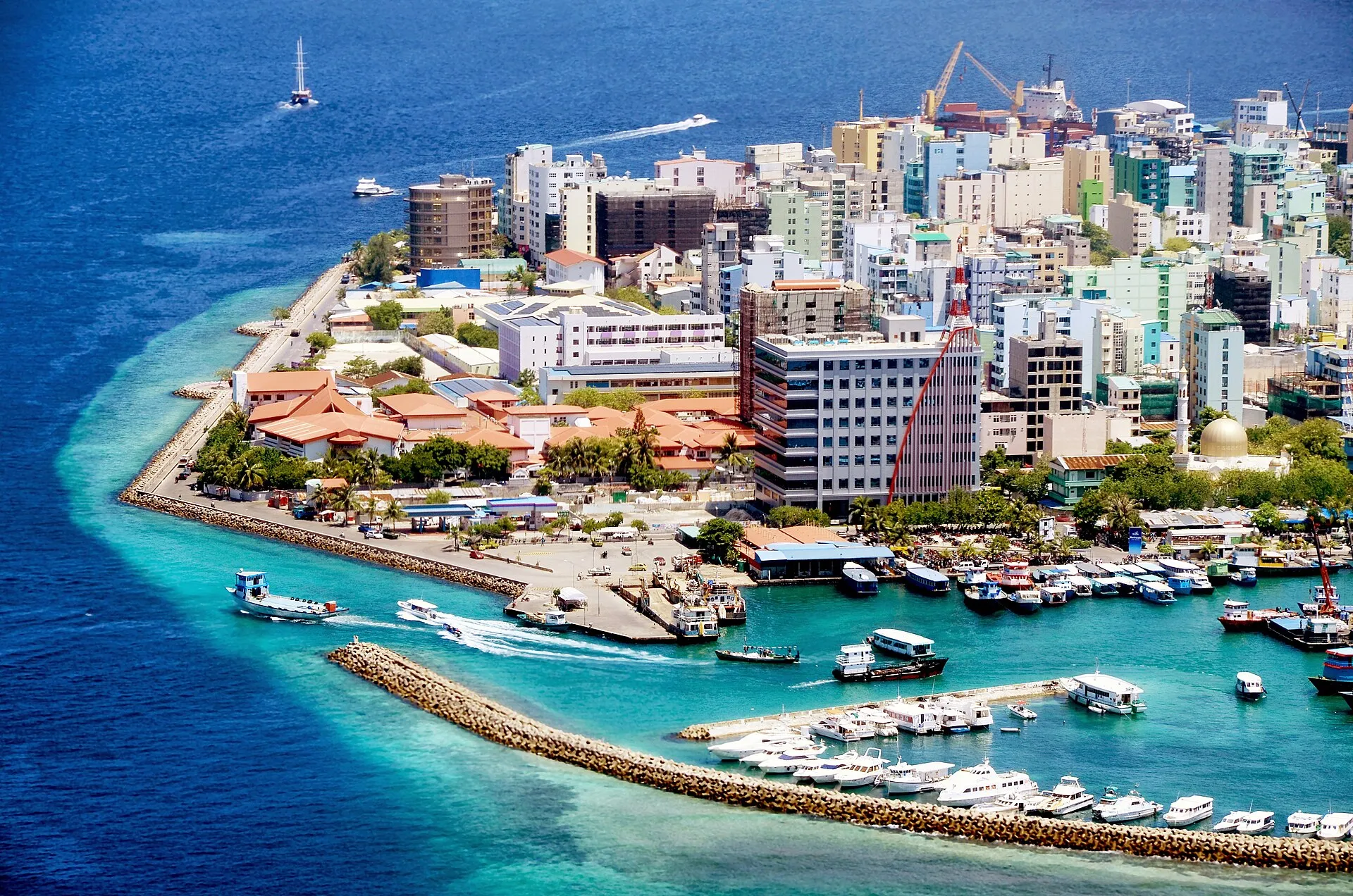
Malé is one of the most densely populated islands on earth and has almost no dedicated coworking stock, so most remote workers base in Hulhumalé, the reclaimed island beside the airport, which has wider streets, newer apartments and a beach. Practical work happens in cafes and apartments: Seagull Cafe' House and the cluster of cafes around Chaandhanee Magu and Boduthakurufaanu Magu in Malé, and the newer cafes along the Hulhumalé beach road, are all usable, and hotel lobbies in Hulhumalé are quietly the most reliable option. Fibre from Dhiraagu and Ooredoo is genuinely good, and the Maldives has strong undersea cable connectivity, though international latency to Europe and the US is noticeable. Caveats matter: VoIP calling over Skype, WhatsApp and Viber has historically been restricted by the operators, so test your calling stack before committing; cafes are small, hot and rarely have sockets; and construction noise in Hulhumalé is constant.
Getting Around Malé
Malé is walkable end to end in about twenty minutes because the island is barely two square kilometres, and that is genuinely the main mode of transport. Beyond walking, the system is ferries and bridges. The Sinamalé Bridge links Malé to Hulhulé, the airport island, and on to Hulhumalé, served by frequent buses at roughly $0.65 to $1.30. MTCC ferries connect Malé to Villingili and other nearby islands for about $0.20 to $0.70, and public speedboat and ferry networks reach the wider atolls at $3 to $30 depending on distance. Taxis within Malé are a flat fare of around $1.60 to $3.20, and across the bridge around $5. Ride-hailing apps such as Ryde and Avas Ride operate locally. The airport is on its own island, so the connection is a bridge taxi or the free-standing airport ferry to Malé at about $0.65. No car is needed; owning one is impractical and parking is a serious problem.
Sorting transport? Book an airport transfer, or compare car rental on Auto Europe and QEEQ.
Visas for Malé
The Maldives grants a free 30-day visa on arrival to every nationality, with no advance application, which is one of the most open policies in the world. Requirements are a passport valid six months, proof of onward travel, a confirmed booking for accommodation registered with the tourism ministry and sufficient funds, and immigration does check the accommodation line. Extensions are possible through Maldives Immigration up to a total of 90 days, applied for before expiry with a local sponsor and a fee. The Maldives does not have a digital nomad visa. A widely publicised long-stay programme was floated years ago and never launched, so plan around the 30-day plus extension reality, not around a nomad permit. Working remotely for a foreign employer on a tourist visa occupies the usual grey zone: it is not explicitly permitted and any local employment absolutely requires a work permit and sponsor. Do not attempt to work for Maldivian entities without one; enforcement on local labour is strict.
Best Time to Visit Malé
The Maldives runs on two monsoons rather than four seasons, and temperatures barely move, sitting between 25C and 31C year round. The dry northeast monsoon, locally the iruvai, runs roughly December to April and is the high season: sunny, low humidity, calm seas and the best visibility for diving and snorkelling. January to March is the peak of that window and also the peak of prices. The wet southwest monsoon, the hulhangu, runs roughly May to November, bringing squalls, higher humidity, choppier seas and shorter but heavier rain; it rarely rains all day and accommodation drops noticeably, so it is the value window for long stays. June and July can be genuinely blowy, which affects ferry schedules between islands. Manta and whale shark season peaks around Hanifaru Bay from May to November. Ramadan, whose dates shift each year, changes daytime opening hours in Malé considerably, and Eid brings a national holiday exodus. The mantas and whale sharks move between the eastern and western sides of the atolls with the monsoon rather than appearing on any fixed date, so the month decides which side of the country the diving is on. A trip planned around them needs the atoll chosen as carefully as the dates. Domestic flights and speedboat transfers between atolls often cost more than the diving does.
Pros and Cons of Malé
The appeal is obvious and real: the Maldives is a genuinely beautiful, safe, low-crime country with excellent internet, a free 30-day entry for every passport, and world-class diving, snorkelling and surfing a ferry ride away. Hulhumalé offers a modern, orderly base with a public beach, and the guesthouse economy on local islands such as Maafushi, Dhigurah, Thulusdhoo and Fulidhoo makes long stays affordable in a way the resort marketing hides. The drawbacks are equally real. Malé itself is a crowded, concrete, hot and largely charmless city with little green space and constant construction. It is a conservative Muslim country: alcohol is banned outside resorts and airport hotels, pork is unavailable, bikinis are restricted to designated beaches and public behaviour is regulated. Costs are high for what you get, imported goods are expensive, medical care for anything serious means evacuation to Colombo or Bangkok, VoIP restrictions frustrate remote work, and 30-day visa limits make long basing awkward.
Who Malé Is For
Divers, surfers, freedivers and anyone whose non-work life is genuinely built around the ocean are the natural audience, plus remote workers on strong Western salaries who want an unusual, safe, sunny base for a month or two. An asynchronous, low-call workload is close to a requirement. So is a tolerance for sitting a long way from everybody else's time zone, and a budget that can meet the cost floor without argument. Couples and solo travellers who want quiet, safety and daily sea time over nightlife will get real value, particularly if they base in Hulhumalé or a guesthouse island rather than central Malé. Skip it if the budget is the priority, since the same money buys far more in Sri Lanka, Bali or Thailand. Skip it too if alcohol, nightlife, a large nomad community, a walkable historic city or a long visa runway matter, or if you need heavy real-time video calling given the VoIP restrictions. Anyone who needs seasons or urban stimulation will go stir crazy fast.