Cost of Living in La Fortuna
Where this figure comes from. No cost survey covers La Fortuna, so the $1,750 a month above is our own estimate rather than a measurement. On 416 of our 999 city guides the figure is built from a published Numbeo basket, a one-bedroom rent in the centre plus one person's monthly costs without rent, converted to USD; this city is not one of them. How we source everything.
Budget roughly $1,750 a month as a solo remote worker in La Fortuna, which is at the higher end for Central America and reflects both Costa Rican prices generally and this town's status as one of the country's busiest destinations. A one-bedroom place in town runs about $600 to $900 on a long lease, with properties out towards El Castillo or on the lake cheaper but requiring a car. Groceries land around $350 to $450. A casado at a soda is $6 to $9, a restaurant dinner aimed at visitors $20 to $35, and entry to the better hot springs $40 to $80, though the free river springs at Chollín cost nothing. Utilities add $70 to $130. Value added tax at thirteen percent sits on almost everything including services, and it is usually included in a quoted price but not always, so it is worth asking which. Imported goods carry duties on top of that, which is why a jar of something familiar costs several times what it would at home and why long-stayers learn to shop locally fast. Electricity is expensive by regional standards despite being generated close by, so a unit running all night shows up clearly on the bill.
Where to Work in La Fortuna
La Fortuna has no coworking space and its economy is built almost entirely around tourism, so the working infrastructure is what your accommodation provides plus a handful of cafes in town that tolerate laptops. Connectivity is better than the setting suggests: fibre has reached the town centre and speeds are workable, though properties further out towards the lake or the volcano can be poor and should be tested before committing. Mobile 4G coverage is good in town and patchy in the surrounding forest. Power cuts happen in the wet season. Because the town runs on tourism, cafes are busy with day-trippers from mid-morning to late afternoon, which makes early starts the practical rhythm. The lake behind the town is a reservoir rather than a natural feature, dammed in the seventies for hydroelectricity, and between that and the wind turbines on its far shore the region generates a good share of the power the country runs on, which is a grid that is almost entirely renewable. Knowing that makes the occasional cut easier to understand, since the fault is usually a line down somewhere in the forest rather than a shortage. The tourism season sets the rhythm of everything else here.
Getting Around La Fortuna
La Fortuna is a small grid of streets around a central park with the volcano filling the sky to the west, and the town itself is walkable in fifteen minutes. Everything else requires transport: the hot springs, the waterfall, the hanging bridges and the national park entrance are all several kilometres out. Taxis are plentiful and cheap for short hops, and many residents keep a scooter or a car. Buses run to San José in about four and a half hours and to La Fortuna from Liberia and Monteverde. The famous jeep-boat-jeep transfer across Lake Arenal to Monteverde takes about three hours and is the standard route. San José's airport is the main international gateway. Private shuttles are how most visitors move between towns and they cost several times what the public bus does over the same ground, which is worth knowing when a hotel offers to book one. The road around the north side of the lake is slow, narrow and unsurfaced in places, so an hour on the map becomes most of a morning in practice. A four wheel drive is unnecessary in town and genuinely useful for anything up the side roads once the rains have set in.
Sorting transport? Book an airport transfer, or compare car rental on Auto Europe and QEEQ.
Visas for La Fortuna
Costa Rica grants most Western passports, including EU, UK, US, Canadian and Australian, up to 180 days visa-free on arrival, which is among the most generous allowances in the world and covers a very long stay with no paperwork at all. Costa Rica's digital nomad visa, introduced in 2022, offers one year with a one-year extension for remote workers earning above a monthly threshold from foreign sources, exempts that income from Costa Rican income tax, and lets holders use a foreign driving licence throughout. Longer-term residency runs through the well-established pensionado, rentista and inversionista categories. The country is politically stable and its immigration system is comparatively predictable, which is worth something in the region. Residency of any kind carries compulsory enrolment in the national health system, with a monthly contribution set against declared income, and it is a condition rather than a benefit to opt into. The generous entry allowance is granted at an officer's discretion rather than by right, and somebody who has been leaving and re-entering for years will eventually get a shorter stamp and a question about what they are doing. A driving licence from home stays valid only as long as the entry stamp does.
Best Time to Visit La Fortuna
La Fortuna sits in one of the wettest parts of Costa Rica, and rain is the defining variable. The driest stretch is roughly February to April, when the volcano is most reliably visible and the trails are firm. May to November is the green season, with rain most afternoons and heavier through September and October; mornings are often clear and this is when prices fall and the forest is at its most spectacular. Temperatures barely change: high twenties and humid all year. High season for visitors is December to April and again in July, when the town is busy and accommodation prices rise substantially. Arenal itself is frequently wrapped in cloud regardless of season, so patience is required.
Pros and Cons of La Fortuna
La Fortuna puts you under a near-perfect volcanic cone with rainforest, hot springs, waterfalls and Lake Arenal within a few kilometres, and Costa Rica's stability, healthcare and 180-day visa-free allowance behind it. Wildlife is abundant and ordinary here. The town is safe and well-serviced by regional standards. It is a tourist town first and a place to live second: prices are set for visitors, restaurants are aimed at them, and and the population turns over more or less constantly. It rains a great deal. There is no remote-work community, no coworking, and internet quality is address-dependent. Anything requiring a city, from specialist healthcare to a professional network, means San José four hours away.
Who La Fortuna Is For
The idea is to live inside a landscape rather than in a town, which asks for Costa Rican money and work that tolerates a moderate connection. Hikers and birders are the core of it, along with anybody who wants rainforest and hot springs to be an ordinary feature of the day instead of an excursion. A few months on Costa Rica's long visa-free allowance is the natural shape of a stay. Couples and outdoor-minded solo workers do best. There is no nomad community, the weather is wet by design since that is what makes the rainforest, the costs are high for the region, and coworking and a beach are both absent. Costa Rica's Pacific coast towns and the Central Valley around Atenas answer those better, and Puerto Viejo offers the Caribbean alternative.
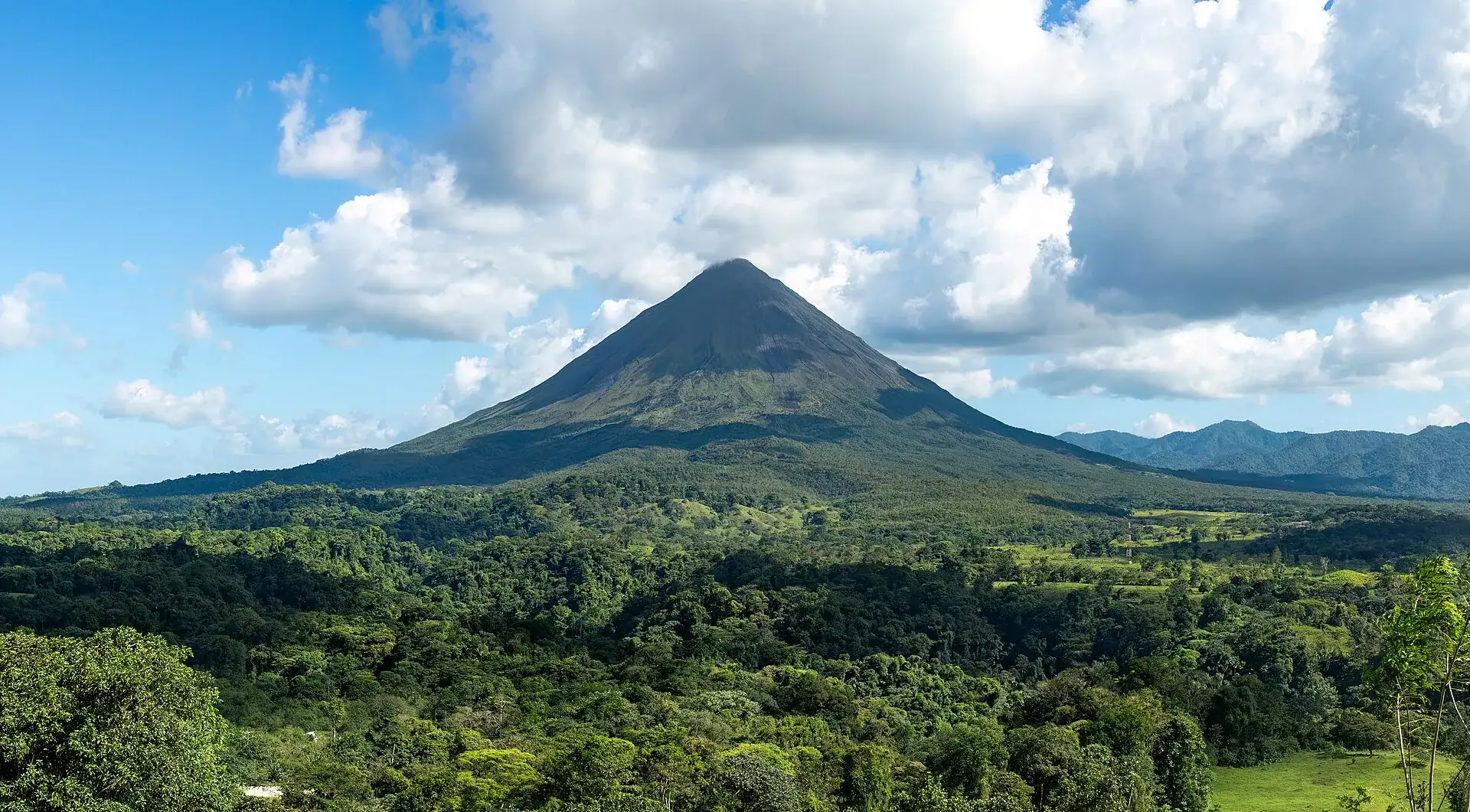 Photo: Rhododendrites / Wikimedia Commons (CC BY-SA 4.0)