Cost of Living in Lubeck
Where this figure comes from. No cost survey covers Lubeck, so the $1,600 a month above is our own estimate rather than a measurement. On 416 of our 999 city guides the figure is built from a published Numbeo basket, a one-bedroom rent in the centre plus one person's monthly costs without rent, converted to USD; this city is not one of them. How we source everything.
Budget around $1,600 a month. A one-bedroom runs roughly $700 to $1,100, cheaper than Hamburg an hour southwest and more expensive than the eastern German cities. Groceries are ordinary German prices. Eating out is reasonable and the marzipan, which Lubeck has made since at least the eighteenth century and which Niederegger sells from a shop on the main street, is the city's most famous product. Utilities run through a cold windy winter. Schleswig-Holstein sits near the German average on costs. Anyone comparing with Hamburg forty five minutes away should note that Lubeck runs roughly a third lower for a comparable flat, which is why the commute is so common. A second home here is taxed by the city on top of everything else, which catches people who keep a room elsewhere and register both addresses. Notice on a tenancy runs three months from the tenant's side and much longer from the landlord's, so the flexibility in a lease is one-directional and worth understanding before signing. Old town flats sit inside a protected building stock, which means the windows and the insulation are often close to original and the heating bill reflects it, whatever the facade does for the street.
Where to Work in Lubeck
Connectivity is good. Fibre coverage is reasonable, mobile service is comprehensive and power is entirely reliable. There is a coworking presence helped by the University of Lubeck, which specialises in medicine and computer science and has a strong research reputation for its size. The time zone is central European. Hamburg is forty five minutes by train, which means the professional market of a major city is within commuting reach while the housing costs stay considerably lower here. The medical faculty was slated for closure in 2010 and saved by a public campaign that filled the streets, which is unusual enough to explain why the city and its university are so closely identified with one another. Medical technology is the local industry that matters, anchored by a long-established maker of ventilators and safety equipment whose name is on buildings across the city, and the university feeds it directly. That is an unusual pairing for a town best known for brick gothic and confectionery. For a freelancer the useful consequence is a cluster of engineering and regulatory work procured locally rather than from the nearest metropolis, which is rare this close to a much bigger city. Working habits are northern and punctual, and nine means nine.
Getting Around Lubeck
Lubeck's old town sits on an island in the Trave and is compact, walkable and largely flat, with buses covering the rest and cycling easy. Travemunde, the seaside district on the Baltic, is twenty minutes by train and has a wide beach and the ferry terminal. Trains reach Hamburg in forty five minutes, Berlin in about three hours and Copenhagen in around four and a half. Ferries run to Sweden, Finland and Latvia from Travemunde, which is one of the largest ferry ports on the Baltic. The island is a UNESCO site and driving onto it is deliberately awkward, with narrow one-way streets and very little parking, so a car is usually left at the edge and the old town covered on foot.
Sorting transport? Book an airport transfer, or compare car rental on Auto Europe and QEEQ.
Visas for Lubeck
Germany is in the European Union and the Schengen area, so European Union and EEA citizens may live and work here without a permit, subject to the Anmeldung within two weeks. Everyone else needs a Schengen visa or a residence permit, with the EU Blue Card the main skilled route and the 2024 Opportunity Card for qualifying job seekers. Anyone commuting to Hamburg should note that the Anmeldung is done where you live rather than where you work, which determines which tax office and which authorities apply. Anyone commuting into Hamburg should also understand that the tax office and the health insurance registration follow the place of residence rather than the workplace. Holders of the skilled worker card reach permanent settlement faster than anybody else, in a little under three years, and faster still with a decent level of the language, which is the strongest argument for taking that route rather than a self-employed one. Appointments at the foreigners office are the bottleneck in every city and are released in batches, so the calendar gets checked daily rather than once. A permit is tied to the district that issued it, and moving to another one means telling both. The Baltic ferries from Travemunde all stay inside Schengen: the Entry/Exit System records no exit, and nights aboard still count.
Best Time to Visit Lubeck
June to August is the season, with July around twenty two degrees and Travemunde's beach usable, though the Baltic is cold and the wind constant. May and September are quieter and often better for walking the old town without crowds. Winter from November to March is cold, grey and windy. The Christmas markets in December are among the better ones in northern Germany and fill the old town, and the Travemunder Woche sailing regatta in July is a genuine local institution. Anyone here in summer should walk the Gange and Hofe, the narrow courtyards and passages behind the main streets, which are the least visited part of the old town. Storm surges off the sea push water up the river and into the lower streets of the island most autumns, and the flood marks on the older buildings record how far it has reached before. The city keeps pumps and sandbags ready and treats it as weather rather than as disaster. Midsummer light at this latitude runs until nearly eleven at night, which is the compensation for an afternoon in the cold half of the year that is finished by four. The water off the beach rarely passes twenty degrees even at its warmest.
Pros and Cons of Lubeck
The old town is an island of brick gothic that was the capital of the Hanseatic League for centuries and that UNESCO listed in 1987, with the Holstentor, seven church spires, and the merchant houses and courtyards behind them still largely intact. Thomas Mann's family were merchants here and Buddenbrooks is set in it. Add a Baltic beach twenty minutes away and Hamburg forty five minutes by train. The northern German weather and a very quiet winter come with the package, and neither is a surprise. Lubeck also gave its name to the Lubeck law, the legal code adopted by more than a hundred Baltic towns, which is why so many of them look and were governed alike.
Who Lubeck Is For
Anyone drawn to Hanseatic history or to German literature, since Thomas Mann and Gunter Grass both have museums here and both won the Nobel Prize. Working in Hamburg without paying Hamburg rents is common enough here to be unremarkable, and the train is frequent enough to make it work rather than merely possible. It suits sailors given Travemunde. Sunshine and warmth are in short supply on this coast for most of the year, and the administration operates in German with no concessions for a newcomer who has not learned any. Marzipan sounds like a trivial thing to build a reputation on, until you stand inside the Niederegger shop with its museum upstairs and understand quite how seriously Lubeck takes the subject.
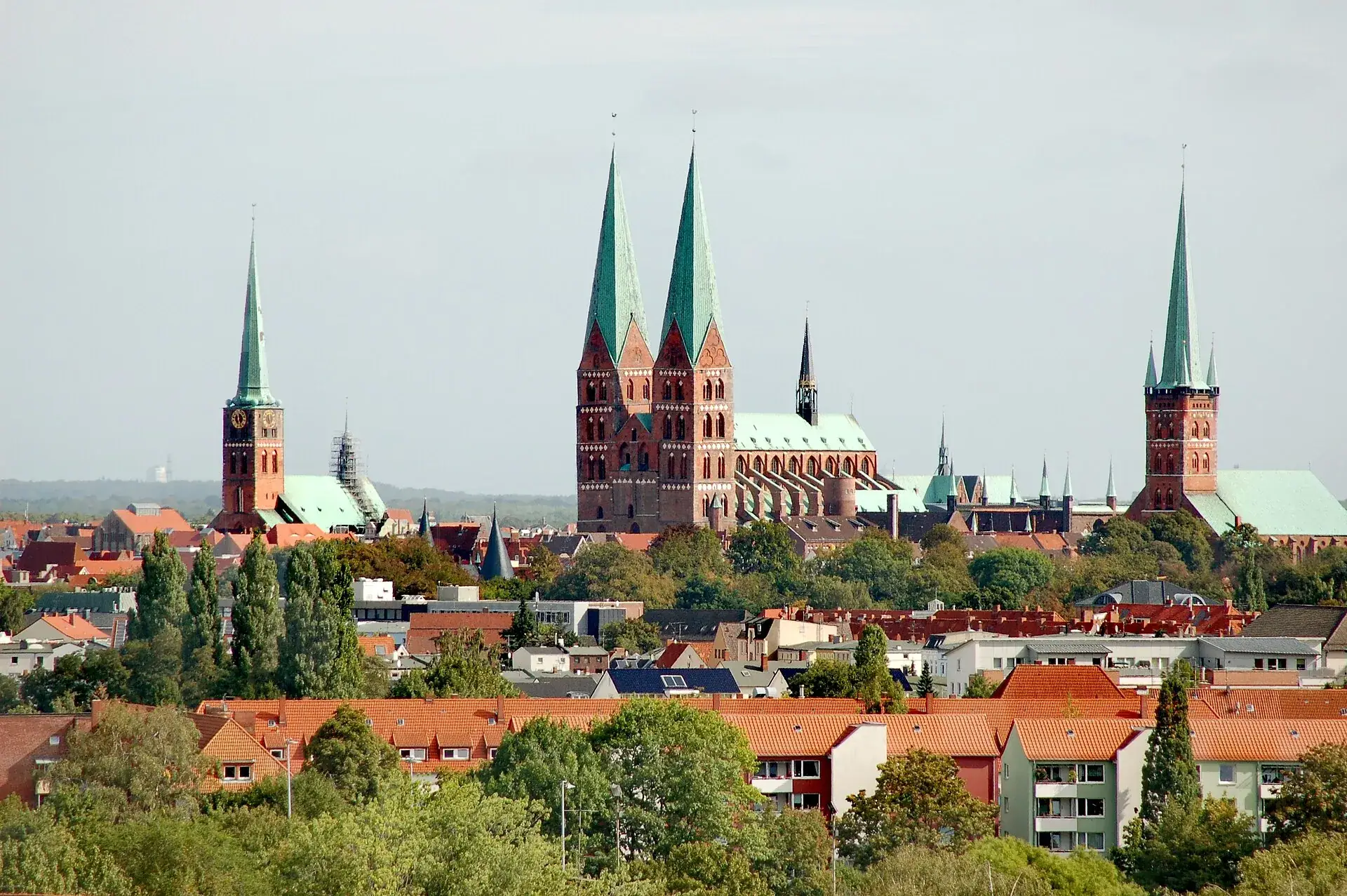 Photo: Oleg Dejan / Wikimedia Commons (CC BY 3.0)