Cost of Living in Karlovy Vary
Real market data
Source: Numbeo · July 2026
$1,390/moSolo nomad1-bed centre + living costs
$1,910/moCoupleshared 1-bed + costs
$1,150/moLean / localcheaper area + costs
- 1-bed rent, city centre$730Kč15,367
- 1-bed rent, outside centre$500Kč10,420
- Monthly costs excl. rent (1 person)$660Kč13,783
- Meal, inexpensive restaurant$10Kč200
- Monthly transit pass$26Kč550
- Buy price, per m² (centre)$7,140Kč150,000
Prices are from Numbeo (July 2026), converted to USD at $1 = Kč21.02 (01 Aug 2026). The monthly living-costs figure is our transparent one-person basket, groceries, a few meals out, utilities, phone, internet, transport and essentials, priced from those figures. Solo adds central rent; couple and lean are estimates from the same numbers.
Budget roughly $1,390 a month as a solo remote worker in Karlovy Vary. A one-bedroom apartment in the valley near the colonnades runs about $480 to $680, and the residential districts up the hill or out towards Rybáře drop that to $360 to $480. The spa quarter is priced for visitors and a few streets of distance saves a great deal. Groceries land around $230 to $290. A pub lunch with a beer is $8 to $11, a restaurant dinner $20 to $28, and the spa wafers everyone eats on the promenade about $1. A monthly transit pass is roughly $18. Utilities add $95 to $180, higher in a valley winter. The town charges a spa fee per night on short stays, small in itself but appearing on every hotel bill and catching out people used to paying it nowhere else. Becherovka, the herbal liqueur made here since 1807, is sold on every corner and is known locally as the thirteenth spring, the other twelve being the hot ones. Private health insurance is compulsory for a long-stay permit and the policy has to meet a specified minimum, which is a real annual cost rather than a formality.
Where to Work in Karlovy Vary
Karlovy Vary is a spa town of about 48,000 and has no meaningful coworking scene; remote workers here work from their accommodation. The cafes along the Teplá river and in the colonnades are comfortable places to sit for hours, which is more or less what the town has been designed for since the fourteenth century. Czech internet is fast and cheap and reaches the valley properly, so a flat with fibre is entirely workable. The practical caveat is that the town's economy runs on visitors and on a Russian-speaking clientele that has thinned considerably since 2022, so some of the infrastructure feels oversized for the people currently in it. German is more useful here than in most of the country, since the border is close and a good share of the spa clientele arrives from Bavaria and Saxony. The public library and the cafes under the colonnades are where people without an office end up, and neither minds a long sitting over one coffee. Festival fortnight is the exception to all of it, when capacity is committed months ahead and nothing anywhere is quiet.
Getting Around Karlovy Vary
Karlovy Vary is strung along a narrow river valley, which makes it long, thin and walkable end to end along the promenade in about half an hour. The spa quarter is largely pedestrian. Buses cover the residential districts up the slopes, with a monthly pass around $18, and two funiculars climb to the Diana tower and the Imperial. Prague is about two hours by bus on a frequent service, and that is the usual link. The railway is slower. Karlovy Vary has a small international airport with a handful of routes, historically to Russia and now much reduced; Prague is the practical gateway. The German border is 40 minutes west. The inner spa zone is closed to ordinary traffic, so anyone arriving with a car parks outside and walks in, which is worth knowing before taking a flat on the promenade. The bus and railway stations sit on opposite banks from one another, and the bus is almost always the faster option for anywhere in Bohemia. Cheb and the German border are forty minutes west by road.
Sorting transport? Book an airport transfer, or compare car rental on Auto Europe and QEEQ.
Visas for Karlovy Vary
The Czech Republic is in the European Union and Schengen. EU and EEA citizens may live and work here freely; most other Western passports get 90 days in any 180. The Czech digital nomad visa, running since 2023, covers highly skilled non-EU remote workers from a listed set of countries and grants up to a year. The alternative is the živnostenský list, the trade licence, which is the established freelance route and involves a genuine amount of paperwork. Both are applied for at a Czech consulate abroad rather than converted in-country. Karlovy Vary falls under the regional office and the process is conducted in Czech. The trade licence route asks for proof of accommodation, a clean criminal record from your own country and evidence of funds held in a Czech account, and the file is judged at the consulate that receives it rather than centrally, so experiences differ sharply from one country to another. Appointment slots at some consulates are booked months ahead, which is the part of the timetable that catches people out. Nobody already inside the country on a short stay can switch to either route without leaving first. Spa hotels still report foreign guests to the Foreign Police, but your Schengen days are now tallied by the EES from the external-border record, not from that register.
Best Time to Visit Karlovy Vary
May, June and September are the best months, warm and green with the valley at its most attractive and the film festival either just ahead or just past. The Karlovy Vary International Film Festival in early July is the town's biggest week by a distance and fills every room in the region, so it is either the reason to be here or the fortnight to avoid. Summer is mild, into the low twenties, which the valley setting keeps comfortable. Autumn is beautiful and quiet as the wooded slopes turn. Winter is cold, damp and often foggy in the valley, with short days, though the hot springs and the spa architecture look their best under snow. The drinking cure is why the colonnades exist: the spouted porcelain cups sold everywhere are for sipping mineral water while walking between springs, and the water is warm, salty and an acquired taste rather than a refreshment. Advent brings a small market under the colonnade and the place looks its best under snow, though the valley traps the damp. Late January and February are the quietest and cheapest weeks of the year.
Pros and Cons of Karlovy Vary
Karlovy Vary is one of the most striking small towns in central Europe: a narrow wooded valley filled with pastel spa architecture, twelve hot springs, colonnades and a film festival with real standing. It is cheap for what it is, safe, walkable, and surrounded by forest with marked trails starting in the town. Czech internet is fast. It is small and seasonal, its economy has been visibly unsettled by the loss of Russian visitors, and the permanent population is ageing year by year. There is no nomad or expatriate community and no coworking. Winters in a deep valley are grey and damp. Prague is two hours away and there is no useful airport. The town was inscribed by UNESCO in 2021 as one of the Great Spa Towns of Europe, a joint listing across seven countries that recognises the spa culture rather than any single building. The Grandhotel Pupp at the head of the valley is the one most visitors recognise, having stood in for a Montenegrin casino in a Bond film, and the Moser glassworks on the edge of town still blows and cuts by hand.
Who Karlovy Vary Is For
Somewhere genuinely handsome and quiet to work from for a season, with forest to walk or run in, and no company provided. Writers get the quiet they came for, and anybody wanting a European Union base at a modest price gets striking surroundings thrown in. Summer or autumn is the stay to plan; a full year here is a different proposition entirely. A professional network, nightlife, an airport, English as a working language and a nomad crowd are five things this spa town has never had and shows no sign of acquiring. Prague is two hours away with all of it, and Plzeň is the nearer city with more of an economy. Rooms are easier to take for a season than for a month, because the letting market here is built around spa stays of three or six weeks and landlords are used to fixed terms. The treatment programmes themselves are a genuine reason some people come for a month and arrange their work around them, which is a better use of the place than most. Anyone who needs to be on a train before nine in the morning should read the timetable before committing.
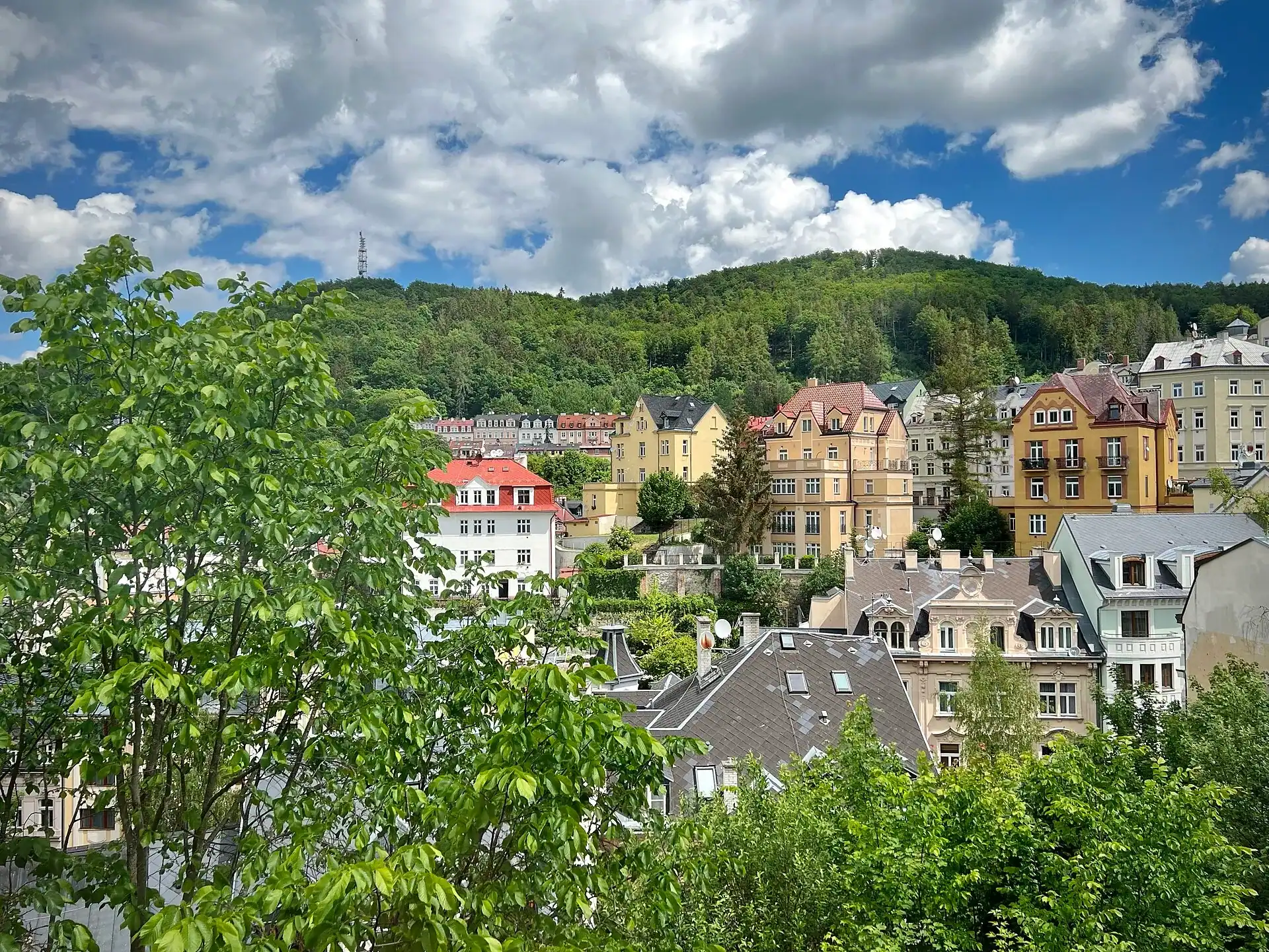 Photo: Sharon Hahn Darlin / Wikimedia Commons (CC BY 2.0)