Cost of Living in Colmar
Where this figure comes from. No cost survey covers Colmar, so the $1,400 a month above is our own estimate rather than a measurement. On 416 of our 999 city guides the figure is built from a published Numbeo basket, a one-bedroom rent in the centre plus one person's monthly costs without rent, converted to USD; this city is not one of them. How we source everything.
Colmar is priced like the prosperous Western European town it is, more affordable than Paris but not cheap, with its fame and tourism keeping costs up. A comfortable single-person budget runs roughly $1,300 to $1,900 a month. A furnished one-bedroom in or near the centre costs about $750 to $1,150, with better value in the surrounding Alsatian countryside. Alsace's excellent food and wine are a highlight but add up if you indulge. These are our editorial estimates in US dollars, with rent the main driver; shopping at markets and cooking at home keeps everyday costs reasonable. The French rental dossier is the real obstacle rather than the rent itself. Agencies expect documented earnings at roughly triple the monthly rent plus a French guarantor, and a foreign remote income often does not fit the boxes on the form; a private landlord, a longer prepayment or one of the paid guarantor services is the usual way through. Note too that December distorts everything. The Christmas markets fill the town and every short-term let in it, so anyone arriving that month pays a holiday rate unless the lease was signed in autumn.
- Furnished 1-bed in or near the centre: roughly $750 to $1,150 a month
- Tarte flambee or a plat du jour: roughly $12 to $18
- Glass of Alsatian Riesling or Gewurztraminer: a few dollars
- Train to Strasbourg (about 30 minutes): a few dollars
Where to Work in Colmar
Colmar is a small, prosperous city with the reliable infrastructure you would expect in France. Home fibre is fast and widely available, easily handling calls and everyday work, and there are a handful of coworking spaces plus plenty of cafes to plug into. An Orange, SFR, Bouygues or Free SIM adds good mobile data. Colmar shares France's Central European time zone, giving comfortable European overlap. Its position is a bonus: Strasbourg, Basel and the German border are all close, widening your options for coworking, community and travel. For a small city, it is a comfortable, well-connected base. Local working habits will shape your week more than the connection does. Many small businesses still close between noon and two and all day Sunday, and much of the country takes August off, which means an errand you assumed would take an afternoon can take a fortnight in the wrong month. You will also get very little done administratively until a local bank account and its RIB exist, so open one first rather than fifth. On the upside, the tri-border position means a serious share of the local workforce commutes to Switzerland or across the Rhine, which keeps the infrastructure better than the population would justify.
Getting Around Colmar
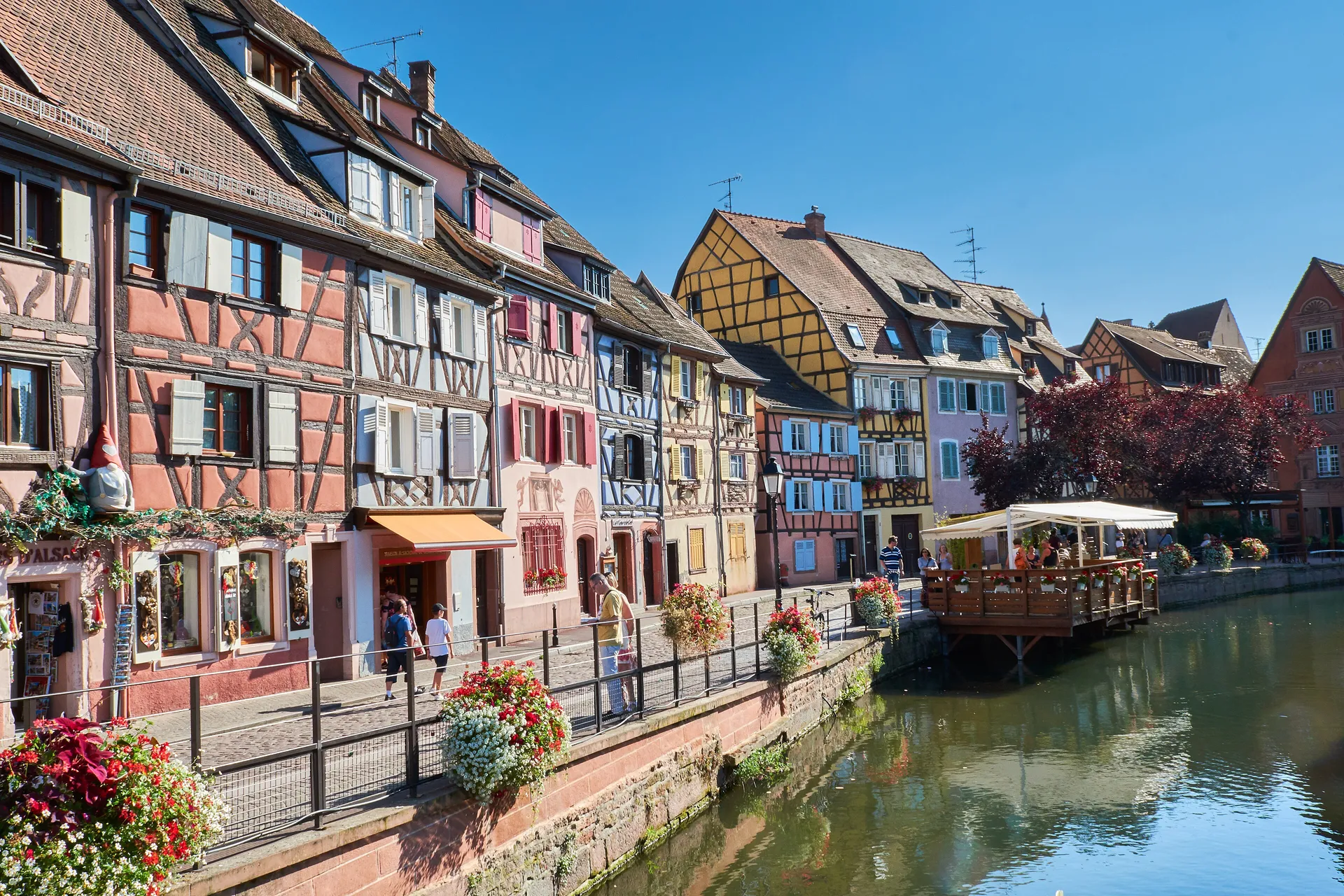
Colmar is flat, compact and a pleasure to get around on foot or by bike, a welcome contrast to hillier historic towns. The picturesque old town, including the Little Venice quarter, is easily walked, and the city is well set up for cycling. Regional trains link Colmar to Strasbourg in about half an hour and to Basel and beyond, and it sits on the Alsace Wine Route, with buses and easy drives to storybook wine villages like Riquewihr and Eguisheim. The airports of Basel-Mulhouse and Strasbourg are close, putting much of Europe within easy reach. Be warned that the wine villages are far better served by bicycle than by bus. The rural lines run a few times a day and not at all on Sunday, so a day out by public transport means committing to one village; a bike, or a hire car for a weekend, opens the whole route. The cycle paths through the vines are flat, signposted and genuinely lovely. For longer journeys, changing at the regional capital puts Paris within a fast-train morning, which makes a day return there perfectly realistic.
Sorting transport? Book an airport transfer, or compare car rental on Auto Europe and QEEQ.
Visas for Colmar
Colmar is in France and the Schengen Area, so most non-EU visitors can stay visa-free for up to 90 days in any 180-day period, while EU and EEA citizens face no limits. For a longer stay, France does not have a single dedicated nomad visa but offers long-stay visas and the Talent Passport for qualifying remote workers, entrepreneurs and skilled professionals, which can lead to residence. Requirements are detailed and processed through consulates, so mind the 90-day Schengen limit if entering visa-free. The step that catches people who do get a long-stay visa is validation. It has to be done through the official portal soon after you land, and skipping it quietly invalidates the whole thing. Renewals are then handled by the prefecture, which in this region means appointments booked well ahead. On tax, the threshold is not only a count of days; the authorities also look at where your main home and economic interests sit, so someone spending most of a year here on a remote salary can become tax resident sooner than a day counter expects. For arrivals from outside the zone the external border is usually EuroAirport, the binational Basel-Mulhouse terminal on French soil, where flights from Britain or Morocco go through Entry/Exit System enrolment and its biometric capture.
Best Time to Visit Colmar
Colmar has a semi-continental climate, one of the driest and sunniest in France thanks to its sheltered position, with warm summers and cold winters. The best times to visit are late spring through early autumn, roughly May to September, when the weather is warm and pleasant, the flowers are out and the wine country is at its finest. Summer is warm and lively, while winter is cold but magical, as Colmar hosts some of Europe's most famous Christmas markets in December, drawing huge crowds. Spring and autumn offer the best balance of good weather and thinner crowds. The market season at the end of the year is the one that needs planning either way. For six weeks the town takes on a crowd that a place this size cannot absorb, and if you are here to work rather than to shop, the weekends in particular are best spent out in the villages. Anyone who wants the stalls should come midweek and early. The other date worth knowing is the grape harvest in early autumn, when the villages hold their own festivals and the vineyards are being worked, which is the region at its best with no crowds to speak of.
Pros and Cons of Colmar
Colmar offers fairytale charm and Alsatian good living, tempered by tourism and cost. Tourism is the word that needs unpacking, because the effect here is unusually concentrated. The old town is perhaps five streets, and those five streets are among the most photographed in the country, which means that between April and October and again in December they belong to coach parties from roughly ten in the morning until six at night. Live two streets outside that box and none of it touches you; live inside it and it will define your daily life. That is a solvable problem, and the solution is simply where you sign. What is not solvable is the cost. This is prosperous Western Europe, salaries and prices both, and a remote income that goes a long way in southern or eastern Europe will feel ordinary here. You are buying comfort, safety, food, wine and a position within two hours of three countries, and those things are worth what they cost, but nobody comes here to save money.
- Pros: a genuinely storybook old town of half-timbered houses and canals, superb Alsatian food and world-class wine, fast internet, a flat and walkable layout, excellent safety and cleanliness, and a central location close to Germany and Switzerland.
- Cons: higher costs than much of Europe, heavy tourism, especially during the Christmas markets, a small resident nomad community, cold winters, and a quieter nightlife suited more to wine bars than late nights.
Who Colmar Is For
Colmar suits the nomad who wants a beautiful, comfortable and walkable European base with outstanding food and wine and easy access to Germany, Switzerland and the rest of France. Anyone who values charm, safety, reliable infrastructure and a slower, refined pace, and who enjoys cycling through wine country, will feel at home. It works well for a medium stay and for those able to arrange a French long-stay route. It is a weaker fit for those seeking low costs, a large nomad community, lively nightlife or guaranteed warmth. Base yourself near the old town, get a bike, and savour Alsace at leisure. The profile that fits best is someone mid-career with a good income, a partner or a family, and no interest in a nomad scene. For that person this is close to an ideal European base: nothing breaks, the schools are good, the healthcare is excellent, and three airports and a fast train are within an hour. For a younger solo traveller counting costs and looking for people, almost every box goes the other way, and Strasbourg an hour up the line is the better call. Choose accordingly rather than on the photographs, which flatter everybody equally.