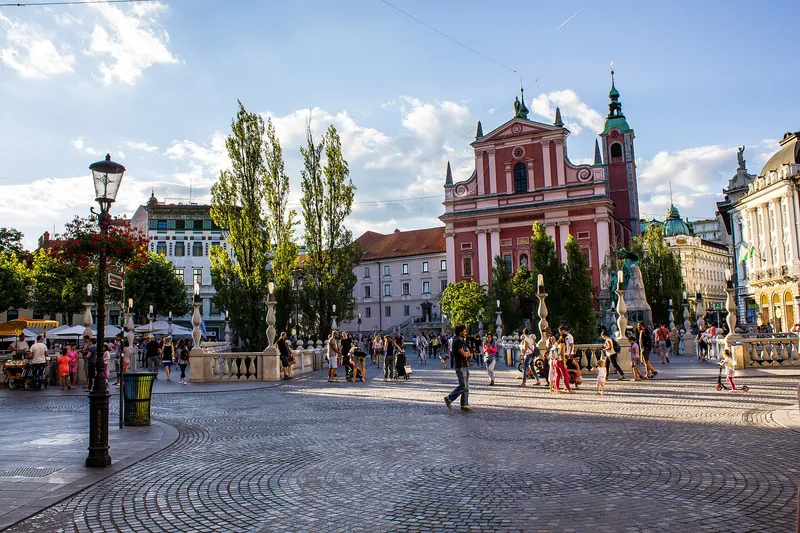
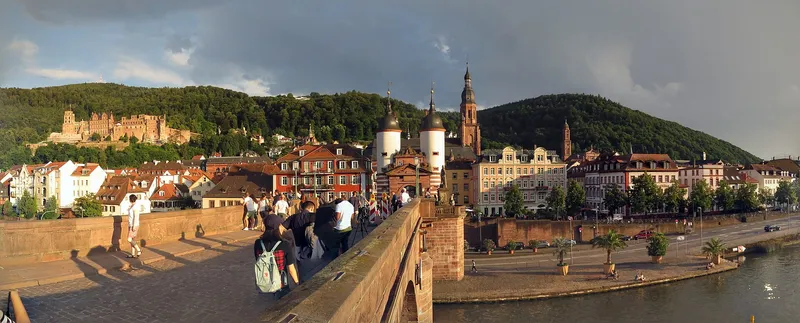
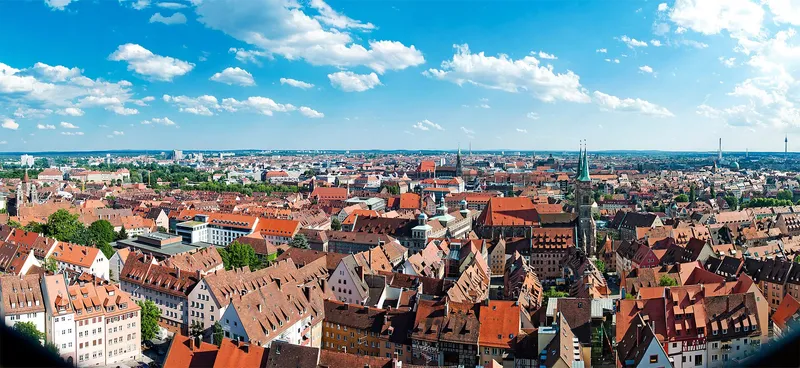
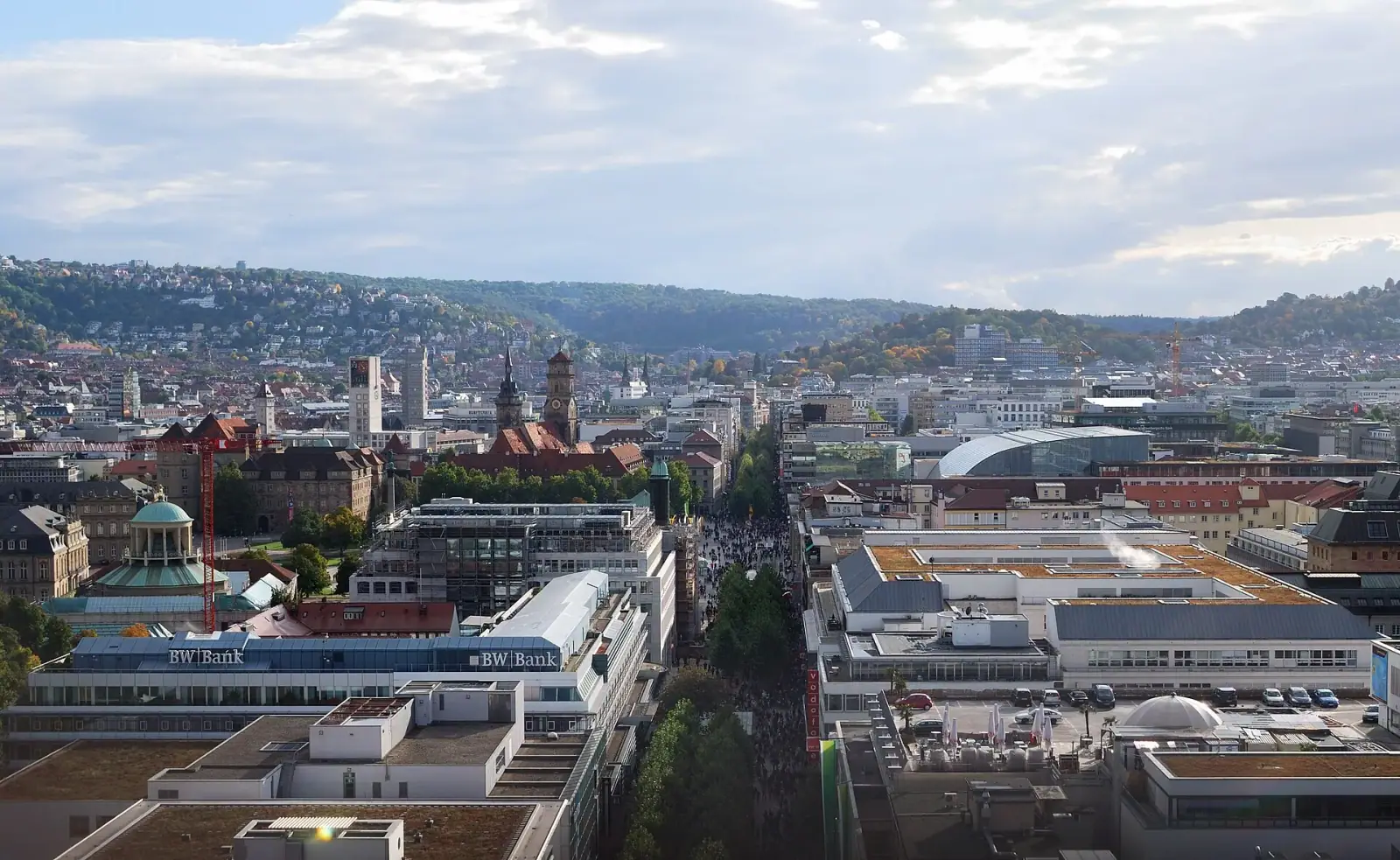
Stuttgart city centre viewed from the Hauptbahnhof tower, showing Königstrasse, Stiftskirche and surrounding hills
Photo: filippo carini / Wikimedia Commons (CC BY 3.0)
Germany flag

Stuttgart

Germany

Porsche, Mercedes, and vineyard-covered hills, engineering precision meets Swabian soul.

€3.200
Monthly Budget
--
Current Weather
Humid Continental
Climate Type
90 Mbps
Avg. WiFi Speed
8/10
Safety Score
500+
Active Nomads
--
Time Difference
Scroll
0
Nomad Score

Why Stuttgart Works for Remote Work

Porsche, Mercedes, and vineyard-covered hills, engineering precision meets Swabian soul. A humid continental climate and strong fast WiFi make Stuttgart an easy base, and at about $3,200 a month it fits a range of budgets. Keep the size of the nomad scene in mind.

Compare Stuttgart vs Heidelberg →

Category Breakdown

How Stuttgart scores across all 13 factors

Weather in Stuttgart

Monthly averages from 2019-2023 (Open-Meteo), and the best time to visit

Jan
10°
Feb
12°
Mar
15°
Apr
18°
May
25°
15°
Jun
25°
15°
Jul
25°
16°
Aug
22°
12°
Sep
17°
Oct
10°
Nov
Dec
Daily high & low (°C)Rainfall (mm/month)Best months to visit

The best time to visit Stuttgart for comfortable weather is Jun, Jul, Aug. The warmest month is Jun (around 25°C by day), and the wettest is Aug (about 100mm of rain).

Chasing good weather? See other cities that are warm in Jun, or plan a multi-city route around the seasons. Staying a while in Stuttgart? Check visa options, your time-zone overlap and how far your budget stretches, or find it on the world map.

Historical monthly averages, not a forecast. Source: Open-Meteo.

Best Neighborhoods in Stuttgart

Where to base yourself for the perfect nomad experience

Mitte (City Center)

$$
Commercial cultural

Shopping and culture in the valley

Stuttgart's center fills the valley with department stores, the famous Königstraße shopping mile, and cultural institutions. Museums and theaters cluster around squares while restaurants serve Swabian specialties.

Best for: Shoppers and culture seekers
✓ Pros
  • Shopping options
  • Cultural venues
  • Good transit
  • Central location
✗ Cons
  • Busy crowds
  • Construction work
  • Generic retail

Stuttgart-West

$$
Urban trendy

Hillside living with urban energy

This popular residential area climbs the western hills with trendy restaurants, boutiques, and café culture. Young professionals and creatives enjoy the urban village atmosphere.

Best for: Foodies and creative types
✓ Pros
  • Great restaurants
  • Café scene
  • Local character
  • Hillside views
✗ Cons
  • Hilly terrain
  • Parking difficult
  • Crowded evenings

Bad Cannstatt

$
Traditional spa

Spa heritage and mineral springs

Stuttgart's oldest settlement offers mineral spas, the MineralBad Berg, and a more traditional atmosphere. The annual Cannstatter Volksfest rivals Oktoberfest while local wineries dot surrounding hills.

Best for: Wellness seekers and traditionalists
✓ Pros
  • Mineral spas
  • Festival atmosphere
  • Historic character
  • Local wineries
✗ Cons
  • Far from center
  • Less trendy
  • Needs transport

Heusteigviertel

$
Alternative diverse

Alternative arts and multicultural life

This diverse neighborhood east of center offers international restaurants, alternative venues, and artistic energy. Student housing and affordable rents attract creative populations.

Best for: Creatives and budget travelers
✓ Pros
  • Diverse dining
  • Alternative scene
  • Affordable
  • Cultural mix
✗ Cons
  • Some rough areas
  • Less polished
  • Basic amenities

Zuffenhausen

$
Automotive industrial

Porsche museum and automotive history

Home to the Porsche headquarters and museum, this industrial suburb attracts automotive enthusiasts worldwide. Beyond the cars, residential areas offer Stuttgart living at more affordable prices.

Best for: Car enthusiasts and budget seekers
✓ Pros
  • Porsche Museum
  • More affordable
  • Good transit
  • Local character
✗ Cons
  • Industrial feel
  • Far from center
  • Less attractions

Cost of Living in Stuttgart

Stuttgart is one of Germany's more expensive cities, driven by its strong automotive and engineering economy. Expect to spend meaningfully more here than in Berlin or Leipzig, though less than Munich.

  • Rent (central Mitte/West): EUR 1,000-1,400/month for a furnished one-bedroom (approx. USD 1,100-1,550)
  • Rent (outer areas like Zuffenhausen or Vaihingen): EUR 750-950/month for a one-bedroom (approx. USD 820-1,050)
  • Groceries: EUR 250-350/month buying from Lidl, Aldi, or Rewe
  • Eating out: EUR 10-16 for a weekday lunch, EUR 20-35 for a proper dinner with drinks
  • Coworking hot-desk: EUR 150-250/month; day passes start at EUR 20-30
  • Local transport (VVS monthly pass): EUR 80-100/month for the metro and S-Bahn network

Total realistic monthly range: EUR 2,000-2,800 (approx. USD 2,200-3,100) for a solo nomad with accommodation, food, transport, and coworking. You can trim costs by living further from the centre and cooking most meals.

Where to Work

Stuttgart has a growing but focused coworking scene. The options are solid rather than sprawling, and most spaces are oriented toward tech freelancers and startup teams rather than short-stay tourists.

Coworking Spaces

Frameworx is the most community-oriented option, with a startup-hub feel in the city centre. It runs regular events and attracts local founders and remote workers. Design Offices Eberhardhöfe at Eberhardstrasse 65 offers a polished corporate-grade setup in a listed 19th-century building near the Rathaus, ideal if you need meeting rooms and reliability. Ruby Fred Workspaces, near the Hauptbahnhof, is newer and more design-forward, with day passes available and barista coffee included in membership.

Cafe Work Culture

Stuttgart's cafe culture is more relaxed about laptops than Munich but less permissive than Berlin. Most specialty coffee shops will let you work through a second coffee, but do not expect to hold a table for hours on a single order. Mokusaka Caffe in Stuttgart-West is the standout for specialty coffee and a genuinely work-tolerant atmosphere. Cafe Kaiserbau near Marienplatz has long opening hours and decent WiFi.

WiFi Situation

Fixed-line internet in Germany is reliable and fast. Coworking spaces typically offer 100+ Mbps. Cafe WiFi is workable for most tasks at 35-50 Mbps, though video calls during peak hours can be unreliable in smaller spots. Carry a local SIM as backup; Deutsche Telekom and Vodafone both offer strong LTE coverage across the city.

Getting Around

Stuttgart has a well-integrated public transport network run by the VVS (Verkehrsverbund Stuttgart). The Stadtbahn (U-Bahn lines marked U1-U19) covers most of the inner city, while S-Bahn lines extend into the suburbs and surrounding towns. Services run from around 4am to 1am on weekdays, with night buses on weekends.

The city centre is walkable between main points, but Stuttgart is famously hilly: the terrain means some routes that look short on a map involve steep climbs. You will use public transport more than in a flat city.

Airport: Stuttgart Airport (STR) is about 14 km south of the city centre. S-Bahn lines S2 and S3 run directly to the airport every 15 minutes; the journey from the Hauptbahnhof takes 25-30 minutes and costs around EUR 4 with a standard VVS ticket. Taxis or rideshares run EUR 30-45.

Cycling is possible but the hills make it demanding outside the valley floor. E-bikes and scooter-share services (TIER, Lime) are available and useful for shorter hops.

Visas and Staying Long-Term

Germany is part of the Schengen Area. Citizens of the US, Canada, UK, Australia, and most other Western countries can enter visa-free and stay for up to 90 days within any 180-day window across the entire Schengen zone.

Germany does not have a dedicated digital nomad visa. If you want to stay longer and work remotely for foreign clients, the most practical route is the freelancer visa (Freiberuflervisum) or the self-employment visa (Selbststandigenvisum). Both require proof of clients, a business plan, and sufficient financial means. Processing takes several months and must typically be initiated from your home country. Once issued, these residence permits can last up to three years with extension possible.

There is no legal shortcut to extend beyond 90 days on a tourist entry. Always verify your specific passport situation and current requirements with the German embassy in your country before travelling.

Best Time to Visit

The most comfortable window for remote work in Stuttgart is May through September. Temperatures sit between 18 and 26 degrees Celsius (65-79F), the city's outdoor spaces and vineyard terraces are in full use, and daylight hours are long. June and September are particularly good: the peak summer crowds in July and August are modest by big-city standards, but if you prefer fewer tourists, those shoulder months are quieter.

Spring (March to April) is variable: warm spells alternate with cold, rainy stretches. Autumn from October onward turns damp and grey quickly. Winters are cold with regular light snowfall and limited daylight, which many remote workers find demotivating unless you are genuinely comfortable in a northern European winter. The city does run a well-regarded Christmas market in November and December if that appeals.

Pros and Cons

  • Excellent public transport covering the city and wider region
  • High safety: crime rates are below the German average
  • Strong infrastructure: fast internet, reliable services, clean streets
  • Proximity to nature: vineyards inside the city, Black Forest day trips, Swabian Alb nearby
  • Good food scene: traditional Swabian cooking plus strong international options
  • Central Europe location: well-connected by rail and air to the rest of the continent
  • Expensive: one of the pricier German cities for rent
  • Limited English in daily life: more German-language day-to-day than Berlin or Hamburg
  • Smaller nomad scene: fewer co-working meetups and nomad events than major hubs
  • Hilly terrain: physically demanding to walk across and limits cycling appeal
  • Air quality has historically been a concern: the valley geography traps emissions, though conditions have improved in recent years
  • Quieter nightlife compared to Berlin or Cologne

Who Stuttgart Is Best For

Stuttgart suits nomads who prioritise stability, safety, and quality of life over cost or a buzzing co-working community. If you work in automotive tech, manufacturing software, or engineering adjacent fields and want to network with local companies, Stuttgart is genuinely interesting: Mercedes-Benz, Porsche, and Bosch all have major operations here. It also works well for people who want a mid-sized German city with good rail connections across Europe, and who plan to spend weekends hiking in the Black Forest or cycling the Neckar valley.

Skip Stuttgart if you are on a tight budget, need a large English-speaking nomad network to stay motivated, or want a city with a vibrant street-level energy every evening. Nomads who thrived in Munich but want slightly lower rents and fewer tourists will likely appreciate it. Those coming from Southeast Asia or Latin America expecting sub-EUR 1,500 budgets to work comfortably will find it difficult.
Where to Stay in Stuttgart

Top neighborhoods and accommodations for digital nomads

CLOUD No7 APARTMENTS

Serviced apartments
Europaviertel

Upscale serviced apartments steps from the main train station with full kitchens, desks, and city views.

Check availability →

Numa Stuttgart Rotebühlplatz

Aparthotel
Stuttgart Mitte

Modern studios with fast WiFi and kitchens, 5 minutes walk from Königstrasse shopping and transit hubs.

Check availability →

EmiLu Design Hotel

Boutique hotel
Stuttgart Mitte

Owner-run design hotel behind City Hall with dedicated workspaces, rooftop lounge, and walkable central location.

Check availability →

Aparthotel Cosy

Aparthotel
Stuttgart Ost

Spacious apartments up to 70 sqm with full kitchens, work desks, and a tram stop directly outside the door.

Check availability →

a&o Stuttgart City

Hostel
Bad Cannstatt

Budget-friendly hostel with free WiFi, meeting rooms, and a bar, ideal for solo nomads on a flexible schedule.

Check availability →

Browse apartments, aparthotels and hotels across Stuttgart. Compare prices and book a base that suits a remote-work stay.

See available stays in Stuttgart →

Affiliate link. See our disclosure.

Best Coworking Spaces

Where nomads get work done in Stuttgart

Frameworx Coworking Space

Startup-focused coworking hub
Stuttgart Mitte

Community-driven coworking and startup hub with regular events, flexible desks, and team offices in the city centre.

Visit website →

Design Offices Eberhardhöfe

Premium coworking and serviced offices
Stuttgart Mitte

Polished coworking across four floors in a listed 1876 building steps from the Rathaus U-Bahn stop.

Visit website →

Ruby Fred Workspaces Stuttgart

Boutique coworking with hotel
Stuttgart Mitte

Design-forward coworking near the Hauptbahnhof with day passes, barista coffee, and fast WiFi included.

Visit website →

Mokusaka Caffe

Specialty coffee roastery cafe
Stuttgart West

Stuttgart's first specialty coffee roastery with in-house roasted beans, a calm workspace atmosphere, and reliable WiFi.

Visit website →

Cafe Kaiserbau

Cafe and bar with long hours
Stuttgart Mitte

Well-located all-day cafe near Marienplatz open until 1am, with working-friendly seating and decent WiFi.

View on Maps →

Kaffeehaus Hagen

Traditional coffeehouse
Stuttgart Mitte

Historic Stuttgart coffeehouse known for specialty blends, professional ambiance, and a setting suited to focused work.

View on Maps →

Where to Eat & Drink

Best food and drink spots in Stuttgart

Weinhaus Stetter

Traditional Swabian wine restaurant
Bohnenviertel

A Stuttgart institution since 1902 serving classic Swabian dishes like Maultaschen and Spaetzle alongside 40+ wines by the glass.

Visit website →

CUBE Restaurant

Fine dining with panoramic views
Stuttgart Mitte

Glazed rooftop restaurant on Schlossplatz serving Pacific-Rim cuisine with 360-degree views over the city centre.

Visit website →

Olivo Gourmetrestaurant

Michelin-starred fine dining
Stuttgart Mitte

Michelin-starred restaurant in the Maritim Hotel offering inventive tasting menus with impeccable service and elegant decor.

View on Maps →

Paulaner Stuttgart

Bavarian beer hall and restaurant
Stuttgart Mitte

Lively traditional restaurant with a local following, generous portions of schnitzel and Swabian classics, and a relaxed atmosphere.

View on Maps →

Palast der Republik

Outdoor kiosk bar
Stuttgart Mitte

A Stuttgart landmark: a small bar pavilion near Schlossplatz with outdoor seating and affordable drinks that fills up on warm evenings.

View on Maps →

Sky Beach Stuttgart

Rooftop beach bar
Stuttgart Mitte

Sand-covered rooftop bar atop the Galeria on Koenigstrasse open April to September with city views and a beach club vibe.

View on Maps →

What Do Nomads Say?

Vote on how accurate these scores are based on your experience

Cities with a Similar Vibe to Stuttgart

Different places that score alike across our 13 categories, if you like Stuttgart, these tend to feel similar.

Frequently Asked Questions About Stuttgart

How much does it cost to live in Stuttgart as a digital nomad?

A comfortable nomad budget in Stuttgart is around $3,200 a month: a furnished rental, food, coworking, and getting around. Live a little outside the center or eat local to spend less.

Is the internet fast enough for remote work in Stuttgart?

With a WiFi score of 9/10, connectivity in Stuttgart is excellent for calls and focused work. A prepaid local SIM keeps you online when you are away from the apartment.

Is Stuttgart safe for digital nomads?

Stuttgart scores 8 out of 10 for safety in our ratings, which is excellent for solo travel and long stays. Use normal precautions at night and with valuables, and choose well-reviewed areas.

Is Stuttgart a good city for digital nomads overall?

For nomads, Stuttgart is worth a look if you value fast WiFi and safety. Costs sit near $3,200 a month and the community keeps growing, though, like anywhere, it will not match every checklist.