Cost of Living in Udine
Where this figure comes from. No cost survey covers Udine, so the $1,350 a month above is our own estimate rather than a measurement. On 416 of our 999 city guides the figure is built from a published Numbeo basket, a one-bedroom rent in the centre plus one person's monthly costs without rent, converted to USD; this city is not one of them. How we source everything.
Budget around $1,350 a month, which makes Udine one of the better value cities in northern Italy. A one-bedroom runs roughly $550 to $850, well below Venice, Milan or Verona. Market produce is good and cheap, and Friuli produces excellent wine, prosciutto from San Daniele up the road, and Montasio cheese. Eating out is inexpensive by northern Italian standards and the frico, a fried cheese and potato dish, is the regional signature. Utilities are moderate. The region's proximity to Slovenia and Austria means cross-border shopping is a normal part of household economics here. The cross-border habit has a direction and a reason: fuel and tobacco are cheaper in Slovenia, so the queues at Gorizia and Tarvisio run one way, while Austrians come south for food and wine, so the traffic runs the other on a Saturday. Rents here sit below Trieste and far below Venice partly because the region lost population for decades and holds more housing than demand, which is also why the hill towns north of the city are cheap enough that people commute in from them.
Where to Work in Udine
Connectivity is good. Italy has extended fibre substantially in recent years and Udine is well served, with comprehensive mobile coverage and reliable power. There is a small coworking presence helped by the University of Udine. The time zone is central European. The practical friction in Italy is bureaucracy rather than infrastructure: a codice fiscale is the gate to almost everything, banking is slow, and residency registration takes patience. Friuli Venezia Giulia is an autonomous region with some of its own administration, which occasionally helps and occasionally complicates. Anyone planning to stay should get a codice fiscale first, since it is required to open a bank account, sign a lease or buy a phone contract, and it is quick to obtain. The university runs one of Italy's stronger engineering and agricultural faculties and is the main reason the town has a technology sector at all, which is a pattern repeated across the smaller northern cities: the campus is the employer of last resort and the network of first resort. Trieste, an hour away, holds the research institutes this city does not, including a large physics and genomics cluster, and a day spent there is often worth more than a month of local networking.
Getting Around Udine
Udine is flat and compact and works well on foot or by bicycle, with the Venetian-arcaded Piazza della Liberta at its centre and the castle on the hill above it. Buses cover the rest. Trains reach Venice in about two hours, Trieste in an hour and Vienna in around six, and the line north through Tarvisio into Austria is a genuinely scenic route. Trieste and Venice airports are both within reach, and Ljubljana is about two hours by road, which makes this a well positioned base. Anyone heading for the wine country should know that the Collio and Colli Orientali hills start about twenty kilometres east and run to the Slovenian border. Palmanova, twenty five minutes south, is a fortress town built by Venice in 1593 as a nine-pointed star and never once attacked, now a UNESCO site and still legible as a diagram from the ramparts. Aquileia lies twenty minutes beyond it, where the basilica floor carries the largest early Christian mosaic in the western Mediterranean, laid in the fourth century and buried under a later floor until 1909.
Sorting transport? Book an airport transfer, or compare car rental on Auto Europe and QEEQ.
Visas for Udine
Italy is a member of the European Union and the Schengen area, so European Union and EEA citizens may live and work here without a permit, registering with the comune once resident. Everyone else needs a Schengen visa for short stays or a permesso di soggiorno for longer ones. Italy introduced a digital nomad visa in 2024 for highly skilled remote workers meeting income and insurance thresholds, though the implementation has been slower and more inconsistent than the announcement suggested. The elective residency visa remains the more established route for those with passive income. The elective residency route is the one most foreigners on this coast actually use, and its terms deserve stating plainly: it wants a stable passive income from pensions, rents or investments, it explicitly excludes income from work of any kind including remote work, and it carries no right to be employed. That last point is where applicants come unstuck, because a remote salary disqualifies rather than helps. Consulates set their own expectations above the legal minimum and the figure varies by mission, the same inconsistency that has dogged the newer scheme. Trieste airport, with its own railway station, is served from Tirana by Wizz Air and Ryanair and from Stansted by Ryanair, so the EES logs those arrivals' biometrics there, not at Venice.
Best Time to Visit Udine
April to June and September to October are the best windows, warm at around twenty two degrees, with the Friulian hills at their best for the wine harvest in September. July and August are hot and humid at around thirty degrees. Winter from December to February is cold, often near freezing, with fog on the plain and the bora wind occasionally reaching down from Trieste. The Alps north of the city hold snow from December to March and the ski areas at Tarvisio and Piancavallo are within ninety minutes. Anyone here in autumn should look for the Friuli DOC food festival in September, which fills the arcaded squares with the region's producers for four days. The 1976 earthquake is the other thing that shaped this landscape, and it shows on any drive north: Venzone and Gemona were levelled and then rebuilt stone by numbered stone over the following decades, and that reconstruction became the model Italy has used since. Venzone in October holds a pumpkin festival far larger than the town, which is the incongruous way most visitors first arrive there.
Pros and Cons of Udine
Udine is a Venetian city that almost nobody outside Italy has ever heard of, with a Tiepolo-frescoed archbishop's palace, an arcaded main square modelled directly on St Mark's, and a position between the Alps, the Adriatic and the Slovenian border that puts three countries within a two hour drive. Friulian food and wine are among the best in Italy and cost a fraction of Tuscany. The winter fog settles in for weeks, Italian bureaucracy tests everyone, and outside the university you will need Italian. Friulian is also a recognised minority language with around half a million speakers, and it appears on road signs alongside Italian throughout the region. The white wines carry a naming story that measures how seriously the region takes them: the grape long called Tocai Friulano lost the right to that name in 2007 after Hungary objected on behalf of Tokaj, and rather than abandon it Friuli renamed it Friulano. Picolit and Ramandolo, the two sweet wines, are made in quantities small enough that most of it never leaves the province. Wine here is a local economy rather than an export brand.
Who Udine Is For
Northern Italy without the tourist economy, particularly for people who take food and wine seriously, since Friuli is a serious wine region and San Daniele prosciutto comes from up the road. It suits skiers and hikers, given the Julian Alps. It suits anyone wanting a base within reach of Slovenia, Austria and Croatia. Italian bureaucracy is unforgiving and attempting it without the language is a way to lose weeks, so some Italian is the entry requirement. There is also no international community in this corner of Friuli to lean on while learning. The First World War is close at hand here. The Isonzo front and the enormous ossuaries at Redipuglia and Caporetto all lie within an hour of the city, and the scale of them is difficult to prepare for. It suits somebody learning a language for its own sake, since Friulian is taught here and spoken daily in the villages, and a foreigner who attempts it is treated quite differently from one who does not. It suits a cyclist willing to climb, because the Collio hills and the road north to Tarvisio are both serious and both empty. Anyone expecting an Italian city to entertain them will find this one polite and self-contained instead.
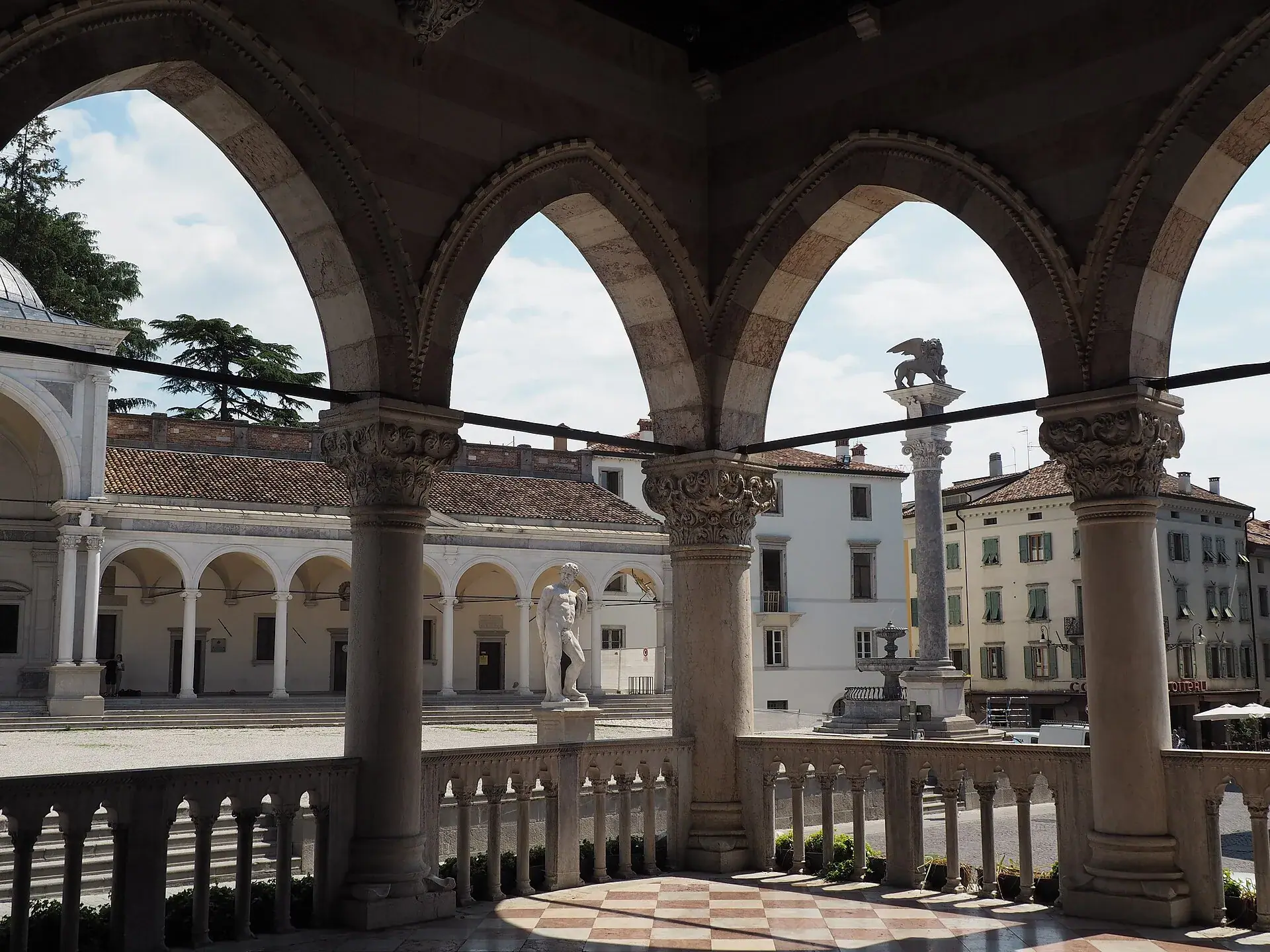 Photo: BelPatty86 / Wikimedia Commons (CC BY-SA 4.0)