Cost of Living in Aktau
Real market data
Source: Numbeo · June 2026
$650/moSolo nomad1-bed centre + living costs
$920/moCoupleshared 1-bed + costs
$530/moLean / localcheaper area + costs
- 1-bed rent, city centre$310₸147,500
- 1-bed rent, outside centre$190₸88,750
- Monthly costs excl. rent (1 person)$340₸160,555
- Meal, inexpensive restaurant$11₸5,000
- Buy price, per m² (centre)$760₸360,000
Prices are from Numbeo (June 2026), converted to USD at $1 = ₸474.52 (01 Aug 2026). The monthly living-costs figure is our transparent one-person basket, groceries, a few meals out, utilities, phone, internet, transport and essentials, priced from those figures. Solo adds central rent; couple and lean are estimates from the same numbers.
Budget around $650 a month. A one-bedroom runs roughly $250 to $450, with the seafront microdistricts at the top. Market produce is cheap and Kazakhstan's meat and dairy are good, though the Mangystau region is desert and most fresh vegetables arrive from elsewhere at a markup. Eating out is inexpensive, with Kazakh, Uzbek, Russian and Turkish food all easily found. Utilities are cheap. Aktau's oil and gas industry pushes some prices above the Kazakh average, particularly rents. The tenge has weakened considerably against the dollar over the past decade, which makes a foreign income go further than it once did. Fibre runs about $10 to $15 a month and a taxi across the city a couple of dollars, so the fixed costs of working here are among the lowest anywhere with this level of reliability. Every drop of fresh water in this city is desalinated from a sea that is itself salty, and for decades the plant doing it ran on a nuclear reactor on the shore, shut down at the end of the nineteen nineties. Water is therefore metered, priced and thought about here in a way it simply is not elsewhere in the country.
Where to Work in Aktau
Connectivity is reasonable. Fibre reaches most of the city at moderate speeds and prices, and mobile data from Kcell and Beeline covers Aktau and the main roads out. Power is reliable, supported by the region's own generation. There is limited coworking, mostly aimed at the oil sector. The time zone is five hours ahead of GMT, giving a full European working overlap in the afternoon. Kazakhstan has imposed internet restrictions during periods of unrest, most notably in January 2022 when a national shutdown lasted several days, which is worth knowing rather than expecting. Coworking desks aimed at the energy sector run roughly $80 to $150 a month, which is high against local rents and reflects who they are built for. Much of the energy workforce lives on rotation, a few weeks on and a few weeks off, flying in from elsewhere in the country and going home again, which means a sizeable part of the population is always in transit. That shapes the bars, the flight schedules and the rental market in equal measure, and it is why short lets are easier to find here than in most cities of this size.
Getting Around Aktau
Aktau has an unusual navigation problem: the Soviet planners gave it no street names, only numbered microdistricts and building numbers, so addresses read as a sequence of digits and taxi drivers work from landmarks. The city is compact and the seafront promenade is walkable. Buses and cheap taxis, including informal ones flagged from the roadside, cover the rest. Aktau International Airport has flights to Almaty, Astana, Istanbul, Baku and Dubai. The Caspian ferry to Baku runs on no fixed schedule and is a well-known adventure rather than a transport option. Bozjyra and the Ustyurt plateau are three to four hours out on unsealed tracks and effectively require a hired four-wheel drive with a driver, which is the standard arrangement rather than an indulgence. Fuel costs almost nothing by any outside standard, which is what makes hiring a vehicle for the desert affordable in the first place and why distances that look punishing on a map get treated casually by residents. North along the coast the road runs out to an old fort and a line of cliffs dropping straight into the water, which makes a good half day and needs nothing special to reach.
Sorting transport? Book an airport transfer, or compare car rental on Auto Europe and QEEQ.
Visas for Aktau
Kazakhstan is among the more open countries in the region. Citizens of most European countries, the United Kingdom, the United States and a long list of others receive thirty days visa-free on arrival, with registration handled automatically at the airport for most arrivals. Remote workers paid from abroad can apply for the Neo Nomad Visa (category B12-1), a multiple-entry visa of up to a year, extendable by one more, issued by Kazakh embassies against six months of income of at least $3,000 a month. Longer stays require a work or residence permit. Anyone entering overland should confirm the registration position, since the automatic system does not always apply at land borders. Most people reading this page will still arrive on the thirty-day visa-free entry, because the Neo Nomad Visa is issued by a Kazakh embassy or consulate before travel, rather than on landing at Aktau airport or the ferry berth. Arriving by sea rather than by air puts the registration question squarely in play, because the automatic system covering airport arrivals does not always reach a ferry berth, and the remedy afterwards is a visit to the migration police rather than a formality. Anyone crossing the water should photograph the entry stamp on the day it is given, before anything else happens to the passport.
Best Time to Visit Aktau
May and September to October are the best windows, warm at around twenty five degrees with the Caspian swimmable in late summer. June to August is hot, regularly above thirty five in a desert with almost no shade, and the wind off the steppe carries dust. Winter from December to February is cold and windy, hovering around freezing with the Caspian occasionally icing at the northern end. Rainfall is minimal in any month. Spring, when the desert briefly flowers, is the best time to go out to Bozjyra and the Ustyurt plateau. The Caspian is at its warmest in August and September and the city genuinely swims in it, which is not something most people expect of a desert oil town.
Pros and Cons of Aktau
Everything worth seeing is in the Mangystau region around the city: Bozjyra's chalk formations, the underground mosques at Beket-Ata and Shakpak-Ata carved into cliffs, and the Ustyurt plateau, which together make one of the strangest and least visited landscapes in Central Asia. The city has a swimmable sea, low costs and reliable services. Aktau itself is an unlovely Soviet oil city with almost no old town and little atmosphere, the desert summers are severe, the region cannot be seen without hiring something with high clearance, and English is rare once you leave the hotels. The Caspian ferry to Baku deserves its reputation: it sails when the cargo is ready rather than to a timetable, and a wait of several days at the port is normal.
Who Aktau Is For
Oil, gas or shipping work, of which there is a good deal, and travellers using the city as the base for Mangystau, which is the real reason to come and increasingly known among photographers and overlanders. It suits anyone crossing the Caspian between Central Asia and the Caucasus. This is a Soviet planned city on a desert coast rather than an attractive one, Russian does most of the work and its absence has to be actively worked around, and the numbered address system with no street names strikes some people as a curiosity and others as a daily irritation. The Caspian is the largest inland body of water on earth, and it is not in good health. Its sturgeon fishery and its retreating shoreline are both subjects of serious study, and Aktau is one of the few places that work gets done from. The port is the western end of the overland Central Asia route and the only practical Kazakh crossing point, which is why overlanders and cyclists turn up here in numbers the city otherwise would not see.
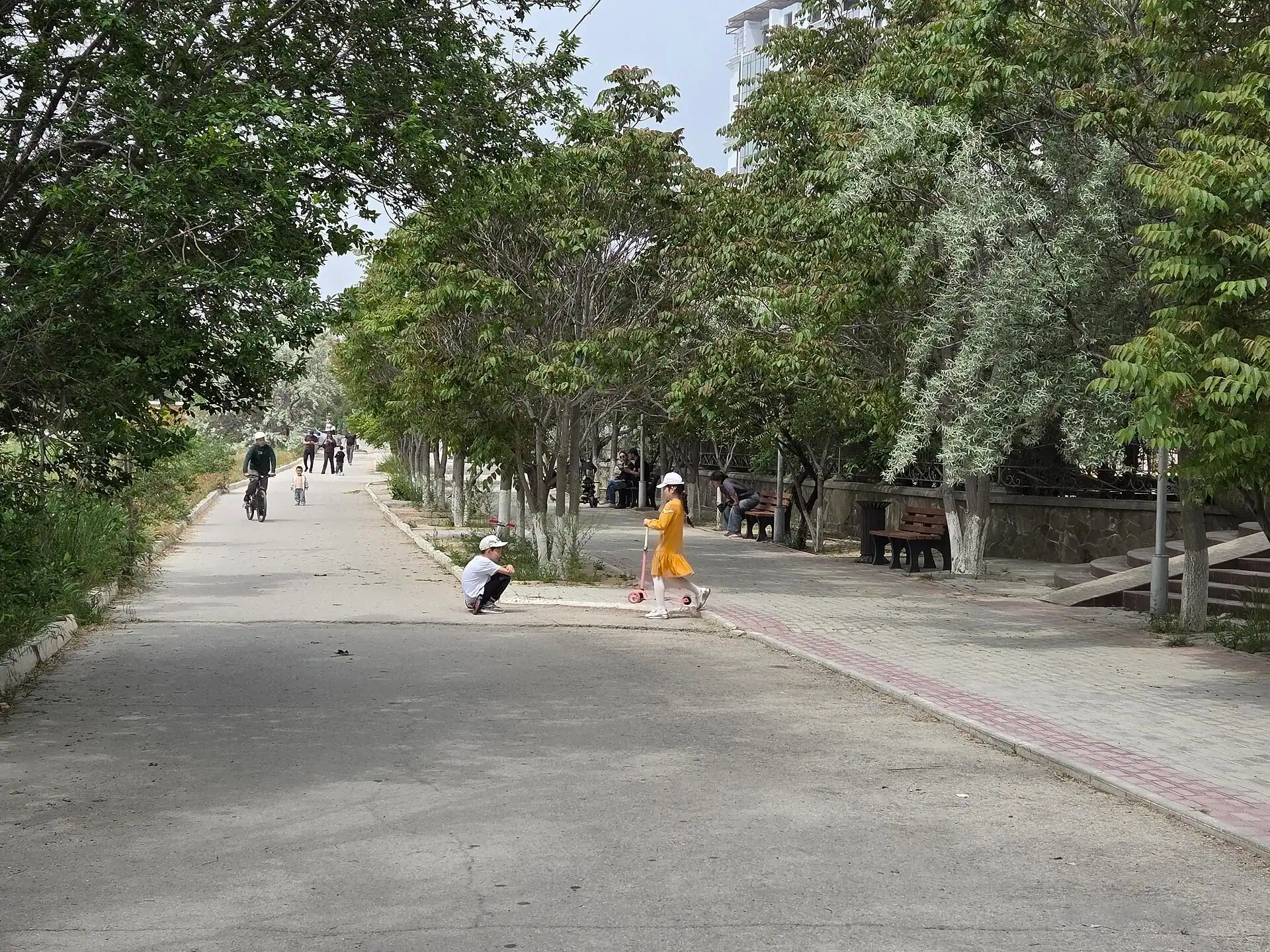 Photo: IvarT / Wikimedia Commons (CC0)