Cost of Living in Varanasi
Where this figure comes from. No cost survey covers Varanasi, so the $800 a month above is our own estimate rather than a measurement. On 416 of our 999 city guides the figure is built from a published Numbeo basket, a one-bedroom rent in the centre plus one person's monthly costs without rent, converted to USD; this city is not one of them. How we source everything.
Varanasi is extremely cheap, among the most affordable cities a remote worker could choose. A comfortable single-person budget runs roughly $650 to $1,000 a month. Guesthouse rooms and simple flats near the ghats or in quieter neighbourhoods rent long-term for about $120 to $350, and street food and thalis cost just a dollar or two. These are our editorial estimates in US dollars, and even factoring in a decent room with reliable power and a backup connection, Varanasi remains very light on the wallet. The main costs beyond rent are food, the odd boat ride, and travel in and out. Air is the thing worth paying for here. A purifier and a stock of filters are effectively a fixed cost from late autumn into midwinter, when smoke from the plains settles over the whole valley, and the difference it makes to sleeping and working is not marginal. Rooms overlooking the river carry a large markup for the view and come with the noise, the steps and the crowds attached; a street or two back costs a third as much and is a great deal easier to live in. Add something for the boatmen, because you will end up on the water more than you plan.
- Guesthouse room or simple flat, long stay: roughly $120 to $350 a month
- Thali or street-food meal: roughly $1 to $3
- Autorickshaw across town: roughly $1 to $2
- Sunrise boat ride on the Ganges: a few dollars
Where to Work in Varanasi
Varanasi is one of India's most intense and spiritual cities, not a remote-work hub, and its infrastructure reflects that. Fibre and 4G reach the city and are cheap, but speeds can be inconsistent and power cuts happen, so test any room's connection and consider a backup before relying on it for calls. Dedicated coworking is essentially absent; a handful of traveller cafes, some with rooftop river views, serve as informal work spots. A Jio or Airtel SIM is an essential backup. Treat Varanasi as a place for focused, lower-intensity work between immersion in the city, rather than a base for constant video meetings. Winter fog is the practical disruption nobody plans for. Between late December and early February the whole plain can sit under it for days, flights are delayed or cancelled and trains run many hours late, which means any travel commitment in that window needs a fallback. Within the city, the lanes are loud from four in the morning, when the first bells and the first pilgrims start, and quieter in the late morning than at any other time. Authorities have also restricted mobile internet in parts of the state during periods of tension, which is rare but not unheard of.
Getting Around Varanasi
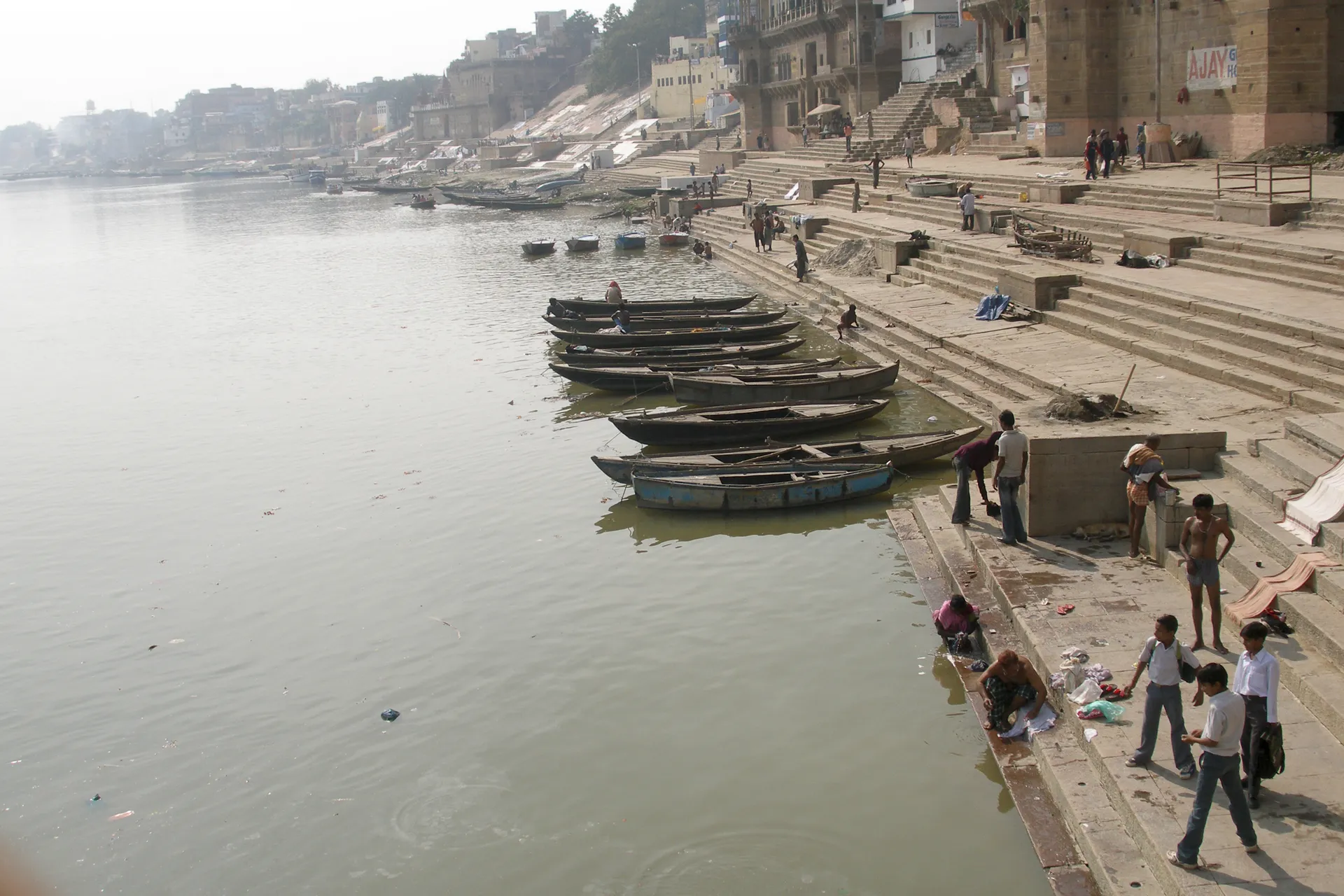
The heart of Varanasi is the labyrinth of narrow lanes behind the ghats, where no cars fit and you explore on foot, dodging pilgrims, cows and motorbikes. For longer trips, autorickshaws and cycle rickshaws are cheap once you agree a fare, and ride apps operate in parts of the city. The most memorable transport is a rowing boat along the ghats at dawn or for the evening Ganga Aarti. Lal Bahadur Shastri Airport, about 25 kilometres out, connects Varanasi to Delhi, Mumbai and other cities, and the railway station is a major hub across northern India. A few orientation points. The riverfront runs about six kilometres and you can walk almost the whole length along the steps, which takes a slow morning and does more to make the place legible than any amount of reading. Electric rickshaws now outnumber the old cycle ones and are cheaper still, though they are barred from some streets around the temple corridor, where a large redevelopment cleared a swathe of the old lanes and changed how the approach works. Sarnath, where the Buddha gave his first sermon, is ten kilometres out and an easy half day.
Sorting transport? Book an airport transfer, or compare car rental on Auto Europe and QEEQ.
Visas for Varanasi
Foreign visitors reach Varanasi on India's e-Tourist Visa, arranged online before arrival and issued in 30-day, one-year and five-year forms, with the longer versions allowing multiple entries, capped at 180 days of presence per calendar year. A tourist visa does not permit local employment, though remote work for a foreign employer sits in the same grey area many long-stayers occupy. Keep copies of your visa and register if your stay triggers any requirement. Choose the length at the application stage, because it is effectively irreversible. A tourist permit will not be stretched or swapped, once you have landed, for another category except in narrow emergencies, so a thirty-day entry that turns out to be too short means leaving and reapplying from outside. The old rule requiring a two-month gap between consecutive tourist visits was dropped years ago and still circulates in forum advice, so ignore it. Biometrics are taken at the immigration desk on arrival, which adds time at a busy airport but nothing else.
Best Time to Visit Varanasi
The best window for Varanasi is the cooler, drier season from October to March, when daytime temperatures are pleasant for wandering the ghats and lanes, though winter mornings can be foggy and chilly. Summer, from April to June, is punishing, often above 40 Celsius, which makes daytime exploring exhausting. The monsoon from July to September brings heavy rain and can flood the lower ghats as the Ganges rises. The city is at its most magical around the autumn and winter festivals, especially Dev Deepawali in November, when thousands of oil lamps light the ghats. There is an unpleasant coincidence in that calendar. The months that are most comfortable to walk around in are also the months when air quality across the northern plains is at its worst, often for weeks at a stretch, and someone with asthma or a young child should weigh that seriously rather than treating it as background. The festival that brings the largest crowds is the mid-January bathing day, when hundreds of thousands come to the river before dawn; it is astonishing and the lanes are impassable. Book anything in that week months ahead.
Pros and Cons of Varanasi
Varanasi offers unmatched intensity and meaning, with comfort and infrastructure a distant second. Intensity is the right word and it is worth being concrete about what it means day to day. Bodies are cremated in public on two of the ghats around the clock, and the smoke, the sound and the processions through the lanes are part of ordinary life rather than a spectacle laid on for anyone. Most visitors find this the most valuable thing about the place and a few find it unbearable, and there is no way to know which you are in advance. Alongside it sits the ordinary difficulty: crowded lanes, aggressive touts around the main temple, cows and rubbish and open drains, and an air quality figure in winter that would close schools in most countries. What you get for all of it is a city that has been continuously inhabited for three thousand years and has not been tidied for visitors. That is either the point or it is not.
- Pros: one of the world's oldest living cities and the spiritual heart of Hinduism, extraordinarily cheap, endlessly photogenic, with the Ganga Aarti, ancient temples and a sensory depth found almost nowhere else.
- Cons: serious air pollution and a heavily polluted river, crowds, noise and chaos, patchy internet and power, poor cleanliness, persistent touts, and an overall intensity that many find exhausting for a long stay.
Who Varanasi Is For
Varanasi is for the spiritually curious, culturally immersive traveller who wants profound experience over comfort, and who can handle India at its most intense. Photographers, writers, seekers and anyone drawn to ritual, history and the raw texture of life and death by the Ganges will find it unforgettable. It works best for shorter, deep stays rather than as a long-term work base, and rewards patience, an open mind and a tolerance for chaos and grime. It is a poor fit for those who need clean air, reliable infrastructure, a nomad community or any sense of calm. Come in winter, stay near the ghats, and let the city overwhelm you on its own terms. Plan for a fortnight, with a room a short walk back from the water and a willingness to be out at dawn. A month is possible if you have a project that benefits from the setting. Beyond that the practical costs start to outweigh what the city gives, and the people who stay longest are usually here for a reason rather than as a base. Whatever the length, hire a guide for the first morning; almost everything that makes the place legible is invisible without one.