Cost of Living in Sfax
Where this figure comes from. No cost survey covers Sfax, so the $650 a month above is our own estimate rather than a measurement. On 416 of our 999 city guides the figure is built from a published Numbeo basket, a one-bedroom rent in the centre plus one person's monthly costs without rent, converted to USD; this city is not one of them. How we source everything.
Sfax runs about $650 a month for one person, a little cheaper than Tunis and considerably cheaper than the coastal resort towns. A furnished one-bedroom apartment near the centre or in Sfax El Jadida is $200 to $350, and further out $130 to $220. Food is inexpensive: a plate of couscous or a bowl of lablabi is $2 to $4, a full restaurant meal $8 to $14, and the fish landed at the port is both excellent and cheap. There is a small coworking scene at $60 to $120 a month. Fixed internet is $15 to $30 for a usable connection. Louages and buses cost pennies and taxis a couple of dollars. Bread, fuel and a handful of staples are subsidised, which is why the gap between a local shopping basket and an imported one is so wide, and why the price of a baguette has almost nothing to do with the cost of making it. The power company invoices on a two month cycle and the tariff steps up in bands, so a summer with air conditioning lands in a higher band and costs more than twice a mild one. A municipal charge on the dwelling is billed annually and usually falls to the tenant.
Where to Work in Sfax
Sfax has a modest but genuine coworking sector, driven by the University of Sfax and a local software industry that is larger than the city's reputation suggests, with desks at $60 to $120 a month. Fixed internet from Tunisie Telecom, Ooredoo or Orange runs $15 to $30 monthly, with fibre available in parts of the city and ADSL elsewhere; ask which one an apartment actually has. Mobile 4G is cheap, widely available and a reasonable primary connection if you are staying a few weeks. International routing to Europe is decent, better than most of North Africa, and video calls generally hold. Cafes are plentiful but are social spaces first. Business runs in French and in Arabic, and a meeting will switch between them mid sentence without anyone noticing, which is harder to follow than either language on its own. The city has a reputation across the country for commerce and for keeping its money, and the family firms that earned it are not advertising for foreign staff. There is an export company regime that lets a business incorporated locally sell abroad under a lighter tax and customs arrangement, and it is the structure most outsourcing operations here use.
Getting Around Sfax
The medina at the centre of Sfax is compact, still enclosed by its walls, and walking is the only way to see it. Beyond that the city is spread out and you will use louages, the shared inter-city taxis, or the yellow city taxis which are metered and cheap at $1 to $3. A local rail line, the Metro du Sahel equivalent here being the Sfax suburban service, plus buses cover the suburbs. The ferry to the Kerkennah Islands leaves from the port and takes about an hour, and is the standard weekend escape. Sfax-Thyna airport is 6km out with limited flights; Tunis is three hours by train or road for wider connections. A car is the thing most residents aspire to and the thing a visitor least needs, since the shared taxis leave when they fill and go everywhere, which in practice is more frequent than any timetable. Cycling is rare and the drivers are not expecting it. The medina is safe to walk at night and is one of the few in the region where doing so involves no tourist economy at all, just people going home. Through traffic from the port keeps the southern approach heavy with lorries at every hour.
Sorting transport? Book an airport transfer, or compare car rental on Auto Europe and QEEQ.
Visas for Sfax
Tunisia is one of the easier North African countries to enter. Most European, North American, Japanese and several other nationalities get 90 days visa free on arrival, with no advance paperwork. Extensions beyond 90 days require an application to the local police and are not routinely granted, and overstaying carries a fine payable on departure. There is no digital nomad visa, though Tunisia has discussed one for several years. A long-stay residence permit, the carte de sejour, exists but is aimed at people with local employment, study or family ties. Most remote workers here simply use the 90 days and leave, which is straightforward given the flight connections to Europe. The currency is the constraint nobody mentions: the dinar cannot legally leave the country and cannot be changed anywhere outside it, so converting back at the airport requires the receipts from converting in, and without them the money stays. Keep every exchange slip. Cards work in the cities and cash is still what most of the country runs on. A departure stamp is given without fuss and there is no exit formality beyond it, which makes the ninety day pattern as simple in practice as it looks on paper.
Best Time to Visit Sfax
Sfax has a hot semi-arid climate, drier than Tunis and drier than most of the Tunisian coast. April, May, October and November are the best months, with highs of 22C to 28C and comfortable evenings. July and August are hot at 33C to 36C and humid near the water, and the city empties somewhat as people head to Kerkennah or the beaches. Winter from December to February is mild at 16C to 18C, with the year's modest rainfall arriving then in short bursts. The olive harvest runs from November into January and is the region's economic heartbeat, since Sfax sits at the centre of one of the largest olive-growing areas in the world.
Pros and Cons of Sfax
Sfax is a working Tunisian city rather than a resort town, with a medina that is intact, walled and almost entirely free of tourists, a genuine software and university sector of its own, excellent seafood, and a monthly cost of living that comes to around $650. The visa is free on arrival for most people, flights to Europe are short, and the Kerkennah Islands are an hour away by ferry. It is an industrial port and it looks like one in several places, air quality near the phosphate plants is genuinely poor, the summers are hot, the foreign presence is small, English is limited so French helps enormously, and there is very little nightlife.
Who Sfax Is For
North Africa without the tourist infrastructure, some French, and a preference for a real city over a pretty one. The combination of visa-free entry, low cost, short flights to Europe and a functioning local tech scene makes it a more practical base than its profile suggests. A month or two in spring or in autumn is the sensible window, and that is time enough to learn whether a city which makes no effort for visitors suits you. This is a working industrial port rather than a beach town, the nightlife is negligible, French and Arabic do the work rather than English, and no community of other remote workers has formed here. If Tunisia is the goal and company matters more than authenticity, Tunis and Hammamet are where the foreigners are.
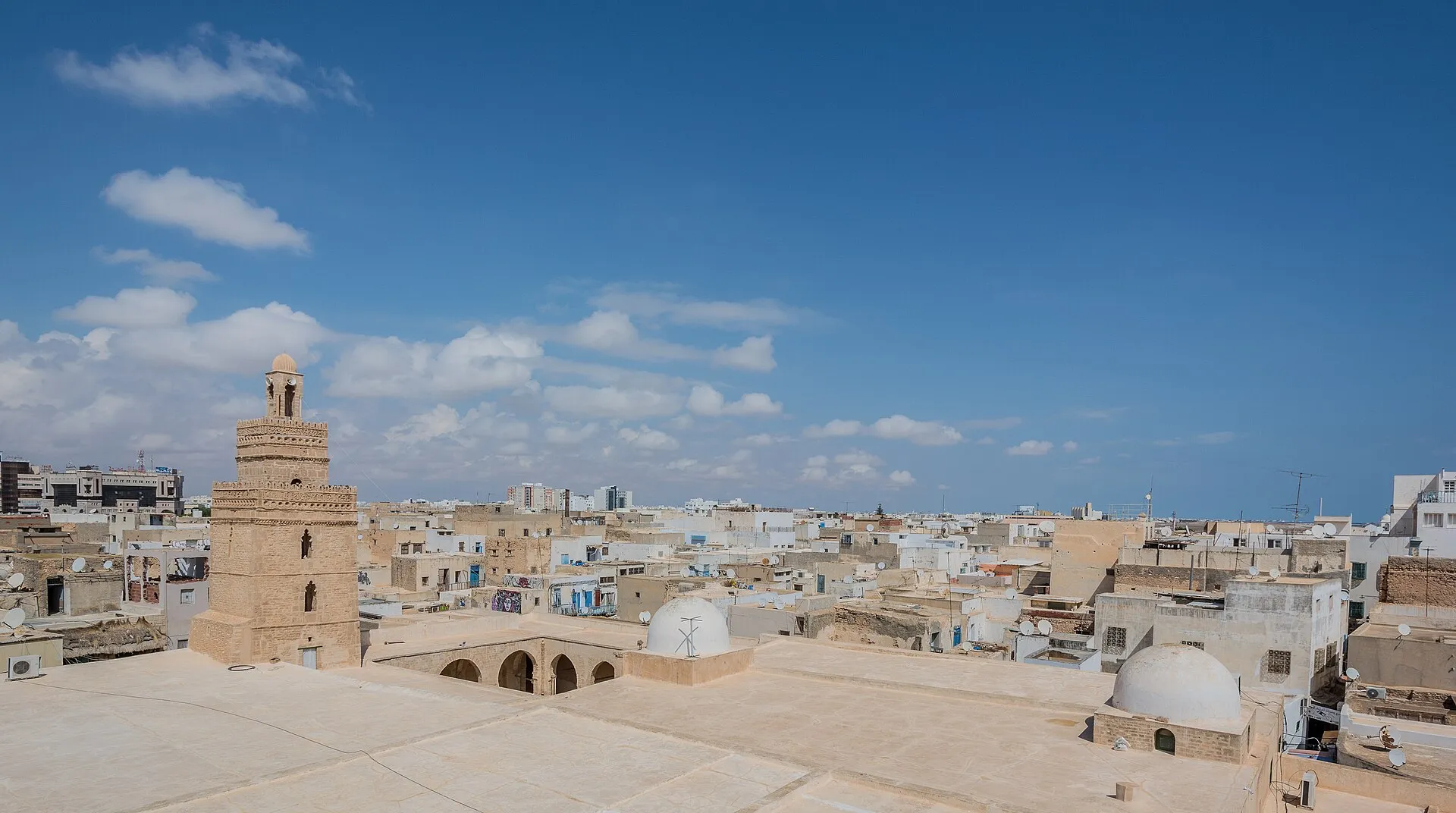 Photo: IssamBarhoumi / Wikimedia Commons (CC BY-SA 4.0)