Cost of Living in Townsville
Where this figure comes from. No cost survey covers Townsville, so the $1,900 a month above is our own estimate rather than a measurement. On 416 of our 999 city guides the figure is built from a published Numbeo basket, a one-bedroom rent in the centre plus one person's monthly costs without rent, converted to USD; this city is not one of them. How we source everything.
Townsville runs about $1,900 a month for one person, which is inexpensive for an Australian city but high against most of this site. A one-bedroom flat near the Strand or in North Ward is $850 to $1,150; a room in a share house is $450 to $650. Groceries are $400 to $500 a month and a pub meal $18 to $28. Coworking is available at $200 to $350 a month. Internet on the NBN costs $50 to $70. Running a car is roughly $200 a month including fuel at about $1.20 a litre, and air conditioning through the wet season pushes power bills to $80 to $140. A bond of four weeks is held by a state authority rather than by the agent, and the rental application is competitive enough that references and payslips are expected before an inspection rather than after it. Reciprocal health agreements cover citizens of a handful of countries for emergency treatment, which is worth checking against a passport before buying insurance. Power is billed quarterly, so the first wet-season bill arrives as one large number rather than in monthly pieces.
Where to Work in Townsville
Townsville has a functioning coworking market for a city of its size, with spaces in the CBD and around the Flinders Street precinct at $200 to $350 a month, supported by James Cook University, the defence presence at Lavarack Barracks and a marine science sector built around AIMS and the reef research institutions. The NBN reaches the city with fibre or fibre-to-the-node depending on the street, for $50 to $70 a month; check which technology an address has, because the difference is large. Mobile coverage from Telstra, Optus and Vodafone is good in the city and thins quickly inland. Cafes along the Strand are pleasant for a morning. There is no daylight saving in this state, so the gap to the southern capitals opens and closes with their clocks rather than ours, and a standing meeting with Sydney or Melbourne drifts accordingly. The working day overlaps Singapore and Tokyo comfortably and misses Europe altogether, which is the calculation to make before taking on a London client. The defence presence also means a share of the professional population turns over on posting cycles rather than by choice.
Getting Around Townsville
Townsville is flat and spread out, and while the CBD and the Strand are walkable, most people drive. Sunbus runs the suburban network on weekdays with a reduced weekend service. Cycling works well given the terrain and the climate for most of the year. The Magnetic Island ferry from the terminal takes 25 minutes and runs frequently, which is what makes the island a genuine part of daily life here rather than an excursion. Castle Hill rises straight out of the centre and the walk up is the local morning ritual. The airport is 5km out with flights to Brisbane, Sydney, Cairns and Melbourne, and Cairns is four hours north by road. The coastal railway runs south and north but takes most of a day in either direction and is a scenic proposition rather than a practical one, so the flights carry almost everyone. The state capital is thirteen hundred kilometres away, which surprises people who expect one to be near. The island ferry sells multi-trip passes that make commuting from offshore viable, and a fair number of people do exactly that.
Sorting transport? Book an airport transfer, or compare car rental on Auto Europe and QEEQ.
Visas for Townsville
Australia's eVisitor and ETA cover most European, North American and several Asian nationalities for stays of up to three months per entry within a twelve-month validity, applied for online for little or no fee. Working holiday visas of twelve months, extendable to two or three years with specified regional work, are available to under-30s or under-35s depending on nationality, and northern Queensland is a common place to complete the regional requirement. There is no digital nomad visa. Working remotely for a foreign employer while on a visitor visa sits in a grey area Australia has not clarified, and tax residency starts to matter well before the visa does. The regional work that buys a second or third year has to fall inside a specified industry and postcode, and this district qualifies, which is why so many working holiday arrivals pass through for a season. A tax file number is needed before any employer can pay at the ordinary rate rather than the top one, and it takes a couple of weeks to come through. Keep the payslips, since the extension application is assessed on evidence rather than on assertion.
Best Time to Visit Townsville
Townsville is in the dry tropics rather than the wet tropics, which is why it gets roughly 300 sunny days a year while Cairns, four hours north, gets drenched. May to October is the dry season and the reason to be here: highs of 25C to 28C, low humidity, blue skies, and the best diving conditions on the Yongala wreck. November to April is the wet, with highs near 31C, oppressive humidity, and the cyclone season running formally from November to April. Stinger season overlaps it, so swimming outside netted enclosures is inadvisable from roughly November to May. The city has flooded badly in exceptional years, most recently in 2019. The stingers that close the beaches are box jellyfish and irukandji, and the netted enclosures are the standard answer rather than a precaution for the nervous. Reef conditions vary from year to year: the bleaching events of recent summers hit some sections hard and left others intact, and the operators know which is which better than any published map does. Winter nights drop enough to want a jacket, which nobody expects of the tropics.
Pros and Cons of Townsville
Townsville has dry tropical winter sun, a beachfront promenade in the Strand, Magnetic Island 25 minutes offshore, the Yongala wreck which is regularly ranked among the best dives in the world, and Great Barrier Reef access without either the Cairns prices or the Cairns crowds. It has a university, a hospital, an airport and coworking, and rents well below the Australian average. It is dear by world standards, you will need a car of your own, the November to April wet season is genuinely hard going work, cyclone and flood risk are real rather than theoretical, and the city away from the waterfront is plain to look at and makes no apology for it.
Who Townsville Is For
Tropical Australia priced as a working city and not as a resort, for anyone whose winter matters more than their summer: a May to October stay is close to ideal. Divers have a specific reason to come, and marine scientists and defence contractors are why much of the professional population is here. It works well on a working holiday visa, particularly for anyone needing regional work. A car is a requirement rather than a convenience, Australian prices will defeat a tight budget, and anybody planning to sit out the wet season should first understand how long it lasts. If you want the reef with more company and more to do, Cairns is four hours north.
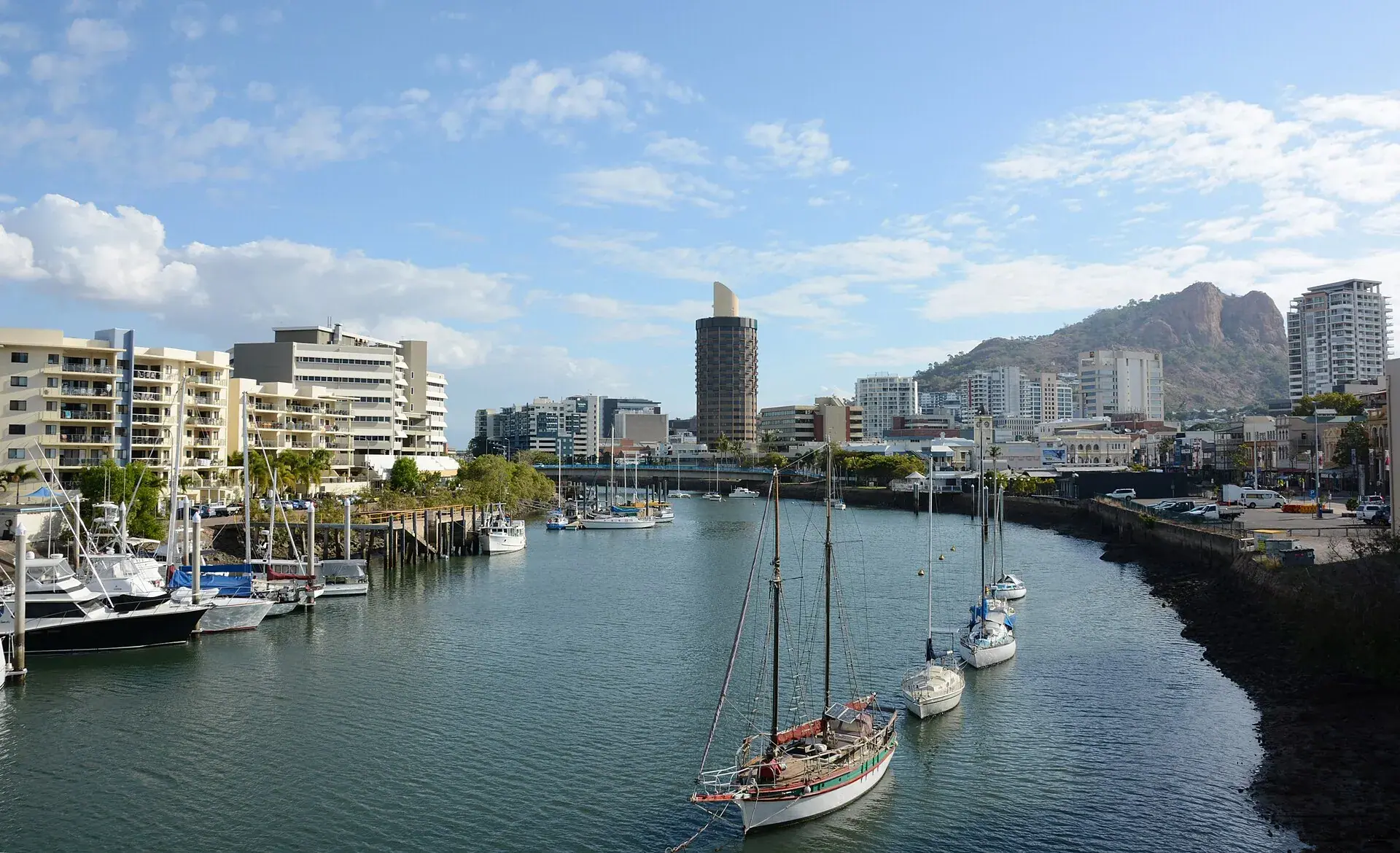 Photo: Rabin Tuladhar / Wikimedia Commons (CC BY-SA 4.0)