Cost of Living in Thessaloniki
Real market data
Source: Numbeo · August 2026
$1,400/moSolo nomad1-bed centre + living costs
$2,020/moCoupleshared 1-bed + costs
$1,260/moLean / localcheaper area + costs
- 1-bed rent, city centre$630€551
- 1-bed rent, outside centre$490€424
- Monthly costs excl. rent (1 person)$770€667
- Meal, inexpensive restaurant$17€15
- Monthly transit pass$18€16
- Buy price, per m² (centre)$3,850€3,347
Prices are from Numbeo (August 2026), converted to USD at $1 = €0.87 (01 Aug 2026). The monthly living-costs figure is our transparent one-person basket, groceries, a few meals out, utilities, phone, internet, transport and essentials, priced from those figures. Solo adds central rent; couple and lean are estimates from the same numbers. The guide below quotes its own monthly range, which is a different measurement rather than a competing one: this table prices a defined basket at the figures above, while that range is a judgement about how somebody actually lives here.
Thessaloniki runs meaningfully cheaper than Athens, and for a Greek city with real culture and infrastructure, that gap matters. A single nomad can live comfortably on a monthly budget of roughly $1,610-2,300, though you can compress this further if you cook at home and pick a cheaper area.
- Rent, central areas (Ladadika, city center, Aristotelous): $635-920/month for a furnished studio
- Rent, cheaper areas (Ampelokipi, Evosmos, eastern suburbs): $405-635/month
- Groceries: $230-345/month; supermarkets like Sklavenitis and AB Vasilopoulos are solid and affordable
- Eating out: A sit-down lunch or dinner at a taverna runs $12-21; souvlaki wraps from $2.50-3.50; eating out budget roughly $230-405/month
- Coworking hot-desk: $115-230/month depending on the space and access hours
- Local transport: $29-46/month; the metro ticket costs $0.50 per 70-minute ride
- Total realistic range: $1,270-2,070/month if you cook regularly; $1,840-2,880/month if you eat out often
Utility bills (electricity, water) add $69-140/month in most seasons, spiking in summer with air conditioning. Mobile data plans are cheap: $17-29/month for a local SIM with decent data.
Where to Work
Thessaloniki has a workable but not saturated coworking scene. You have real options, and cafe-working culture is genuinely nomad-friendly, though you will want to time your sessions around peak hours.
Coworking Spaces
Coho is consistently rated the best full-service coworking space in the city, with two city-center locations (one near the waterfront at Kidonion and Marias Kallas, another in Ampelokipi). It offers hot desks, dedicated desks, private offices, meeting rooms, and community events. Pricing is on the higher end for Thessaloniki at around $460-555/month for a hot desk but the facilities are professional.
ToWork (Leof. Vasilissis Olgas 83, city center) is a small, quiet space capped at four simultaneous users, with fiber internet and a calm environment. A good pick if you need focused work without distractions. Osmosis (Olgas Street area) is the only 24/7 access coworking in the city, with a more relaxed millennial-friendly vibe and a monthly rate of around $230 plus VAT. Regus maintains a location at Vasileos Irakleiou 53 near Tsimiski Street, with standard business-center amenities and dedicated desks from $160/month on longer contracts.
Cafe-Working Culture and WiFi
Cafe culture in Thessaloniki is real and deeply embedded. Specialty coffee shops are common, and many welcome laptop workers, especially mid-morning on weekdays. Tabya (Melenikou 14, near Kamara/Rotonda) is a go-to: housed in a preserved neoclassical building, vinyl on the walls, fast WiFi, and a relaxed working atmosphere. Svolos Coffeespace (Alexandrou Svolou 39, downtown) leans explicitly workspace-friendly, with two floors, ample power outlets, and good coffee.
That said, plan around the lunch rush and evening peaks when cafes fill up and noise rises. Fiber internet coverage across the city center is solid, reaching most modern accommodations and coworking spaces. Standard cafe WiFi handles video calls without issue.
Getting Around
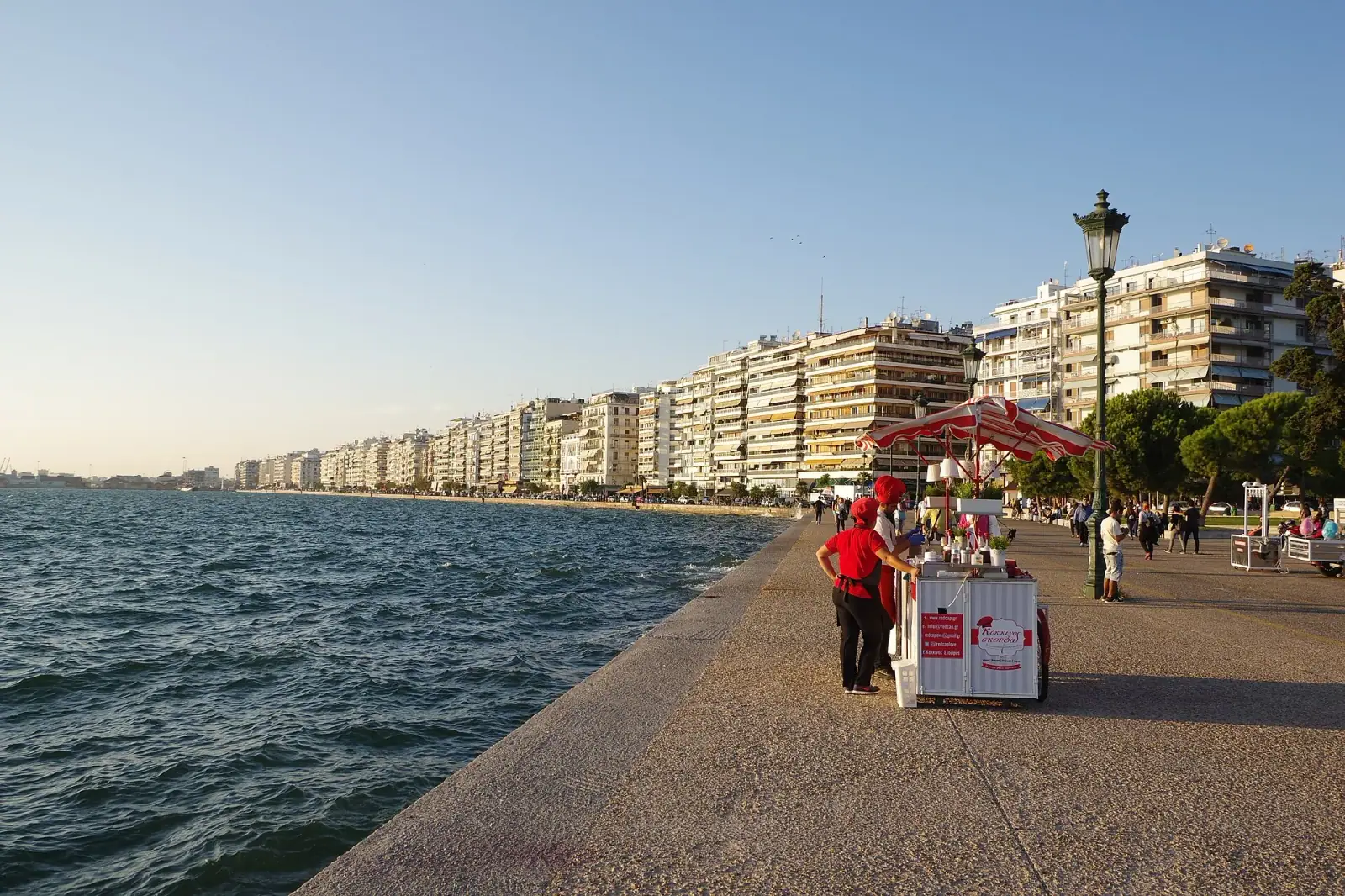
The central city is walkable. Most of the old town, the waterfront promenade, Aristotelous Square, and the main commercial street (Tsimiski) sit within comfortable walking distance of each other. You can cover a lot of ground on foot, which suits the nomad lifestyle well.
Thessaloniki opened a metro in late 2024, which has made city transit genuinely practical. A single ticket costs $0.50 and is valid for 70 minutes. Buses cover the wider city and suburbs. Taxis and ride-hailing (Beat) are available and cheap by Western European standards.
Getting to/from the airport: Makedonia International Airport sits about 16 km southeast of the city. The metro now connects to a terminal at Nea Elvetia station, from which you transfer to express bus lines X1 toward the airport. Bus routes 01X (daytime) and 01N (night) run directly from the city center to the airport in roughly 40 minutes for a few dollars. A taxi costs $23-35. There is no direct metro-to-terminal connection yet, so budget at least 50-60 minutes for airport runs using transit.
Sorting transport? Book an airport transfer, or compare car rental on Auto Europe and QEEQ.
Visas and Staying Long-Term
Greece is a Schengen member, so citizens of the US, Canada, Australia, UK, and most Western nations can enter without a visa and stay up to 90 days within any 180-day window across the entire Schengen Area. After that, you need to leave or get a longer-term status.
Greece offers a Digital Nomad Visa (a national long-stay visa that leads on to a residence permit) for non-EU remote workers. It requires proof of stable remote income of at least $4,030/month after taxes, health insurance, and a clean criminal record. The visa is granted for one year, after which you can move onto a two-year Digital Nomad Residence Permit that keeps renewing in two-year steps; after five years of legal stay, you can apply for permanent residency. The permit gives you the right to live in Greece but not to work for a Greek employer locally.
Applications go through the Greek consulate or embassy in your home country before you arrive. Processing times vary, so apply early.
Best Time to Visit
For remote work, April through June and September through October are the sweet spot. Temperatures sit in the 18-27C (64-81F) range, crowds are manageable, accommodation prices are lower than peak summer, and the city operates at a natural, unhurried pace. You can keep your windows open, walk everywhere, and the coastal breezes off the Thermaic Gulf keep things pleasant.
July and August bring serious heat, sometimes reaching 35-38C (95-100F), humidity, and a significant tourist and domestic visitor surge. Cafes and coworking spaces get crowded, and working is uncomfortable without strong air conditioning. Coastal areas near the city attract weekend crowds. Some local businesses shorten hours or close for portions of August.
Winter (December through February) is mild by northern European standards, averaging 5-10C (41-50F), with occasional frost and rare snow. It rains more often. The city is quiet, cheap, and very livable if you do not mind grey skies. Spring arrives early, typically by March, making shoulder-season stretches in February to March surprisingly good for focused, distraction-free work.
Pros and Cons
Pros
- Low cost of living compared to most Western European cities, with no quality sacrifice on food or lifestyle
- Exceptional food scene, widely considered the best in Greece
- Walkable city center with a functional new metro system
- Good fiber internet coverage and a growing coworking infrastructure
- Genuine cultural depth: Byzantine history, Ottoman heritage, a Jewish cultural legacy, and lively contemporary arts
- Very warm local hospitality; English is widely spoken in cafes, coworking spaces, and tourist areas
- Easy Schengen travel base for reaching the rest of Europe affordably
Cons
- No direct metro connection to the airport terminal yet; transit to the airport takes time
- Coworking scene is real but smaller and less polished than Athens or major Western hubs
- Summers are genuinely hot and humid, making outdoor time or cafe-working uncomfortable in July and August
- Bureaucratic processes (banking, residency registration) can be slow and frustrating without local Greek language skills or help
- Petty theft is the main safety concern around busy squares and markets; standard urban precautions apply
- Nightlife can make central neighborhoods noisy on weekends
Who Thessaloniki Is Best For
Thessaloniki suits nomads who want real European city life at a genuine budget. If you care about food, culture, and a city that rewards exploration without bleeding your savings, this is a strong choice. It works well for those staying 1-6 months and who want to feel embedded in a place rather than just passing through. The Greek Digital Nomad Visa makes longer stays practical for qualifying earners.
It is a particularly good fit for food-focused nomads, those interested in Byzantine and Ottoman history, and anyone who wants the warmth and scale of a Mediterranean city without paying Athens or Barcelona prices.
Skip Thessaloniki if you need a deep, saturated nomad community with daily networking events and a large supply of premium coworking options. Athens is better for that. Also skip it if peak summer is your only window: the heat and humidity are real, and productivity can suffer unless you have strong air conditioning.