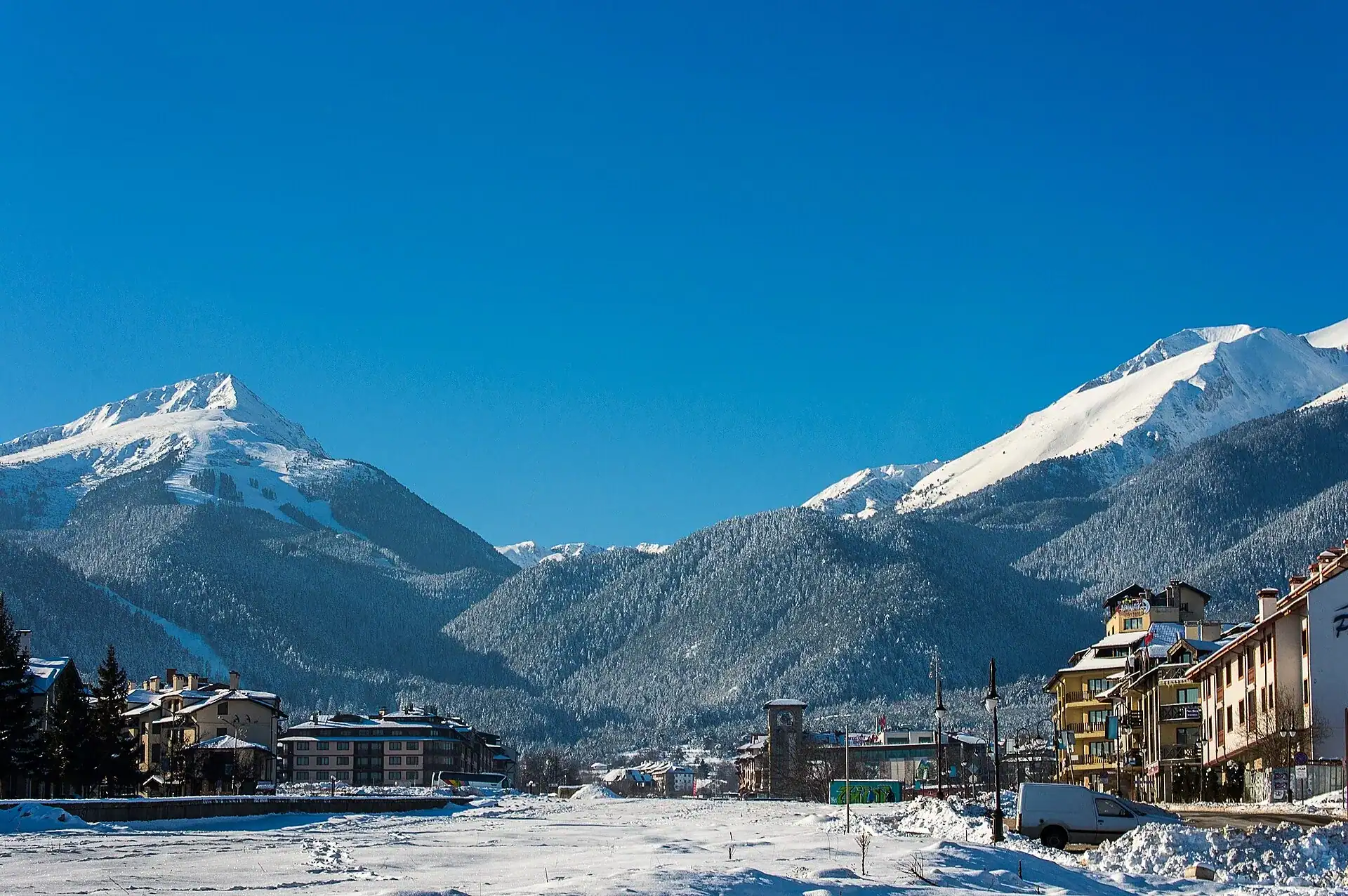
The town of Bansko under the snow-covered peaks of the Pirin mountains
Photo: www.bdmundo.com / Wikimedia Commons (CC BY-SA 2.0)
Bulgaria flag

Bansko

Bulgaria

A Pirin ski town that turned itself into one of Europe's cheapest nomad hubs.

$900
Monthly Budget
--
Current Weather
Continental
Climate Type
7/10
WiFi Score
8/10
Safety Score
UTC+2
Timezone
0
Nomad Score

Setting Up as a Nomad in Bansko

A Pirin ski town that turned itself into one of Europe's cheapest nomad hubs. A continental climate and strong nature make Bansko an easy base, and at about $900 a month it fits a range of budgets. Keep the culture scene in mind.

Nomad Facts at a Glance

The practical basics for Bansko, Bulgaria

CurrencyEuro (€, EUR), since January 2026
LanguageBulgarian
Plugs & powerType C/F · 230V / 50Hz
Tap waterSafe to drink
TippingRound up or 10%
Ride-hailingBolt
Emergency112
Mobile dataeSIM: Airalo / Holafly
Driving sideRight
Dialling code+359
Time zoneUTC+2
Best time to visitJun, Jul, Aug

Country-level guidance to get you oriented, not a substitute for checking locally. Numbers and norms can change; 112 reaches emergency services from most mobiles worldwide.

Category Breakdown

How Bansko scores across all 13 factors

Bansko's Nomad Score is 8.0 out of 10, from 13 category ratings (each out of 10): Climate 6, Cost of Living 8, WiFi 7, Nightlife 5, Nature 9, Safety 8, Food 6, Nomad Community 8, English 6, Visa Ease 7, Culture 5, Cleanliness 7, Air Quality 8.

Weather in Bansko

Monthly averages from 2019-2023 (Open-Meteo), and the best time to visit

6°
-3°
Jan
8°
-3°
Feb
10°
-1°
Mar
14°
2°
Apr
19°
7°
May
23°
11°
Jun
26°
13°
Jul
27°
14°
Aug
23°
10°
Sep
18°
6°
Oct
12°
3°
Nov
8°
0°
Dec
Daily high & low (°C)Rainfall (mm/month)Best months to visit

The best time to visit Bansko for comfortable weather is Jun, Jul, Aug. The warmest month is Aug (around 27°C by day), and the wettest is Nov (about 121mm of rain).

Chasing good weather? See other cities that are warm in Jun, or plan a multi-city route around the seasons, or search flights when you are ready to move. Staying a while in Bansko? Check visa options, your time-zone overlap and how far your budget stretches, or find it on the world map.

Historical monthly averages, not a forecast. Source: Open-Meteo ERA5, a grid of roughly 25 km cells, because no weather station with published normals is close enough to the city.

Best Neighborhoods in Bansko

Where to base yourself for the perfect nomad experience

Old Town

$$
Historic & Social

Stone houses around the Holy Trinity church, where the coworking is

Bansko's original village core of thick-walled stone houses and cobbled lanes around the Holy Trinity church and its bell tower. The mehanas are here, and so are the coworking spaces that built the town's nomad reputation. It is the most pleasant part to live in and the most social.

Best for: Anyone here for the nomad community, with the coworking spaces on the doorstep
Pros
  • Coworking spaces and the nomad social scene
  • Traditional mehanas and the best restaurants
  • Walkable to everything in the town
Cons
  • The highest rents in Bansko
  • Busy and noisy through the ski season
  • Old stone buildings vary in comfort

Gondola Base

$
Ski Base & Cheap Off-season

Around the lift station, apartment blocks and ski-season noise

The strip near the gondola station where most of the construction-boom apartment blocks went up, aimed at the ski market. Out of season these sit half empty and rent for very little, which is exactly why the long-stay remote-work community found the town in the first place.

Best for: Long stays taking advantage of empty ski apartments outside the season
Pros
  • Very low rents from April to November
  • Gondola for skiing and summer hiking at the door
  • Modern apartments with good heating
Cons
  • Loud and expensive through the ski season
  • Half-empty blocks and unfinished buildings
  • Ten to fifteen minutes from the old town

Pirin Street and the Centre

$$
Central & Loud

The main strip, apres-ski bars and the supermarkets

The commercial spine running from the town square towards the gondola, with the bars, the rental shops, the supermarkets and the taxi ranks. It is the loudest part of Bansko in winter and the most practical year-round, with everything you need for daily life on one street.

Best for: Short winter stays that want the bars and the lifts both close
Pros
  • All shops, supermarkets and services on one street
  • Halfway between the old town and the gondola
  • The centre of the apres-ski scene
Cons
  • Genuinely loud on winter nights
  • Traffic and taxi queues in season
  • Little charm

Glazne River and the Northern Edge

$
Local & Quiet

Quiet residential streets along the river

The residential streets on the northern side of the town along the Glazne, with Bulgarian family houses, small guesthouses and a genuine local population that has nothing to do with skiing. Rents are low, the streets are quiet, and the town centre is a ten-minute walk.

Best for: Longer stays that want quiet and a local street rather than the resort
Pros
  • Genuinely quiet even in high season
  • Low rents and houses rather than blocks
  • Ten minutes on foot to the centre
Cons
  • No shops or restaurants nearby
  • Further from the gondola
  • Little contact with the nomad community

Banya (5 km east)

$
Thermal & Village

The hot springs village down the valley

A small village five kilometres east with natural thermal springs and a row of small hotels and public baths built around them. It is quieter and cheaper than Bansko, has an outdoor pool culture that runs all winter, and is a ten-minute drive or a regular minibus from town.

Best for: Stays that want the hot springs and are content to travel into Bansko
Pros
  • Natural thermal baths and outdoor pools
  • Cheaper and much quieter than Bansko
  • Ten minutes by road to the town
Cons
  • A car or the minibus is needed for everything
  • Almost no shops or restaurants
  • No community or coworking

Cost of Living in Bansko

Where this figure comes from. No cost survey covers Bansko, so the $900 a month above is our own estimate rather than a measurement. On 416 of our 999 city guides the figure is built from a published Numbeo basket, a one-bedroom rent in the centre plus one person's monthly costs without rent, converted to USD; this city is not one of them. How we source everything.

Budget roughly $900 a month as a solo remote worker in Bansko, which makes it one of the cheapest bases in the European Union. A one-bedroom apartment near the gondola runs about $350 to $500 in summer and considerably more from December to March, when the ski season pushes short-term rates up and long leases signed in advance become the only sensible option. Groceries land around $200 if you shop at Lidl and the Saturday market rather than the tourist minimarkets. A mehana dinner with wine is $12 to $18, a coffee about $1.50, and a gondola day pass in winter roughly $50. Coworking membership at the established space in town is around $110 a month. The single biggest variable is whether you arrive before or after the season sets rents. A great many of the apartment blocks here went up in an off-plan building boom that collapsed around 2008, which is why the town holds more flats than it needs and why buying one costs so little. Maintenance charges on those blocks vary wildly and are levied by whoever ended up managing the building, so a cheap purchase in a badly run block is not the bargain it looks from the listing.

Where to Work in Bansko

Bansko's reputation as a nomad town rests almost entirely on one institution: Coworking Bansko, which opened in 2016 and effectively created the scene here. It runs across two buildings, has fast fibre, standing desks, phone booths and a members' calendar that carries most of the town's social life through the winter. The annual Bansko Nomad Fest in June is its doing as well. Outside it, options thin quickly. A handful of cafes on Pirin Street have wifi and will tolerate a laptop for an hour, but Bulgarian cafe culture does not really run to all-day working, and in high season the seats go to skiers. Most residents work from their apartments and use the coworking space for company rather than for connectivity, which is generally good across town. The lift concession and the boundaries of the national park above the town have been fought over in the courts for years, environmental groups on one side and the operator on the other, and it is the one local subject on which nobody here is neutral. Everything else in the town is hotels, lifts and the trades that serve them, so the working population halves when the snow goes.

Getting Around Bansko

Bansko is small enough to cross on foot in twenty minutes, and most people never use anything else. The old town, the coworking space, the supermarkets and the gondola base station all sit within that radius. There is no local bus network worth the name. For the ski lifts a free shuttle loops the main hotels in season, otherwise it is a walk or a $3 taxi. Getting to Bansko is the harder part: it is about 160km from Sofia, roughly two and a half hours by road, with several daily buses from Sofia's central station for around $8. The train exists, is narrow gauge and scenic, and takes five hours. Many residents rent a car for the mountains, though winter tyres are a legal requirement from November. The gondola queue in high season is the town's running complaint and can swallow an hour on a Saturday morning, which is why residents ski midweek or walk up to the second station instead. Mountain roads south towards Greece stay open all year and put Thessaloniki within about four hours, which is a better airport connection than most people arriving here realise they have.

Sorting transport? Book an airport transfer, or compare car rental on Auto Europe and QEEQ.

Visas for Bansko

Bulgaria is in the European Union and joined the Schengen area for air and sea borders in March 2024, with land borders following in 2025, so the standard Schengen rules now apply: EU and EEA citizens may live and work freely, and most other Western passports get 90 days in any 180. Bulgaria added a remote-work residence permit at the end of that same year, but its income bar of 50 times the national minimum monthly wage keeps the older routes relevant for anyone planning more than three months. The usual routes are a freelance or self-employed residence permit, which requires a Bulgarian company or registered activity, or company formation, which is common enough here that local accountants advertise the service in English. Bulgaria's 10 percent flat corporate and personal income tax is the reason a number of long-term residents register a business rather than simply visiting. Plenty of Bansko's winter crowd flies into Thessaloniki rather than Sofia, and for them the EU Entry/Exit System check, a biometric enrolment that replaces the old stamp, happens at the Greek airport, after which the drive north through Kulata crosses an internal border with no check at all.

Best Time to Visit Bansko

Bansko has two clearly separate seasons and a quiet gap between them. The ski season runs roughly mid-December to mid-April, brings the town to life, fills the coworking space and doubles rents. Summer, from June to September, is the season most remote workers prefer: daytime highs in the mid-twenties, cool nights at 900 metres, hiking straight into the Pirin national park, and accommodation at half the winter rate. June brings the Nomad Fest and the largest concentration of remote workers in the year. The shoulder months, late April to May and October to November, are cheap and very quiet, with many restaurants closed and the weather unreliable. If you want the community, come in winter or in June. If you want the mountains and the prices, come in September. Snow lingers on the high traverse into July most years, so an early summer walk above the tree line still wants proper boots and an ice axe, whatever the valley looks like from a terrace. Brown bears live in this range in real numbers, and the local advice about making noise on a quiet trail is meant seriously rather than offered as colour for visitors.

Pros and Cons of Bansko

Bansko's appeal is unusually easy to state. It is cheap by European Union standards, it has one genuinely excellent coworking space with a real community around it, the Pirin mountains start at the edge of town, and Bulgaria's flat tax makes it attractive to anyone with a registered business. Wifi is good and the town is safe. The catch is the size of the place. The nomad scene concentrates in one building, and if you do not click with it there is not a second one. Restaurant variety is limited and largely Bulgarian. English is common among the nomad crowd and much less so elsewhere. Winter rents can double, healthcare means a trip to Blagoevgrad or Sofia for anything serious, and the nearest international airport is two and a half hours away.

Who Bansko Is For

European Union residency options and mountain access, on a budget that would not cover a room in Lisbon, is the whole proposition. Serious skiers and hikers are the core of it. Anybody running a registered business has Bulgaria's 10 percent rate to consider, and the town trades a large anonymous city for one strong community, which some people want badly and others find claustrophobic. It is a good first base for someone nervous about going far from Europe. Variety, nightlife, a large dating pool and a nearby major airport are all absent, and no season here changes that. Families will find the town safe and the schooling limited to Bulgarian state options. If your work depends on meeting clients in person, Sofia is the better address and Bansko the better weekend.
Where to Stay in Bansko

Top neighborhoods and accommodations for digital nomads

We have not yet verified specific places to stay in Bansko. When we list one it will name the source we checked it against, the same as every other figure on this page, and until then we would rather show nothing than a name we have not confirmed. The neighbourhood guide above says which parts of the city to look in, which is the more useful half of the answer anyway.

Best Coworking Spaces

Where nomads get work done in Bansko

We have not yet verified specific coworking spaces in Bansko. When we list one it will name the source we checked it against, the same as every other figure on this page, and until then we would rather show nothing than a name we have not confirmed. The guide sections above cover what working from Bansko is actually like, including connection speeds and cafe culture.

Where to Eat & Drink

Best food and drink spots in Bansko

We have not yet verified specific places to eat in Bansko. When we list one it will name the source we checked it against, the same as every other figure on this page, and until then we would rather show nothing than a name we have not confirmed. The guide sections above cover what eating in Bansko costs and what the city is known for.

Cities with a Similar Vibe to Bansko

Different places that score alike across our 13 categories, if you like Bansko, these tend to feel similar.

In the rankings

Bansko in our rankings

  1. Best cities in Europe→

A comfortable solo budget in Bansko is about $900/mo, one of the more affordable bases for nomads.

Frequently Asked Questions About Bansko

How much does it cost to live in Bansko as a digital nomad?

A comfortable nomad budget in Bansko is around $900 a month, covering a furnished rental, food, coworking, and getting around. You can spend less by living outside the center and eating local, or more in the most popular neighborhoods.

Is the internet fast enough for remote work in Bansko?

Bansko rates 7 out of 10 for WiFi in our scoring, so connectivity is good for video calls and everyday remote work. A local SIM with a data plan is a smart backup for cafes, coworking, and travel days.

Is Bansko safe for digital nomads?

Bansko scores 8 out of 10 for safety in our ratings, which is excellent for solo travelers and long stays. Use the usual precautions with valuables and at night, and favor well-reviewed neighborhoods when you choose where to stay.

Is Bansko a good city for digital nomads overall?

Bansko stands out for nature and the outdoors and affordability among remote workers. With a typical budget near $900 a month and a growing nomad scene, it is worth a look if those priorities match what you want from a base.