Cost of Living in Prilep
Where this figure comes from. No cost survey covers Prilep, so the $600 a month above is our own estimate rather than a measurement. On 416 of our 999 city guides the figure is built from a published Numbeo basket, a one-bedroom rent in the centre plus one person's monthly costs without rent, converted to USD; this city is not one of them. How we source everything.
Budget around $600 a month, which makes Prilep the cheapest place in Europe on this site. A one-bedroom runs roughly $150 to $280. Market produce is very cheap and the Pelagonia plain around the town is North Macedonia's agricultural centre, producing the tobacco the town is built on along with peppers, tomatoes and wine. Eating out costs almost nothing. Utilities are moderate. North Macedonia uses the denar and is outside the European Union, which keeps prices well below the bloc. Anyone comparing with Skopje should note that Prilep runs roughly forty per cent lower for a comparable flat, which is a large gap even within North Macedonia. Landlords deal face to face and in cash here, frequently with no written contract at all, which keeps the figure low and leaves a tenant with nothing to fall back on. Winter heating is what shifts a budget, and the cheap fuel is wood, which is also what fills the valley with smoke. Local wages are low enough that a foreign income goes a very long way here, and that gap is worth being conscious of rather than pleased about. Cards work in the supermarkets and rarely anywhere else.
Where to Work in Prilep
Connectivity is adequate. North Macedonia has fibre in the towns at low prices and mobile coverage across the populated areas, with generally reliable power, though speeds and reliability lag the European Union. There is essentially no coworking in Prilep. The time zone is central European, which gives a full European working overlap. Administration is slow and requires certified translations for most applications, and English is limited enough that anything official generally needs help. Anyone working here should treat the connection as adequate for ordinary remote work and should test it before committing, since speeds vary considerably by building. There is no professional scene to speak of, and that is the honest position: the town runs on tobacco processing, agriculture and a marble industry, while anything technical happens in Skopje. Emigration has been heavy for a generation, so a great many working-age Macedonians from here are in Germany, Switzerland or Italy and remittances form part of the local economy. The practical setup for a remote worker is a flat with fibre, a mobile bundle as backup, and the expectation that any official errand will take a morning and somebody's help.
Getting Around Prilep
Prilep is flat and compact and entirely walkable, with buses covering the rest cheaply. Buses reach Skopje in about two hours and Bitola in forty minutes. Ohrid, which is the country's main destination and a UNESCO site, is about two hours west by road. Skopje airport is the practical connection at two hours, with Thessaloniki about three and a half hours south and often cheaper. The granite boulder fields around the town are walkable directly from the edge of it. Anyone visiting Treskavec should allow the best part of a day, since the monastery sits high above the town and the track up is rough and long. Intercity buses leave from the station rather than picking up along the road, and the timetable is posted on a board rather than online, so a first trip anywhere involves going and looking. A railway runs to Bitola and north towards Skopje, but the service is slow and infrequent enough that almost nobody uses it. Roads are decent on the main routes and deteriorate quickly off them, and the mountain track to Treskavec suits a vehicle you do not mind scraping.
Sorting transport? Book an airport transfer, or compare car rental on Auto Europe and QEEQ.
Visas for Prilep
North Macedonia grants ninety days in any one hundred and eighty visa-free to citizens of the European Union, the United Kingdom, the United States, Canada, Australia and many others. It is outside the European Union and Schengen, so time here does not count against a Schengen allowance, which makes it useful for anyone managing that limit. There is no digital nomad visa. Longer stays require a temporary residence permit applied for locally, and the process is slow and paper-based. Anyone staying beyond ninety days should apply well ahead, since the residence process is paper-based and generally requires local help to complete. The registration rule catches people out: foreigners must be registered with the police within forty-eight hours of arrival, which a hotel handles and a private landlord frequently does not, and it gets asked for at the residence stage. The wider Balkan position is worth knowing for anyone stringing a long stay together, since Albania grants many nationalities a full year visa-free, Serbia and Bosnia ninety days each, and none of them touch a Schengen count, so the region can absorb a great deal of time quite legally.
Best Time to Visit Prilep
April to June and September to October are the best windows, warm at around twenty two degrees. July and August are hot on the Pelagonia plain, regularly above thirty five. Winter from December to February is cold, often around freezing, and brings the acute Balkan air quality problem: North Macedonia's towns regularly record among the worst winter particulate levels in Europe, driven by domestic wood and coal heating in valleys that trap it. The tobacco harvest in late summer is the town's economic event. Anyone here in July should know that Prilep hosts the Pivo Fest, the country's beer festival, which fills the town for four days and is its largest annual event. For anyone who must be here in winter, an indoor air filter is the practical response, since the smoke settles in the valley for weeks and waiting for wind is not a plan. Spring arrives late on the plain, and the poppies through May are the compensation. The Orthodox calendar shapes the year more than the civil one does, with Easter and the summer saints' days emptying the town into the villages where families still keep houses.
Pros and Cons of Prilep
Marko's Towers, the ruined fortress on a hill of enormous granite boulders directly above the town, is associated with the fourteenth century King Marko who became the central figure of South Slavic epic poetry, and it comes with the Treskavec monastery on a mountain above and the Varos quarter of medieval churches below it. Costs are the lowest in Europe. The winter air is genuinely severe, and the town has almost nothing in the way of infrastructure for an outsider. The town also produces most of North Macedonia's tobacco, and the drying sheds and the autumn smell of curing leaf are unavoidable parts of the place. Cyrillic is the working alphabet, and learning to read it takes an afternoon, which changes a stay here more than any phrasebook does. Medical care is basic in the town, with Skopje the referral point for anything serious and private clinics there inexpensive by European measures. Safety is not a concern in the ordinary sense, and the risks are those that come with a place where very little happens, which some people find restorative and others find long.
Who Prilep Is For
Cost above everything, and a readiness for a town where nothing is organised for foreigners at all. It suits climbers and boulderers, since the granite formations around the town are extensive and largely undeveloped. Tobacco is what this town runs on. Prilep grows and cures a large share of the national crop, and it shows in every street. Winter here means breathing air that regularly ranks among the worst in Europe, which is reason enough to plan around it. The other requirement is patience, because almost nothing in this town operates in English. Byzantine fresco painting survives here in quantity. The churches in the Varos quarter and the monastery at Treskavec hold work from the twelfth century onwards, most of it never restored into something cleaner. Anyone choosing a Macedonian base should look at Bitola first, which is handsomer and has a consular history and a livelier centre, or at Ohrid if the lake is the draw, and treat this town as the choice for cost and for climbing. It rewards a stay with a purpose attached, a book, a language, a project, rather than an open-ended one. Skopje holds the flights, the hospitals and whatever international community the country has, and it is two hours away when any of that is needed.
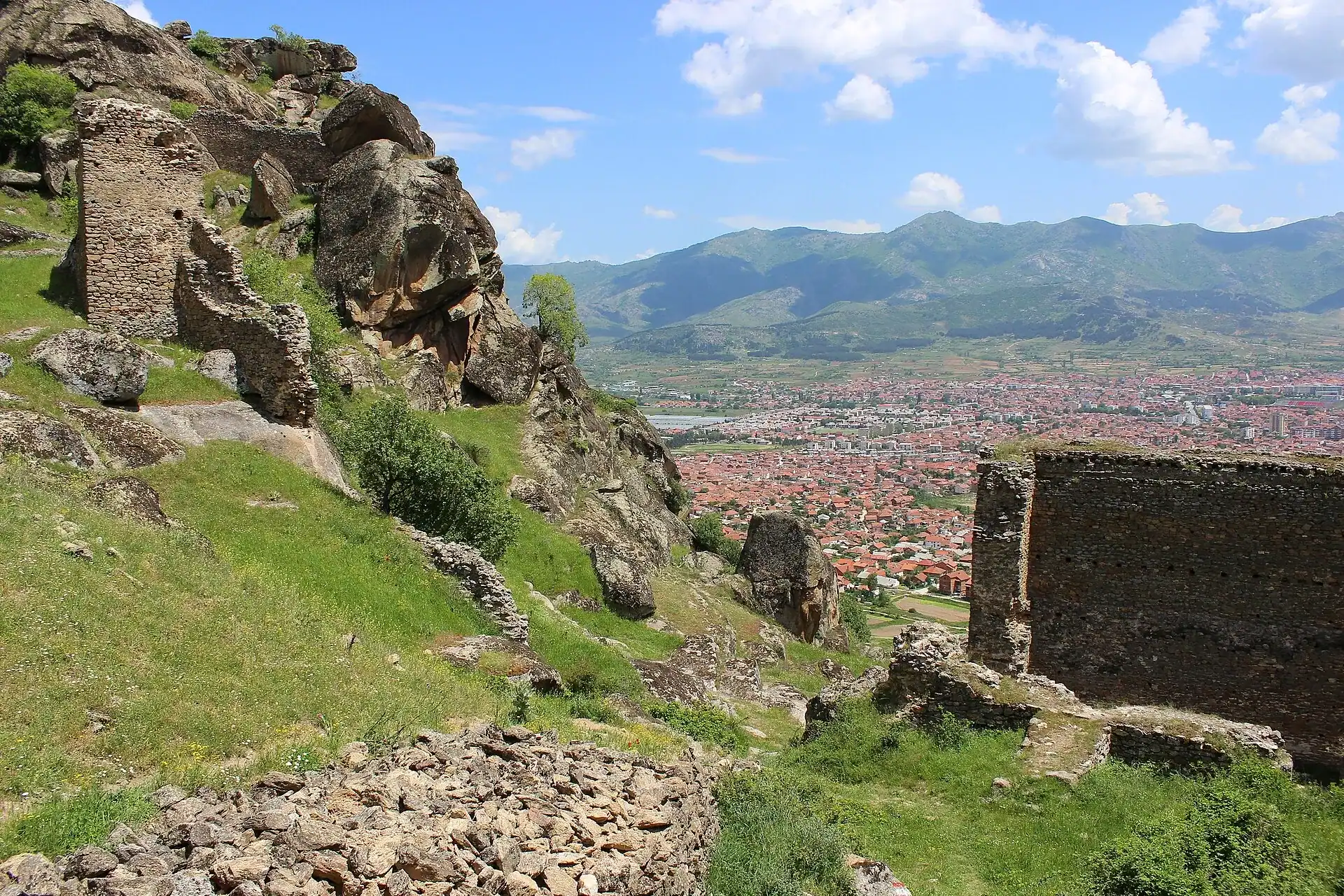 Photo: Risto Rolevski / Wikimedia Commons (CC BY-SA 3.0)