Cost of Living in Siwa
Where this figure comes from. No cost survey covers Siwa, so the $550 a month above is our own estimate rather than a measurement. On 416 of our 999 city guides the figure is built from a published Numbeo basket, a one-bedroom rent in the centre plus one person's monthly costs without rent, converted to USD; this city is not one of them. How we source everything.
Budget roughly $550 a month as a solo remote worker in Siwa, which makes it about as cheap as anywhere habitable. A room or small house in the town runs about $150 to $280, and the eco-lodges built from local kershef mud-brick are more but often negotiable for long stays. Groceries land around $100 to $150; Siwa grows its own dates and olives in enormous quantity and both are excellent and nearly free, while anything trucked in from the coast costs more. A local meal is $2 to $4, a lodge dinner $8 to $14. There is very little to spend money on, which is either the appeal or the difficulty depending on temperament. Cash is the whole system here: the machines that exist run out, there is no branch of any consequence, and the sensible arrangement is to arrive with the stay in notes and keep them somewhere sensible. Nothing outside one or two lodges takes a card. Houses are let by word of mouth rather than advertised, so the way to find one is to stay a week somewhere and ask, and the rate a resident pays is not the rate first quoted to a visitor. Anything trucked in carries the freight of a long desert road in its price.
Where to Work in Siwa
Siwa has no coworking space and no expectation of one. Work happens in your accommodation. Connectivity is the honest obstacle: this is an oasis 550 kilometres from Cairo and 300 from the Mediterranean coast, and while mobile 4G reaches the town and fixed connections exist in the better lodges, speeds are modest and reliability is not guaranteed. Anyone whose work depends on video calls should treat Siwa as a place for asynchronous or offline-heavy work rather than a normal base, and should test any specific accommodation before committing. Power interruptions occur. A local SIM with a large data allowance is the standard arrangement and generally the most reliable option. Work here fits around the heat rather than around a clock, and the local day is split by a long middle that nothing interrupts, which suits an asynchronous job and defeats a scheduled one. The older generation speaks a Berber language first and Arabic second, so a phrasebook aimed at the rest of the country only goes so far in the market. Lodges run on generators when the supply drops, and the better ones say so plainly if asked, which is the question to put before booking anything longer than a week.
Getting Around Siwa
Siwa town is small and the standard local transport is a bicycle or a donkey cart, both of which are genuinely the normal way people move around the oasis. Bicycles can be rented for a couple of dollars a day and cover the town, the springs and the nearer ruins comfortably. For the salt lakes, the Great Sand Sea and Cleopatra's spring, a bicycle or a hired 4x4 works depending on distance. Getting to Siwa is the commitment: buses run from Alexandria in about eight hours and from Cairo in ten to twelve, and there is no airport or railway. Marsa Matruh on the coast is the nearest town of any size, about four hours north.
Sorting transport? Book an airport transfer, or compare car rental on Auto Europe and QEEQ.
Visas for Siwa
Egypt grants most Western passports a 30-day visa on arrival at the airport or through an e-Visa obtained online in advance, and this can be renewed in-country at a passport office. There is no digital nomad visa. Long stays are handled through repeated renewals, which is well established but bureaucratic and generally done in Cairo or Alexandria rather than in Siwa. One important local consideration: Siwa sits close to the Libyan border in a military-sensitive area, and travel into the desert beyond the oasis requires permits arranged through local operators. Foreigners should register as required and follow local guidance. The road in passes a checkpoint where passport details are written down, and that record is the reason a visitor who wanders off a declared route can expect to be found and turned back. Desert travel beyond the cultivation is arranged through a licensed operator who applies for the permit, which takes days rather than hours and cannot be done on the morning of the trip. Driving out there alone is not an option whatever the vehicle. None of this is onerous, but it does make a spontaneous plan impossible.
Best Time to Visit Siwa
October to April is the season in Siwa. Winter days are warm and clear, around 20 to 25 degrees, and the nights are genuinely cold in the desert, dropping close to freezing in December and January, so warm clothing is needed despite the setting. This is when desert trips, the salt lakes and the sand sea are at their best. Summer, May to September, is extreme: temperatures regularly above 40 degrees and often much higher, which makes outdoor activity impractical between mid-morning and evening. The date harvest in October is the oasis's main annual event and a good time to visit. The Siyaha festival, a local reconciliation gathering, falls around the October full moon. Rain is so rare here that when it does come it does damage: the old mud-brick fortress above the town was largely ruined by three days of it in 1926, and the buildings have been repaired against a climate that almost never tests them. The olive pressing follows the date harvest and runs on into the cold months, which is when the oasis is busiest with its own work rather than with visitors. The light in the hour before sunset over the salt lakes is what photographers come for, and it is the one thing here that is reliable.
Pros and Cons of Siwa
Siwa is one of the most striking places in Egypt: an oasis of 300,000 date palms in the western desert, with a ruined mud-brick fortress town, salt lakes you float in, cold and hot springs, and the Great Sand Sea beginning at the edge of the cultivation. It has a distinct Amazigh culture and language quite separate from the rest of Egypt, and costs are extraordinarily low. It is genuinely remote: ten hours from Cairo, no airport, limited healthcare, and internet that will not support a call-heavy job at all. It is conservative and travellers should dress and behave accordingly. Its proximity to the Libyan border means checking travel advice is a necessity, not a formality.
Who Siwa Is For
Somewhere genuinely unlike anywhere else, for asynchronous work that is light on bandwidth and a person content with very little in the way of amenities or company. Writers, researchers and photographers are the people the isolation actually suits, and Amazigh culture and the desert itself are what most of them came for. Treat it as a deliberate stretch of low-cost focus, not somewhere to settle. Almost everybody else will struggle. Reliable internet, healthcare, a social scene and easy travel are all missing, and the oasis is socially conservative in ways that a visitor should understand before arriving rather than discover afterwards. Dahab in Sinai and Alexandria on the coast are the practical Egyptian alternatives with far more infrastructure.
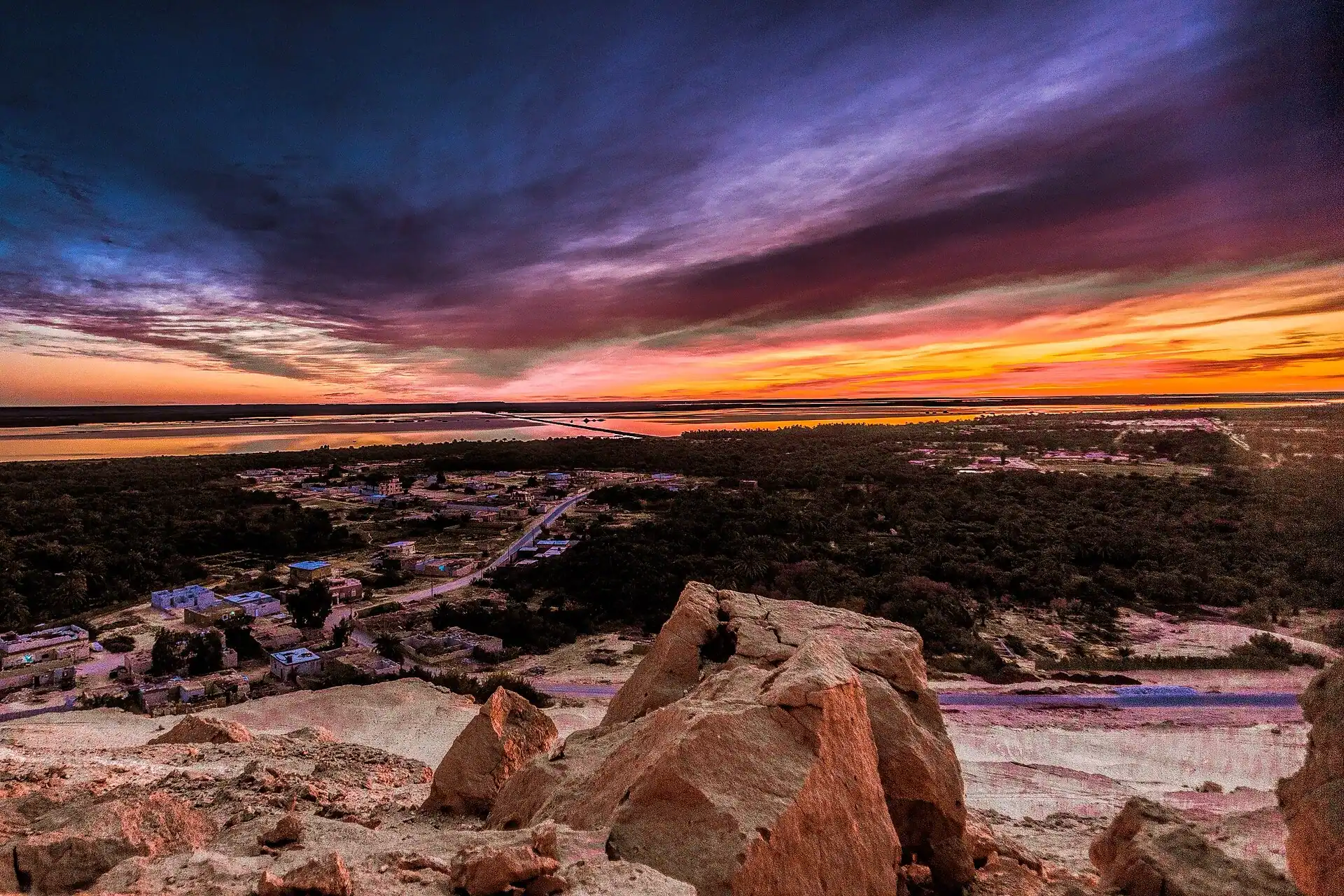 Photo: Adelbayoumi / Wikimedia Commons (CC BY-SA 4.0)