Cost of Living in Hampi
Where this figure comes from. No cost survey covers Hampi, so the $600 a month above is our own estimate rather than a measurement. On 416 of our 999 city guides the figure is built from a published Numbeo basket, a one-bedroom rent in the centre plus one person's monthly costs without rent, converted to USD; this city is not one of them. How we source everything.
Hampi is one of the cheapest places you could base yourself in India, though it is a rural heritage village rather than a city with modern conveniences. A budget of roughly $500 to $800 a month covers a simple guesthouse room, daily meals at traveller cafes and getting around by scooter or coracle. Rooms on the Hippie Island side and around Hampi Bazaar are basic but affordable, and vegetarian thalis cost very little. There is little to spend money on beyond food, lodging and the odd temple visit, so many travellers find their outgoings drop naturally here. These are editorial estimates and prices vary by season. Know one thing before booking anything on the far bank. The guesthouses there have been under repeated pressure from the authorities over building inside the protected zone, and clearances have happened more than once, with places demolished at short notice; what is standing in one season is not guaranteed to be standing the next. Book close to the date rather than months ahead. On the near side, the village itself was cleared years ago for the same reason, which is why the accommodation sits outside the ruins rather than among them and why prices there are steadier.
- Guesthouse room: rustic, cheap and often family run, more basic than a city hotel.
- Meals: simple vegetarian thalis and traveller cafe dishes for very little.
- Transport: scooter hire, coracle river crossings and the odd rickshaw to Hospet.
- Extras: minimal, as there are few shops, bars or paid attractions to tempt you.
Where to Work in Hampi
Hampi is not a digital-nomad hub and there are no coworking spaces or reliable business-grade offices, which is the first thing to settle before choosing it as a work base. Internet is patchy and slow across the whole area, dropping out during power cuts and struggling with video calls. Most people work from their guesthouse veranda or a riverside cafe on the Virupapur Gaddi side, where the Hippie Island vibe is relaxed but the connection is unpredictable. A strong local SIM with mobile data is the most dependable option, and even that can falter. Hampi suits light, offline-friendly tasks and short stays far better than deadline-heavy remote work. The power is the specific constraint rather than the bandwidth. Cuts here are routine, they last hours rather than minutes, and the generators that guesthouses run cover the lights and the fans rather than the router. Nothing you can pack matters more than a laptop that holds a full working day on its own battery. Beyond that, the far bank loses its connection more often than the near one, and the ferry that links them stops at dusk, which is worth knowing if your working day and your accommodation are on opposite sides of the water.
Getting Around Hampi
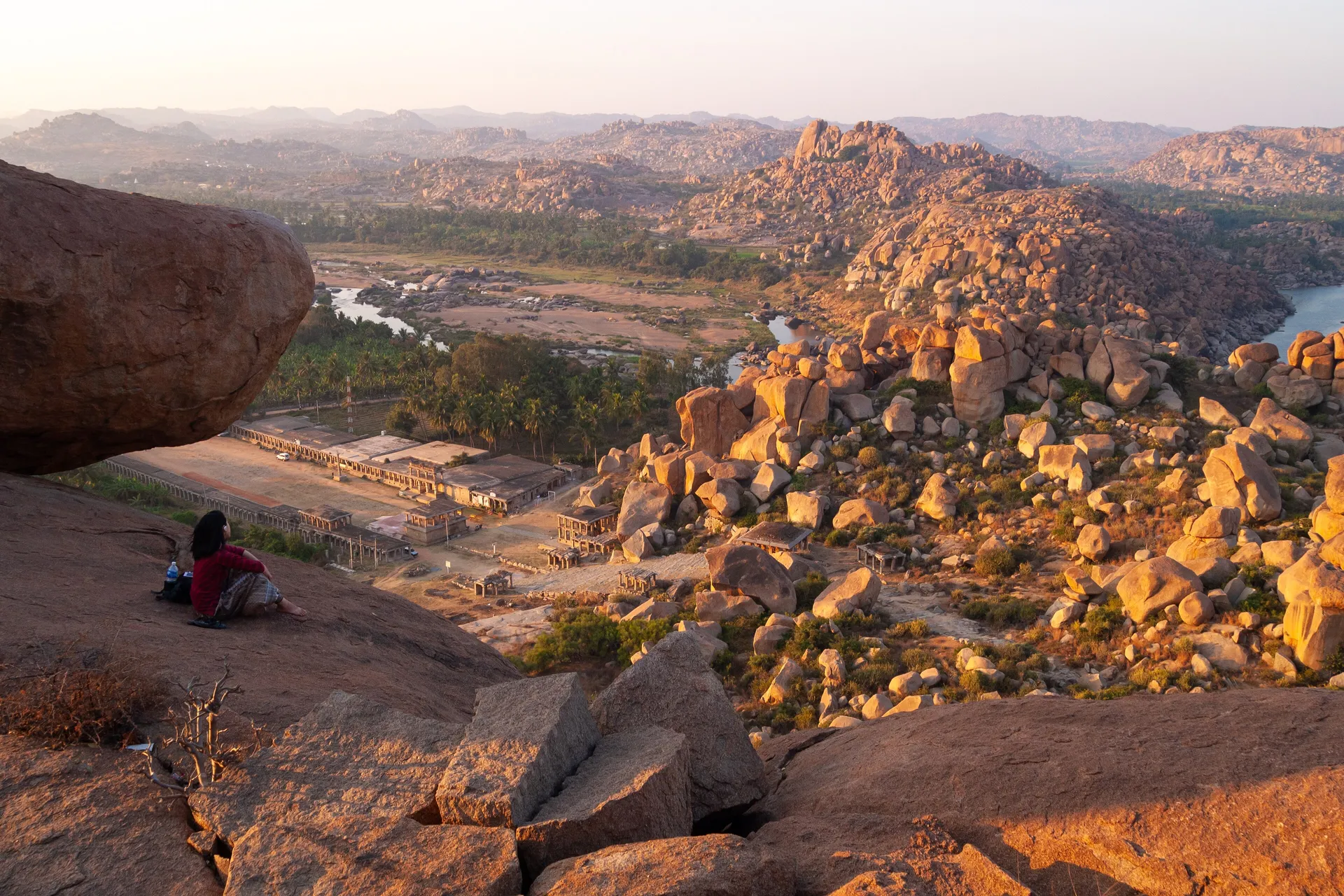
Hampi is small and spread across a landscape of giant granite boulders, ruins and the Tungabhadra river, which splits it into two sides. The temple-town Hampi Bazaar side sits near the working Virupaksha temple, while the laid-back Virupapur Gaddi, known as Hippie Island, lies across the water and is reached by a short coracle crossing or a much longer road loop. Many travellers hire a scooter or bicycle to reach the Vittala temple, the royal enclosure and Matanga Hill for sunset. Autorickshaws handle longer trips. The nearest railhead is Hospet, roughly 30 to 45 minutes away, with train links onward to Bangalore and Goa. The river crossing deserves a warning rather than a mention. The coracle ferry runs in daylight only, stops entirely when the river is high, and the road alternative is a detour of about thirty kilometres, so a stay on the far bank means organising life around a boat that may not run. People have been stranded overnight by it. There have also been serious accidents on overloaded crossings. Take the boat that is not full, wear the jacket if one is offered, and treat the last crossing of the day as a fixed appointment rather than a rough guide.
Sorting transport? Book an airport transfer, or compare car rental on Auto Europe and QEEQ.
Visas for Hampi
Hampi sits in Karnataka, so the rules are simply India's national visa rules. Most visitors arrive on the e-Tourist Visa, an electronic visa you apply for online before travelling, which is convenient and avoids queuing at an embassy. It is issued for tourism and typically allows stays across single or multiple entries depending on the option you select. Hampi has no dedicated visa services of its own, so sort your paperwork well before you arrive in this remote rural corner. A detail specific to a protected site rather than to the country: flying a drone is prohibited across the whole monument zone and enforced, and a tripod or anything that looks professional will be questioned at the ticketed monuments. Permission for commercial filming is a formal application made well in advance. None of that affects an ordinary visitor with a phone. On entry, the electronic permit is accepted only at certain named ports of arrival, so match the approved ones against your actual route rather than against the country; the airport nearest to here is not necessarily among them.
Best Time to Visit Hampi
Hampi has a hot semi-arid climate, so timing matters if you want to enjoy the ruins on foot. The most comfortable months run from roughly October to February, when days are warmer but far more bearable and evenings pleasantly cool for clambering up Matanga Hill at sunset. From March onwards the heat builds sharply, and the pre-monsoon and summer months can be punishingly hot for exploring the exposed granite landscape. The monsoon brings some rain and greener surroundings but also humidity. Aim for the cooler winter window if you can, and start your temple walks early in the day to dodge the fierce midday sun. The heat here is worth a number rather than an adjective. April and May routinely pass forty degrees on exposed granite that has been absorbing sun all day, which makes the ruins genuinely dangerous in the afternoon rather than merely uncomfortable, and the standard local pattern is out at six and indoors by ten. The compensation is that the winter mornings are close to perfect. There is also a music and dance festival held among the monuments in the cool season, which is the one time the site is lit and busy after dark.
Pros and Cons of Hampi
Hampi is a genuinely extraordinary place, a UNESCO World Heritage Site holding the vast ruins of Vijayanagara, once one of the world's great cities, set among surreal boulder-strewn hills. That magic comes with real trade-offs for anyone hoping to live and work here. The infrastructure is basic, the internet weak, the food limited and the amenities few. It rewards slow, curious travellers and punishes those needing reliability or nightlife. Weigh what you value: unforgettable scenery and heritage on one side, and everyday practicality on the other. For a short, unplugged stay the balance tips firmly in Hampi's favour. A single historical fact reframes the whole site and is usually reduced to a sentence. The city was sacked in 1565 after one lost battle, the victorious armies spent months systematically destroying it, and a place that may have held half a million people was abandoned and never reoccupied. What you walk through is not a ruin that decayed; it is a ruin that was deliberately broken and then left. That is why the scale is so strange, why intact temples stand beside smashed ones, and why the landscape reads as emptied rather than merely old. Knowing it changes the experience of a boulder field considerably.
- Pros: jaw-dropping ruins and boulder scenery, very low costs, calm pace, rich culture and history, memorable sunsets.
- Cons: weak patchy internet, no coworking, limited mostly vegetarian food, alcohol restricted near temples, basic infrastructure and few amenities.
Who Hampi Is For
Hampi is for the traveller who wants wonder rather than convenience. If you are a history lover, a photographer, a climber drawn to the famous bouldering, or simply someone craving a quiet, unplugged spell in a landscape unlike anywhere else, this rural heritage site will reward you deeply. It suits flexible remote workers who can front-load their tasks, tolerate a shaky connection and treat Hampi as a short retreat rather than a long-term base. It is a poor fit for anyone needing fast internet, coworking, varied dining or a lively social scene. Come with modest expectations and an open mind, and Hampi will leave a lasting mark. A fortnight is the honest length and a month is generous. What extends it is climbing: the bouldering here draws people who stay for a whole season, running through the cool half of the year, and there is a small established community around it. Everybody else runs out of ruins. Move on to a proper city for the connection and the food, because the nearest one is a night train away and the difference in both is total. And get up for sunrise at least half the days you are here.