Cost of Living in Sao Tome
Where this figure comes from. No cost survey covers Sao Tome, so the $1,100 a month above is our own estimate rather than a measurement. On 416 of our 999 city guides the figure is built from a published Numbeo basket, a one-bedroom rent in the centre plus one person's monthly costs without rent, converted to USD; this city is not one of them. How we source everything.
Budget around $1,100 a month as a solo remote worker in Sao Tome, which is moderate for the region and higher than a country this small might suggest, because almost everything is imported and the islands sit a long way off the West African coast. A one-bedroom place runs roughly $350 to $650. Market food is cheap and the fish is exceptional. The dobra was redenominated in 2018 and is pegged to the euro through an arrangement with Portugal, which removes currency volatility. This is our own estimate rather than measured data. The roças are where the country's accommodation economy quietly sits. These estates, built for cocoa and long since idle, survive in every condition from restored guesthouse to roofless shell with families living in the old workers' quarters, and a room in one is often cheaper and always stranger than a hotel in town. Electricity is expensive and rationed in practice by the cuts. Everything imported arrives through a single small port, so a delayed ship empties the shelves of particular items for weeks at a time and nobody can tell you when they will return.
Where to Work in Sao Tome
Sao Tome's connectivity is weak and it is the main practical constraint. The islands are served by a single submarine cable and domestic prices are high relative to speed, with mobile data from CST and Unitel the usual fallback. Power cuts are frequent and generators are standard in anything serious. There is no coworking. Portuguese is the official language and the language of everything; Forro and the other creoles are spoken at home, and English is genuinely rare. Portuguese is close to necessary here. Anyone working with Europe will find the offset trivial, since the islands keep the same time as London through most of the year. The economy is thinner than the scenery suggests and worth understanding before arriving. Oil was found in the maritime zone shared with Nigeria and a generation of national planning assumed it would arrive, which it has not, leaving cocoa, fishing and aid as the actual pillars. There is no professional network for an outsider to join. What works in practice is a routine built around the power: heavy tasks in the morning when supply is steadier, and everything important saved locally rather than in a browser tab.
Getting Around Sao Tome
The city of Sao Tome is small and its centre around the cathedral, the fort and the market is walkable in half an hour. Shared taxis and motorcycle taxis cover the island cheaply. The main island is only fifty kilometres long and a road runs most of the way round it, though the southern section is rough. Principe, the smaller island, is reached by a short flight or a long boat crossing, and it is quieter and considerably more expensive to stay on. Obo National Park covers roughly a third of the country and its trails start close to the road, which makes the forest unusually accessible. Getting to Principe is the trip that needs planning rather than improvising. The domestic flight takes half an hour on a small aircraft with a strict baggage allowance and sells out around holidays, while the boat is slow, infrequent and genuinely uncomfortable in a swell. Once there, the island has almost no vehicles for hire and lodges arrange transport themselves. On the main island, the road down the east coast is the good one and the western route past the plantations deteriorates the further south it runs.
Sorting transport? Book an airport transfer, or compare car rental on Auto Europe and QEEQ.
Visas for Sao Tome
Sao Tome and Principe abolished visa requirements for citizens of the European Union, the United States and several other countries in 2017, granting stays of up to fifteen days visa-free, with a straightforward e-visa available for longer. That makes entry unusually easy for a country this obscure. There is no remote work visa. Longer stays run through a residence permit applied for locally. A yellow fever certificate is required from endemic countries. The policy has been adjusted more than once. Anyone flying in should note that connections run mainly through Lisbon, Accra and Libreville, and that the schedules are thin enough to shape a trip. Almost every route in passes through Lisbon, and the transit is where the paperwork actually bites: these islands ask for very little, while Portugal is Schengen and admits nobody without whatever their passport requires of them. That reshapes more itineraries than the entry rules here ever do. For a longer stay the residence application is handled locally and slowly, and the country has no scheme aimed at remote workers, so the honest position is that this is a place to visit properly rather than to base yourself.
Best Time to Visit Sao Tome
June to September is the gravana, the main dry season and the practical window, with less rain and daytime temperatures around twenty-eight. A shorter dry spell runs through January and February. The islands sit on the equator and are hot and humid throughout, with the southern half of Sao Tome among the wettest places in Africa. Sea turtles nest on the beaches between October and March and whales pass between July and October, both of which are reasons to time a visit. The southern beaches around Praia Jale and Praia Piscina are the ones worth the drive, and the road to them is rough in any season. Rainfall here varies more by place than by month: the southern half of the main island receives several metres a year while the northeast is comparatively dry, so a wet forecast for the country means very little without knowing which side of it you will be on. The cocoa harvest runs through the second half of the year and the estates are at their most active then. Ilheu das Rolas, off the southern tip, sits on the equator itself with a marker on the line, and a boat out to it is the standard day trip.
Pros and Cons of Sao Tome
Sao Tome and Principe are two volcanic islands on the equator, once the largest cocoa producer in the world, whose abandoned plantation houses stand in the forest with trees growing through them. Principe is a UNESCO Biosphere Reserve with a fraction of a thousand visitors a year. It is safe, the fish and cocoa are exceptional, and almost nobody goes. The internet is poor, Portuguese is essential here, flights are both limited and expensive, and there is very little infrastructure of any kind aimed at visitors. The country also produces some of the finest cocoa in the world from the old plantation estates, several of which now run their own small chocolate operations. Malaria is the health fact that has actually improved here, and dramatically: sustained spraying and bed-net programmes cut cases by a very large margin from the early 2000s, though transmission continues and prophylaxis remains a conversation with a doctor. Anything beyond routine care exceeds what the country's one hospital can offer. Set against the thin infrastructure, the islands have no history of political violence to speak of, elections have changed governments peacefully, and the safety of walking around is not something anyone here worries about.
Who Sao Tome Is For
A Portuguese speaker after somewhere genuinely unvisited and beautiful, with work that does not depend on bandwidth, and an interest in the plantation history or the birdlife, which includes a remarkable number of endemic species for so small a country. Portuguese is doing the work here, the internet is not reliable enough to plan a week around, and anybody on a schedule should reckon with a flight list that is short and a cancellation rate that is not unusual. It also suits birdwatchers, since the islands hold around thirty endemic species in an area smaller than most national parks, which is a density found almost nowhere else. Divers get uncrowded reef with no operators competing for it. Chocolate is the reason a specific sort of traveller comes, since the estates producing single-origin cocoa run tours and several make their own bars, and the quality is taken seriously by people who take that seriously. The realistic stay is two or three weeks, split between the main island and Principe, with slack for the flights. Anyone who wants the Gulf of Guinea with functioning infrastructure should look at Libreville or Douala instead and accept a far less interesting place.
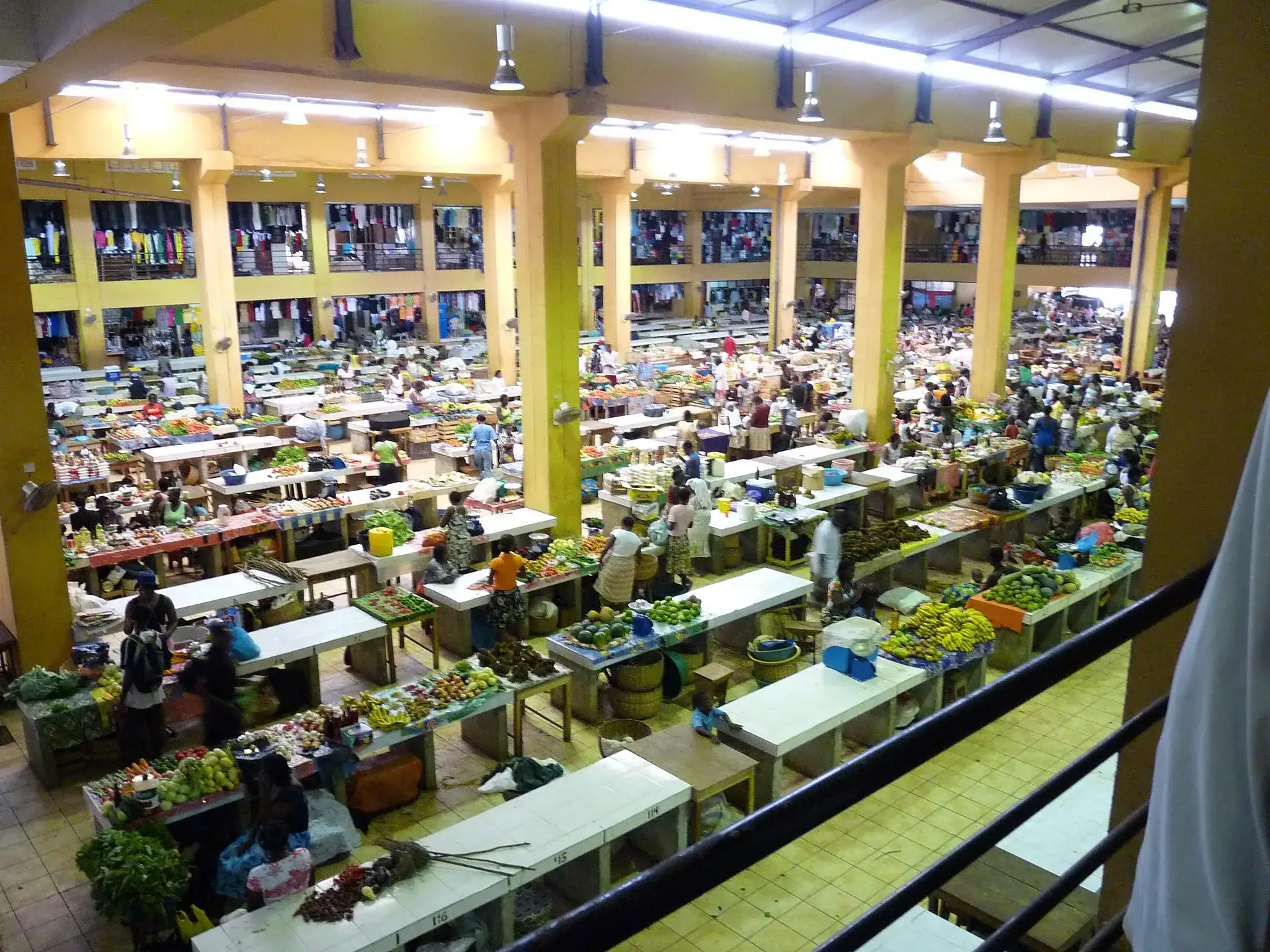 Photo: Bdickerson / Wikimedia Commons (CC BY-SA 3.0)