Cost of Living in Ruse
Where this figure comes from. No cost survey covers Ruse, so the $680 a month above is our own estimate rather than a measurement. On 416 of our 999 city guides the figure is built from a published Numbeo basket, a one-bedroom rent in the centre plus one person's monthly costs without rent, converted to USD; this city is not one of them. How we source everything.
Budget around $680 a month, which makes Ruse one of the cheapest places in the European Union. A one-bedroom runs roughly $200 to $350, with the streets around the main square at the top. Market produce at the covered market is very cheap and Bulgaria grows a great deal of its own food, so vegetables, dairy and wine cost very little. Eating out is inexpensive and a full meal with wine runs under ten dollars in an ordinary place. Utilities are moderate and winter heating is the main variable. Bulgaria adopted the euro in 2026, which removed the lev conversion. Fibre runs about $10 to $15 a month. A coworking desk is $60 to $110. Central heating in the older blocks is district-supplied and billed collectively, which can be cheap or expensive depending on the building rather than on how much you use, and it is worth asking about before signing. Rents in the outer blocks run below the centre by a third and the difference buys a longer walk rather than a worse neighbourhood.
Where to Work in Ruse
Connectivity is good and cheap. Bulgaria has some of the least expensive fibre in Europe, and Ruse is well served, with comprehensive mobile coverage and reliable power. There is a small coworking presence and a growing number of cafes set up for laptop work, helped by a university population. The time zone is two hours ahead of GMT, which puts Ruse an hour ahead of central Europe and gives an excellent overlap with the whole continent and a workable afternoon with the eastern United States. This combination of speed and cost is the city's practical case. Bulgaria's fibre network was built late and largely from scratch, which is why prices compare favourably with almost anywhere in Europe. Ruse also sits close enough to Bucharest that some residents take on work there while paying Bulgarian rents, which is a genuine arbitrage the border no longer complicates. Ruse University supplies a steady flow of engineering graduates and is the reason the city retains any technology employment at all.
Getting Around Ruse
Ruse is flat and compact, and the centre around Svoboda Square is comfortably walkable. Trolleybuses and buses cover the rest cheaply and taxis are very inexpensive. The Danube Bridge, built in the 1950s, crosses to Giurgiu in Romania, and Bucharest is about seventy five kilometres north, roughly ninety minutes by road, which makes Henri Coanda the practical international airport rather than anything in Bulgaria. Trains run south to Sofia in six or seven hours and to Varna on the Black Sea. River cruise ships stop at the quay through the season. The Danube Bridge is the only fixed crossing between Bulgaria and Romania for hundreds of kilometres and carries both road and rail, which is why the queues at it were a fact of life before Schengen and are less so now. A ferry runs further downstream at Silistra. Bucharest's Henri Coanda is closer than Sofia's airport and considerably better connected, which reshapes how anyone here plans a trip out of the country.
Sorting transport? Book an airport transfer, or compare car rental on Auto Europe and QEEQ.
Visas for Ruse
Bulgaria is a member of the European Union and joined the Schengen area fully in 2025, so European Union and EEA citizens may live and work here with no permit and everyone else needs a Schengen visa or residence permit, with the ninety in one hundred and eighty day rule applying to visa-free nationalities. Since the end of that year there has also been a permit for people working remotely for employers outside the EU, reached through the type D long stay visa, alongside the residence permits for the self-employed. Crossing to Romania is now an internal Schengen movement rather than a border check. Bulgaria's full Schengen accession in 2025 means time spent here now counts against a Schengen allowance, which it did not before, and anyone who previously used Bulgaria as a reset between Schengen stays needs to rethink that arrangement entirely. For most non-EU arrivals the external crossing is Bucharest's Henri Coanda airport, so the Entry/Exit System enrolment of your prints and photograph is done there, before the Danube is even in sight.
Best Time to Visit Ruse
May to September is the comfortable window, with July and August around twenty eight degrees and the Danube quay at its best in the evenings. April and October are pleasant and quiet. Winter from December to February is properly cold, often around freezing with fog off the river and occasional snow, and the Danube plain has a reputation for damp cold rather than crisp cold. Air quality is the seasonal problem: winter heating pushes particulate readings up considerably, as it does across much of Bulgaria and Romania. The March Music Days festival, one of the oldest classical festivals in Bulgaria, runs in the spring and is the cultural high point of the city's year. The Danube freezes rarely but the fog off it in December and January is persistent enough to close the bridge occasionally, and the damp cold of the plain is noticeably harder to dress for than a drier equivalent. The Danube quay and the Rowing Canal are where the city exercises through the summer evenings, and both are within walking distance of the centre.
Pros and Cons of Ruse
Ruse is the best-preserved nineteenth century town in Bulgaria, built in Viennese and neo-baroque stone during a period when it was the country's most prosperous city and its window on Europe, and it costs almost nothing at all to live in by European standards. Bucharest is ninety minutes away. The town has been in slow decline since the socialist era, the population has fallen substantially, the air in winter is poor, and there is no international community here at all for a newcomer to fall back on. The Danube itself is industrial rather than scenic here. Ruse was the first Bulgarian city to have a railway, a modern sewer system and a cinema, and the wealth of that period is what built the centre, which is why a city of this size has architecture that would not look out of place in Vienna. The Pantheon of the National Revival Heroes and the Monument of Liberty anchor a centre laid out on a European plan rather than an Ottoman one.
Who Ruse Is For
European Union residency rights, cheap internet and very low costs, which works best for people keeping European hours. Elias Canetti was born in this town and wrote about it at length, and the architecture of the late Ottoman and early independence years still stands to be read alongside him. No international scene exists here, the winter air quality is poor enough to matter for anybody sensitive to it, and the quiet has a cause rather than a charm: three decades of emigration have left the city with fewer people than its architecture was built for. Treating the town as a quiet base for Bucharest is a more serious idea than it first appears. The Romanian capital's flights, concerts and restaurants are ninety minutes up the road, and the border between the two no longer stops anybody. The Rusenski Lom nature park and the rock-hewn churches at Ivanovo lie twenty kilometres south. The UNESCO listing is for the frescoes, cut into the cliff face in the thirteenth century and still there to be looked at. Next to Veliko Tarnovo, Ruse is flatter, cheaper, considerably less picturesque and an hour closer to an international airport.
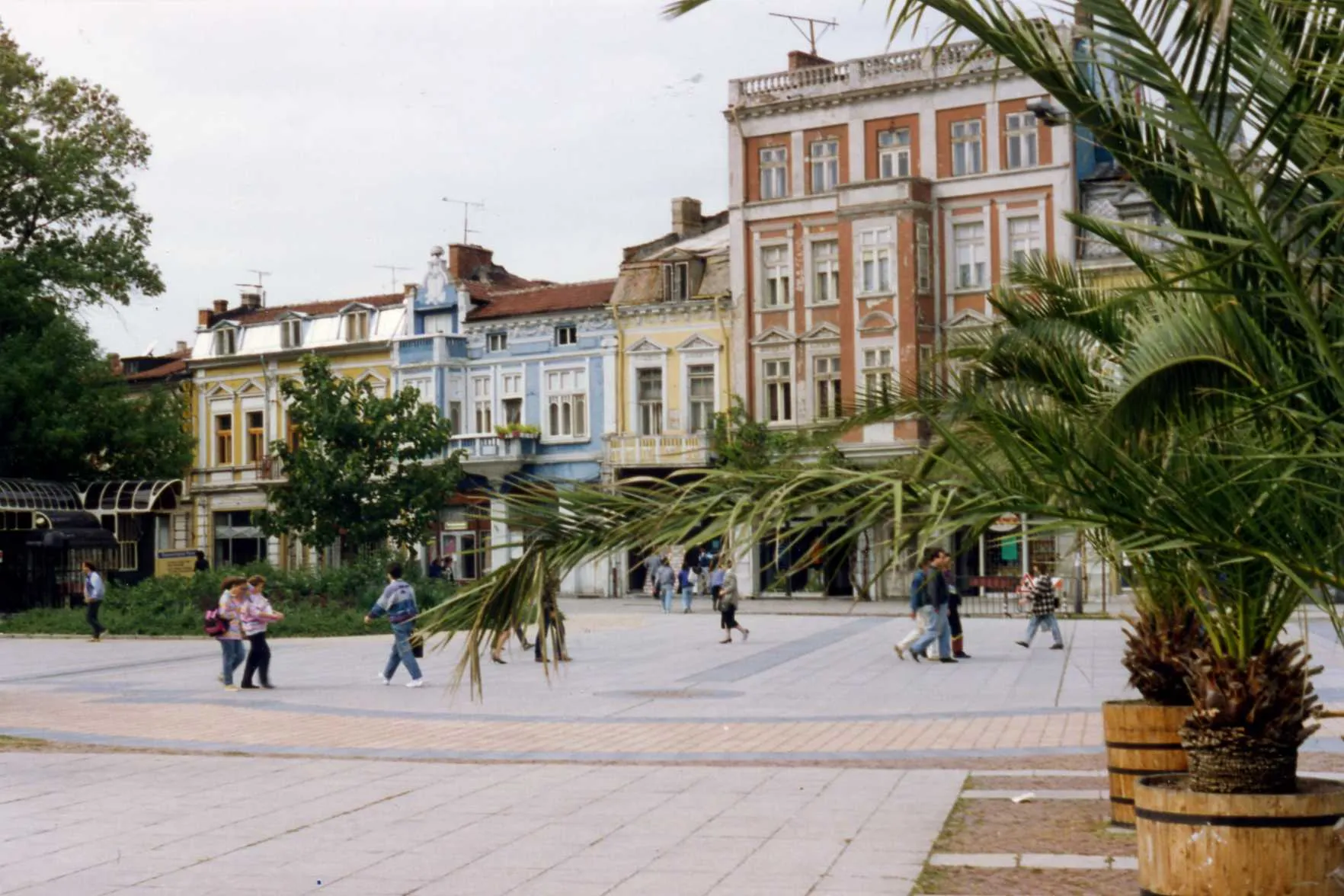 Photo: sludgeulper / Wikimedia Commons (CC BY-SA 2.0)