Cost of Living in Ronda
Where this figure comes from. No cost survey covers Ronda, so the $1,300 a month above is our own estimate rather than a measurement. On 416 of our 999 city guides the figure is built from a published Numbeo basket, a one-bedroom rent in the centre plus one person's monthly costs without rent, converted to USD; this city is not one of them. How we source everything.
Ronda is affordable by Western European standards, cheaper than the Costa del Sol resorts and the big Andalusian cities, though its fame keeps prices above those of sleepier inland towns. A comfortable single-person budget runs roughly $1,100 to $1,600 a month. A furnished one-bedroom in or near the old town costs about $600 to $900, and hearty Andalusian menus del dia and tapas are cheap. These are our editorial estimates in US dollars, with rent the main variable; eating like a local and living slightly outside the tourist core keeps costs comfortably down. The Spanish rental market wants paperwork before it wants money. You need an NIE, the foreigner identification number, before a lease, a utility or a bank account, and landlords commonly ask for a payslip or a contract, which a freelancer abroad does not have; several months paid in advance is the usual substitute. Note also that houses here are built for heat, not cold, and a stone place with no insulation is genuinely uncomfortable in January, so factor in electric heating for two or three months of the year.
- Furnished 1-bed near the centre: roughly $600 to $900 a month
- Menu del dia (set lunch): roughly $12 to $16
- Glass of local Ronda wine: a couple of dollars
- Bus or scenic train toward Malaga or the coast: a few dollars
Where to Work in Ronda
Ronda is a small historic town rather than a nomad hub, so the work scene is modest but workable. Home fibre is available in much of the town and handles calls and everyday work well, and there is a small coworking presence plus plenty of cafes where you can settle in with a laptop. A Movistar, Vodafone or Orange SIM adds cheap mobile data as backup. Ronda shares Spain's time zone, giving comfortable overlap with the rest of Europe. For a scenic base with a slower pace, the connectivity is more than adequate for most remote work, if without a big coworking community. The daily rhythm here is set by the coaches. They arrive from the coast mid-morning, fill the bridge and the main streets until late afternoon, and leave, after which the town belongs to the people who live in it and is one of the pleasantest places in the region to be. Plan the working day around that and it becomes an advantage rather than an irritation. Shops still close in the early afternoon and reopen until eight or nine, dinner starts late, and August is hot enough that most local life moves to the evening entirely.
Getting Around Ronda
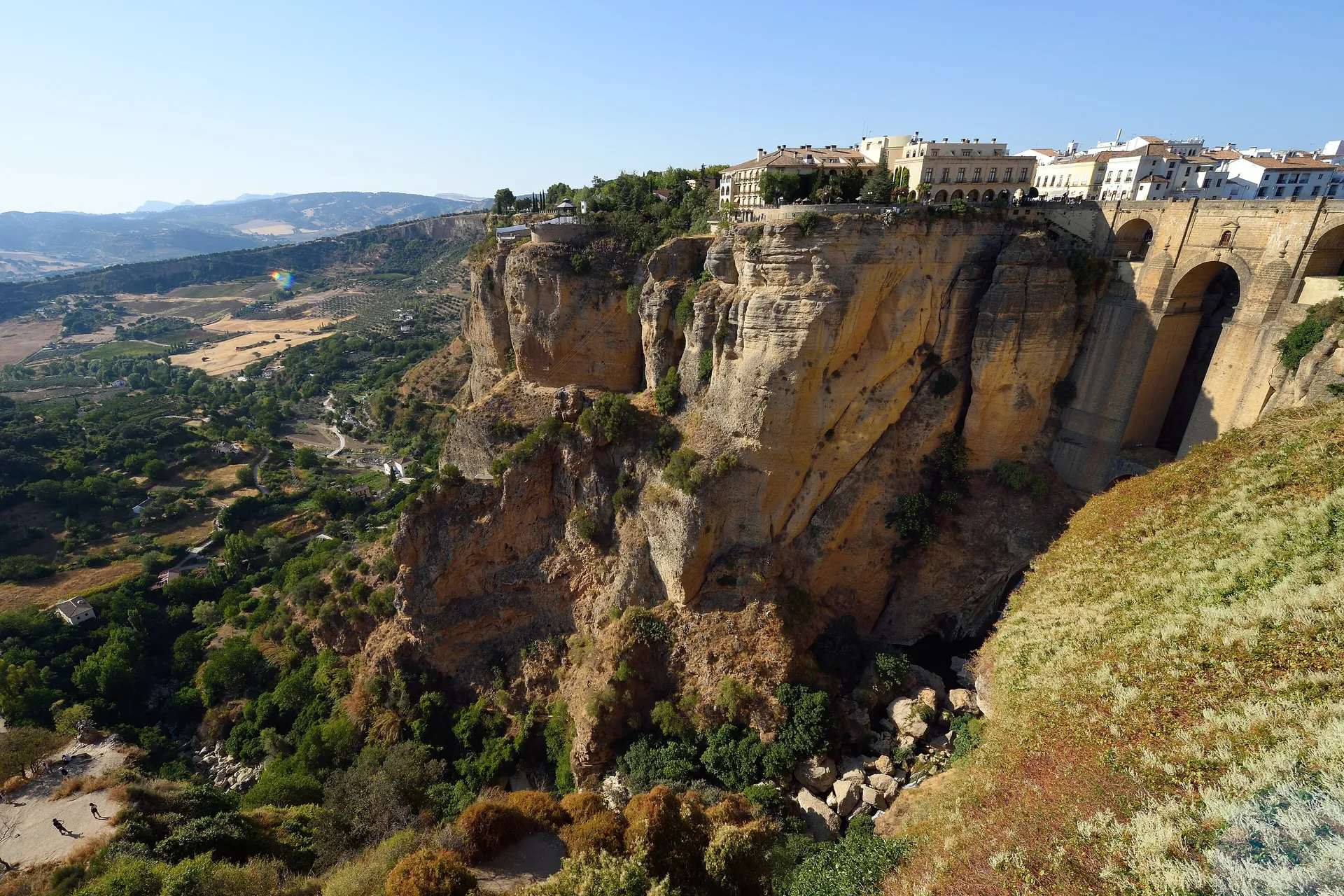
Ronda is compact and highly walkable, with the dramatic gorge, the Puente Nuevo, the old Moorish quarter and the newer town all within an easy stroll, though the climb in and out of the gorge is a workout. For longer trips, buses connect Ronda to Malaga, Seville and the coast, and the scenic railway line down to Algeciras is one of Spain's most beautiful train rides. A car helps for exploring the surrounding white villages, the pueblos blancos, and the vineyards and countryside of the Serrania de Ronda. Malaga's airport is about an hour and a half away. That railway line is beautiful and it is not frequent. A handful of services a day is the reality, so you build the journey around what the timetable offers rather than the reverse, and the bus is often the practical choice despite being less scenic. Getting down to the sea means a spectacular series of hairpins that takes longer than the map suggests and is not a drive to attempt tired. In town, leave the car outside the old quarter; those streets were laid out for mules and the fines are real.
Sorting transport? Book an airport transfer, or compare car rental on Auto Europe and QEEQ.
Visas for Ronda
Ronda is in Spain and the Schengen Area, so most non-EU visitors can stay visa-free for up to 90 days in any 180-day period, while EU and EEA citizens face no limits. For a longer stay, Spain offers a digital nomad visa for remote workers who can show sufficient income from foreign clients or employers, granting residence with the option to renew and bring family. The process involves paperwork and a consulate or in-country application; mind the 90-day Schengen limit if entering visa-free. The tax side is the part worth researching hardest, because it is unusually favourable and unusually easy to get wrong. Holders of the remote-work residence can apply for a special regime taxing employment income at a flat rate up to a high ceiling instead of the progressive scale, for several years, but it has to be claimed within a short window of registering and cannot be added later. Take advice before arriving rather than after. Anyone applying from inside the country on a tourist entry gets a longer initial permit than those applying from a consulate, which is a genuine quirk worth knowing.
Best Time to Visit Ronda
Ronda sits inland at altitude in the Andalusian hills, giving it warm summers and mild but cooler winters than the coast. The best times to visit are spring, from April to June, and autumn, from September to October, when the days are warm and sunny, the countryside is green or golden, and the crowds of summer day-trippers thin out. Summer, from July to August, is hot and busy, with tour buses filling the centre by day. Winter is mild and quiet, with the occasional cold or rainy spell. Aim for the shoulder seasons for the best balance of weather and calm. Early autumn is the date locals plan around. The town holds a festival then whose centrepiece is a bullfight staged in eighteenth-century costume in the oldest ring in the country, and whether or not that appeals, the week around it fills every bed for miles. The other window worth knowing is February, when the almond trees on the hillsides come into blossom and the light is sharp and clear with almost nobody about. Anyone who dislikes crowds should simply avoid the middle of the day through high summer entirely.
Pros and Cons of Ronda
Ronda offers one of Spain's most spectacular settings with the calm of a small town. Calm is accurate for about eighteen hours of each day and wildly inaccurate for the other six. From mid-morning until the light starts to go, this is one of the most visited small towns in the country, with coaches from the coast unloading into a centre built for a few thousand people. Live on the right side of that and it barely touches you; live on the wrong side and it is relentless. The genuine limitation is different and it is professional rather than scenic. A town of thirty thousand in the hills has no industry to plug into, a thin labour market, and a foreign population made up mostly of retirees rather than of people your age doing your kind of work. What it has instead is a setting that people travel a long way to photograph, a food and wine culture that costs very little, and a countryside of white villages and limestone ridges that takes months to exhaust.
- Pros: a jaw-dropping clifftop and gorge setting, a beautiful historic old town, excellent Andalusian food and local wine, genuine safety, a walkable core, easy access to white villages and countryside, and lower costs than the coast or big cities.
- Cons: heavy daytime tourism in peak season, a small nomad community and limited coworking, hot summers, a quieter nightlife, and a modest range of amenities compared with a larger city.
Who Ronda Is For
Ronda suits the remote worker who wants a dramatic, atmospheric Andalusian base with history, nature and great food over a big-city scene. Anyone who loves clifftop views, tapas, wine and exploring white hill villages, and who values safety and a walkable town, will be delighted, especially outside the summer rush. It works well for a medium stay and for those pursuing the Spanish nomad visa. It is a weaker fit for those needing a large nomad community, lively nightlife, or a wide range of city amenities. Come in spring or autumn, base yourself near the old town, and let the gorge and the Serrania set the scene. A workable plan is six months from September, which covers the best weather at both ends and misses the worst of the summer. Take a flat out in the newer streets rather than in the old quarter; it costs less, it is quieter, and the walk in takes ten minutes. Anyone who drives will get far more out of the region than anyone who does not, because the villages that make this corner worth staying in are not on a bus route. And learn enough of the language to hold a conversation, since English drops off sharply the moment you leave the tourist streets.