Cost of Living in Nice
Real market data
Source: Numbeo · Jul 2026
$2,300/moSolo nomad1-bed centre + living costs
$3,260/moCoupleshared 1-bed + costs
$2,170/moLean / localcheaper area + costs
- 1-bed rent, city centre$1,110€962
- 1-bed rent, outside centre$970€845
- Monthly costs excl. rent (1 person)$1,200€1,039
- Meal, inexpensive restaurant$21€18
- Monthly transit pass$52€45
- Buy price, per m² (centre)$7,520€6,529
Prices are from Numbeo (Jul 2026), converted to USD at $1 = €0.87 (01 Aug 2026). The monthly living-costs figure is our transparent one-person basket, groceries, a few meals out, utilities, phone, internet, transport and essentials, priced from those figures. Solo adds central rent; couple and lean are estimates from the same numbers. The guide below quotes its own monthly range, which is a different measurement rather than a competing one: this table prices a defined basket at the figures above, while that range is a judgement about how somebody actually lives here.
Nice sits at the pricier end of French cities, but it is cheaper than Paris. A realistic monthly budget for a solo nomad runs from $2,300 to $3,680 depending on how central your flat is and how often you eat out.
- Rent, central (Carré d'Or, Jean-Médecin, Vieux-Nice): $1,040-1,500/month for a studio or small one-bed.
- Rent, cheaper areas (Libération, Musicians Quarter): $830-1,090/month for a studio; these neighborhoods are still walkable and tram-served.
- Groceries: $290-405/month shopping at Lidl or the covered markets; the Libération market is excellent and affordable for produce.
- Eating out: A plat du jour at a local bistro costs $15-21. Budget $345-575/month if you eat out regularly.
- Coworking hot-desk: $290-460/month at dedicated spaces; drop-in day passes run $23-40.
- Local transport (tram/bus pass): $23/month for an unlimited pass on the Lignes d'Azur network.
- Total range: Around $2,000-2,960/month excluding health insurance and extras.
Nice is not a budget destination, but the quality of life per euro is high. The main costs are rent and eating at cafes on the Prom or in the old town. Cook at home several days a week and you will keep spending in check.
Where to Work
Nice has a solid set of dedicated coworking spaces, and a small but growing scene of genuinely laptop-friendly cafes. Expect to pay for the privilege either way.
Coworking Spaces
Le LABO Coworking (6 Rue du Congrès) is the most community-oriented option, a short walk from the beach with fast WiFi, printing, and secure lockers. Startway Coworking (21 Av. Thiers, near the train station) is larger and brighter, though acoustics can be an issue during busy periods. Paradigm (38 Bis Bd Victor Hugo, Carré d'Or) is a well-equipped choice in the central golden square. Hot-desk rates at most of these run $29-40 per day or $290-405 per month.
Cafe Work Culture
French cafe culture does not revolve around laptops the way it does in Lisbon or Chiang Mai. Many cafes tolerate a laptop for an hour or two, but table pressure at lunch is real and outlets are scarce. A growing number of specialty coffee shops are genuinely remote-work-friendly: Copenhagen Coffee Lab (47 Rue de France), Brume Coffee Shop (Vieux-Nice), The Daily Ric (city center), and Full Bloom Café (near Port) all offer free WiFi and a quieter atmosphere. Buy something every 90 minutes and you will not be rushed out.
WiFi Situation
Fiber connectivity in apartments is widely available and generally fast. Coworking spaces are reliable. Cafe WiFi varies and is sometimes blocked by speed caps. A French SIM with a data plan (Orange, SFR, or Free Mobile) is cheap insurance and costs around $23/month for unlimited 5G data.
Getting Around
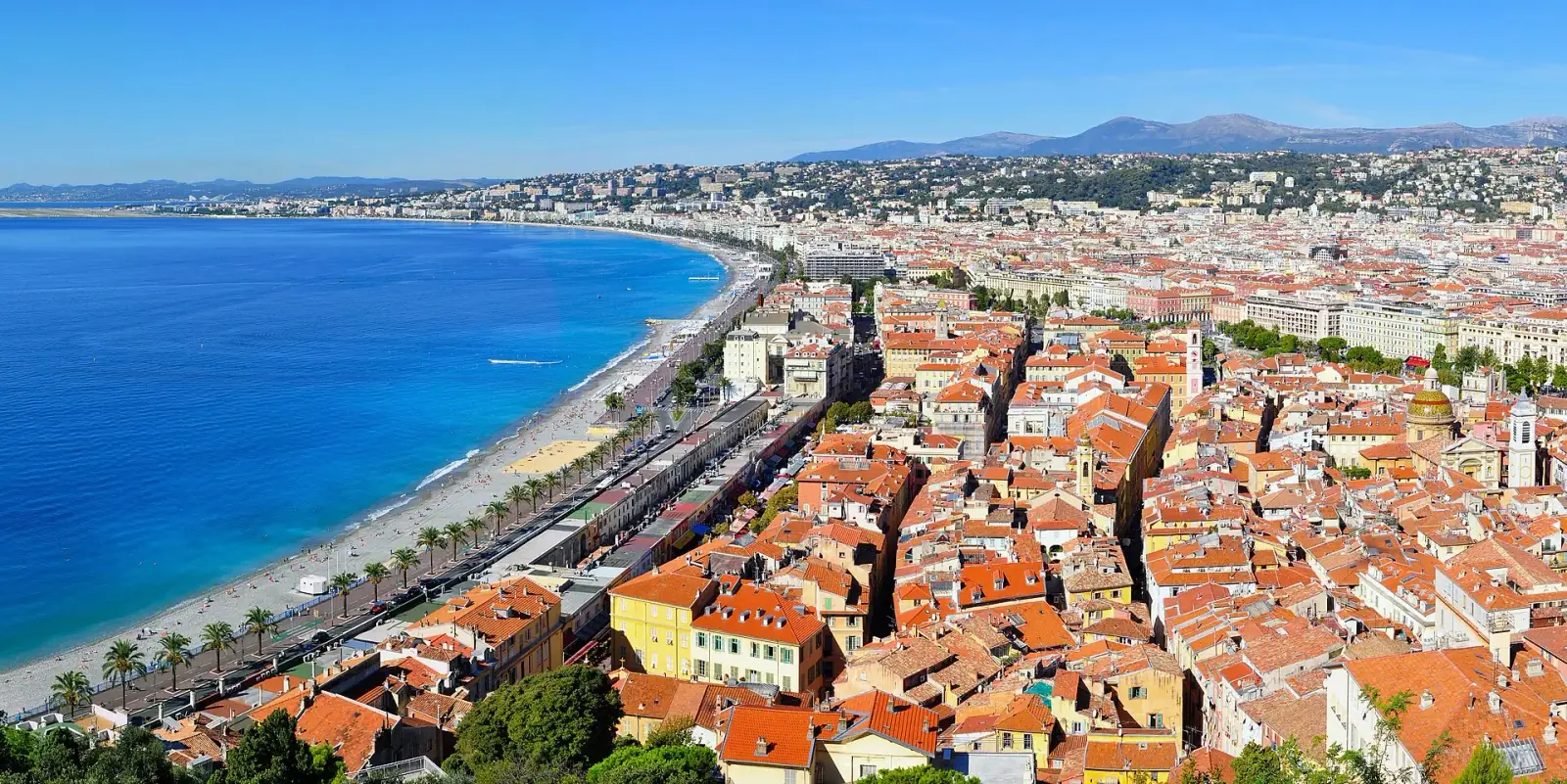
Nice is one of the most walkable cities in France. The city center, old town, the seafront, and the main commercial streets all sit within a compact area you can cross on foot in 30 minutes.
Two tram lines and an extensive bus network cover the city well. A monthly unlimited pass costs just $23. Tram Line 1 runs east-west through the center (Jean-Médecin to the port). Tram Line 2 connects the airport to the port, making it the most useful line for nomads: it runs every 7-8 minutes and takes around 25-30 minutes from either airport terminal to the city center for $2 per trip. There is no need for a taxi from the airport.
The Promenade des Anglais is 7 km of flat seafront walking and cycling path from the airport to the old port. Bike rental and e-scooters are available and practical. A car is unnecessary and actively inconvenient given parking costs and the city's pedestrian-friendly layout.
Sorting transport? Book an airport transfer, or compare car rental on Auto Europe and QEEQ.
Visas and Staying Long-Term
France is part of the Schengen Area. US, Canadian, and Australian passport holders can enter without a visa and stay up to 90 days within any 180-day period. UK citizens (post-Brexit) have the same 90/180-day limit under Schengen rules. There is no dedicated digital nomad visa for France as of mid-2026.
For stays beyond 90 days, the most practical legal route is the Long-Stay Visitor Visa (VLS-TS) or the Profession Liberale visa for freelancers with foreign-based clients. Note that France tightened enforcement in 2025: remote work on the visitor visa has been officially restricted, and some prefectures have refused renewals where remote work was disclosed. If you intend to work remotely beyond 90 days, the Profession Liberale visa is the safer route, but it requires documentation of freelance income and a French address.
Best Time to Visit
Nice enjoys a Mediterranean climate: hot dry summers, mild winters, and roughly 300 days of sunshine per year. For remote work, the best windows are April to June and September to October. Temperatures sit between 18-26°C (64-79°F), there are far fewer tourists, cafe tables are available, and rents for short-stay furnished flats are lower.
July and August are peak season. Temperatures hit 30-35°C (86-95°F), the city is packed, prices rise sharply, and coworking spaces fill up. Productivity can suffer when the entire Promenade calls you to the beach. November to February is quiet, occasionally rainy, and some restaurants close, but the city remains beautiful, costs drop, and you will have coworking spaces largely to yourself. Winter temperatures rarely fall below 8°C (46°F).
Pros and Cons
- Pro: Exceptional quality of life: beaches, mountains, and Provençal food all within reach.
- Pro: Compact, walkable, and well-connected city with a reliable tram and a major international airport.
- Pro: Strong coworking infrastructure for a city its size.
- Pro: Direct flights to much of Europe, and Italy is 30 minutes by train.
- Pro: Excellent Mediterranean diet food scene, including one of the best daily markets in France.
- Con: Expensive by Southern European standards; rent in particular has risen sharply since 2022.
- Con: No dedicated digital nomad visa; legal long-stay options require paperwork and careful planning.
- Con: Cafe work culture is not as permissive as in Southeast Asia or Eastern Europe.
- Con: English is less common outside the tourist strip; everyday errands benefit from basic French.
- Con: Summer overcrowding makes July and August genuinely difficult for focused work.
Who Nice Is Best For
Nice suits nomads who earn in a strong currency (USD, GBP, CHF) and want a European base with genuine lifestyle quality rather than rock-bottom costs. It is a strong fit for people who value outdoor access, top-tier food, easy travel, and a city that feels like a real place rather than a tourist hub. The 90-day Schengen window works well for slow travelers who rotate between European countries.
It is a less good fit for nomads on a tight budget (Southeast Asia or the Balkans offer far more value), those who need a thriving English-speaking nomad community, or anyone who wants to plant roots for six-plus months without navigating French visa bureaucracy. If you want beach life with lower costs, Bali and Tbilisi will stretch the same money much further. If you want France at a lower price point, consider Montpellier or Marseille instead.