Cost of Living in Manarola
Where this figure comes from. No cost survey covers Manarola, so the $1,300 a month above is our own estimate rather than a measurement. On 416 of our 999 city guides the figure is built from a published Numbeo basket, a one-bedroom rent in the centre plus one person's monthly costs without rent, converted to USD; this city is not one of them. How we source everything.
Manarola is one of the most expensive small villages in Italy to stay in, and it is worth saying plainly upfront: this is not a budget base. A private studio or room in a converted fisherman's house typically runs $105 to $205 a night in peak season (May to September), dropping to $69 to $115 in the quieter months. Monthly rentals are scarce because almost every unit is run as a short-term tourist let, but if you can find one, expect $2,070 to $3,450 for a small one-bedroom, more if it has a sea view. A simple lunch of focaccia and a coffee costs $7 to $12, while a sit-down seafood dinner with wine at a harbourside restaurant easily reaches $52 to $81 per person. Grocery prices are inflated compared to inland Liguria since almost everything arrives by train or boat. Budget $2,880 to $4,600 a month all-in for a comfortable stay, and that is before factoring in the Cinque Terre Card (around $8.50 to $23 a day) needed for trail access. Off-season, costs soften noticeably, but so does the village itself, with many restaurants and shops closing for weeks at a time.
Where to Work in Manarola
There is no coworking space in Manarola, and there likely never will be given the village's footprint of a few hundred residents squeezed onto a cliffside. Remote work here means a laptop on a café terrace or the small terrace bar overlooking the harbour, with wifi quality that varies from decent to frustrating depending on the season and how many tourists are simultaneously trying to upload photos. Cell signal (Italian carriers TIM, Vodafone, WindTre) is generally reliable for tethering and often more dependable than café wifi. Serious video calls are a gamble here: the terrain, the crowds, and the limited fibre infrastructure all work against you. Most people who need to actually produce work treat Manarola as a place to sleep and wander rather than a place to sit at a desk for eight hours; they base themselves in La Spezia, which has proper apartments, better connectivity, and a direct rail line into all five villages, and commute in for the scenery. If you do work from Manarola, mornings before the day-trip crowds arrive (roughly 7 to 9:30am) are the calmest window.
Getting Around Manarola
Manarola has no cars, no scooters, and essentially no roads beyond service access, which is part of its charm and part of its logistical challenge. Everyone arrives by the Cinque Terre regional train line, which connects La Spezia and Genoa, stopping at all five villages roughly every 15 to 30 minutes depending on the season. Driving is not really an option: if you come by car you park in La Spezia or the hillside lots above the villages (Volastra has a small car park) and walk or bus down, since Manarola itself has no visitor parking. Within the village, everything is on foot, and it means stairs: steep stone staircases connect the harbour to the upper streets and the train station, which is genuinely tough with luggage or mobility limitations. The famous Sentiero Azzurro (Blue Trail) links the villages along the cliffs, though sections between Manarola and its neighbours have periodically been closed for landslide repair, so check current status before planning a hike. Local ferries run in high season between villages and to La Spezia and Portovenere, weather permitting, offering a scenic alternative to the train.
Sorting transport? Book an airport transfer, or compare car rental on Auto Europe and QEEQ.
Visas for Manarola
Manarola sits in Italy, a Schengen Area country, so the same rules apply here as anywhere else in the zone. Most Western passport holders (US, UK, Canada, Australia and others) can stay visa-free for up to 90 days within any 180-day period for tourism or informal remote work. Italy also offers a dedicated digital nomad and remote worker visa, launched in 2024, aimed at non-EU remote employees and freelancers with a minimum income threshold (about $28,540 a year, three times Italy's income threshold for exemption from health charges) and proof of remote employment or a portfolio of clients; it requires applying at an Italian consulate before travel. Freelancers can alternatively look at Italy's self-employment visa route, though it is quota-limited and paperwork-heavy. In practice, almost nobody bases a long-term visa application around Manarola itself, since the village lacks the residency infrastructure, housing stock, and questura (immigration office) access that a longer stay requires; that administrative work happens in La Spezia or a larger city, with Manarola treated as a side trip. The record the Entry/Exit System opens at your first external crossing stays on file for three years, which is why a return for the next spring's hiking season takes a brief identity check at the airport instead of a full new registration.
Best Time to Visit Manarola
Late spring (May to mid-June) and early autumn (September to mid-October) are the sweet spot: warm Mediterranean weather, swimmable sea, blooming or harvest-ready vineyard terraces, and noticeably thinner crowds than July and August. Summer brings reliably sunny, hot weather (highs around 27-30C) but also the heaviest cruise-ship and day-tripper crowds, when the harbour and main street can feel uncomfortably packed by midday. Winter (December to February) is mild by northern European standards (daytime highs around 10-13C) but genuinely sleepy: many restaurants, shops, and even some trail sections close, ferries stop running, and the village can feel half-shuttered. Rain and occasional storms hit hardest in autumn and can trigger trail closures due to landslide risk, so shoulder-season visitors should stay flexible. For anyone combining remote work with sightseeing, April through early June offers the best balance of manageable crowds, open trails, and pleasant working weather.
Pros and Cons of Manarola
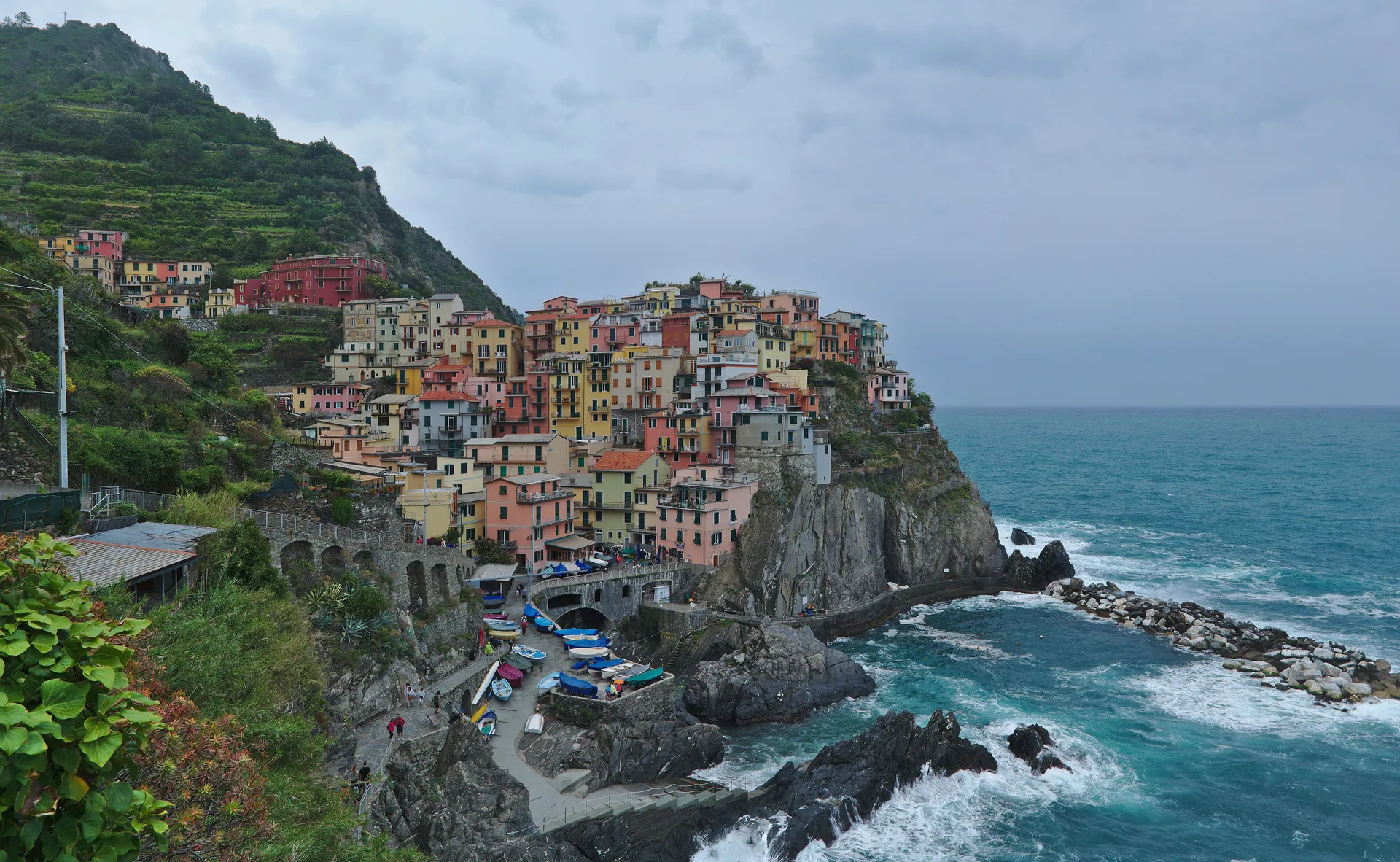
The pros are obvious the moment you step off the train: pastel houses stacked above a tiny natural harbour, terraced vineyards producing the local Sciacchetra dessert wine, clifftop trail views over the Ligurian Sea, and a genuine sense of having landed somewhere out of a postcard. It is compact, walkable (steps aside), and safe, with warm, unpretentious local food. The cons are equally real: it is tiny, meaning there is very little to actually do once you have walked the harbour and hiked the trails a few times, prices are high relative to the amenities on offer, the steps are unavoidable and hard on knees or luggage, mobile data and wifi are inconsistent, and in peak season the village can feel more like a cruise-excursion stop than a place to live. There is essentially no long-term rental market, no coworking, and a very thin English-speaking service base outside of tourism staff.
Who Manarola Is For
Manarola suits remote workers looking for a short, scenic detour rather than a home base: a long weekend or a week tacked onto a longer Italy stay, ideally combined with a more practical anchor point like La Spezia or Genoa where the actual work gets done. It rewards people who value hiking, photography, wine, and seafood over nightlife, fast wifi, or a wide social scene, and who are comfortable with stairs and small-village limitations. It is a poor fit for anyone needing consistent connectivity, a coworking community, budget living, or car access. Think of it less as a nomad base and more as a reward you build a work trip around: come for a few unforgettable days, then move on to somewhere with the infrastructure to actually get things done.