Cost of Living in Madurai
Where this figure comes from. No cost survey covers Madurai, so the $470 a month above is our own estimate rather than a measurement. On 416 of our 999 city guides the figure is built from a published Numbeo basket, a one-bedroom rent in the centre plus one person's monthly costs without rent, converted to USD; this city is not one of them. How we source everything.
Budget around $470 a month, which makes Madurai one of the least expensive cities on this site. A one-bedroom runs roughly $100 to $250, with the areas near the temple and the newer suburbs at either end of that. Market produce is very cheap and Tamil Nadu grows a great deal of its own food. Eating out costs almost nothing: a full meal on a banana leaf at one of the mess halls runs a couple of dollars and is among the best food in India. Utilities are cheap. Imported goods and Western groceries carry a markup and the choice is limited compared with Chennai or Bengaluru. Fibre runs about $8 to $12 a month, which is among the best value anywhere on this site. A full South Indian meals plate on a banana leaf costs well under a dollar and is what most of the city eats at lunch. Autorickshaws are a dollar or two across the centre, and the main variable in a monthly budget is whether the flat has air conditioning for the hot months, which it should.
Where to Work in Madurai
Connectivity is reasonable. Fibre from Jio, Airtel and BSNL reaches most of the city at good speeds and low prices, and mobile data in India remains among the cheapest anywhere. Power cuts happen but are shorter and less frequent than they were. There is a small coworking scene serving the local IT and startup sector, which is real but modest next to Chennai's. The time zone is five and a half hours ahead of GMT, which gives a full European working overlap in the afternoon and an early morning with East Asia. Summer heat makes air conditioning a working requirement rather than a comfort from April onwards. Coworking desks run about $50 to $90 a month, which is modest even by Indian standards. The city's economy is textiles, temple tourism and increasingly software services, and the professional population that supports what coworking exists comes from the local engineering colleges rather than from anywhere else.
Getting Around Madurai
Madurai is dense and best covered by autorickshaw, which is cheap and everywhere, with ride-hailing apps working reliably. The area around the Meenakshi temple is walkable and closed to vehicles in parts, which makes it the most pleasant part of the city on foot. City buses are very cheap and crowded. Madurai Junction is a major railway station with overnight services to Chennai, Bengaluru and Kerala, and the trains are the sensible way to move around south India. Madurai Airport has domestic flights and a small number of regional international ones to Colombo, Dubai and Singapore. Rameswaram and the Pamban rail bridge are about three hours southeast, and the new vertical-lift bridge that replaced the century-old cantilever opened in 2024. Kodaikanal in the Western Ghats is a similar distance west and around 2,100 metres up, which is the standard escape from the April heat. Overnight buses leave for the hill country to the west every evening, climbing out of the plain and over a state line while everybody sleeps, which is how most people here take a weekend away from the heat. The mountain section is done in the dark, restful or alarming depending on the passenger.
Sorting transport? Book an airport transfer, or compare car rental on Auto Europe and QEEQ.
Visas for Madurai
India requires a visa of almost every nationality. The e-Visa is the practical route: a tourist e-Visa is issued for thirty days, one year or five years depending on the option chosen, applied for online several days before travel, and it is valid for arrival at Madurai among other airports. Business and employment visas are separate categories with their own requirements. There is no remote work visa, and working on a tourist visa is not permitted. Overstaying is taken seriously. Registration is required for some longer visa types within a fortnight of arrival, which catches people out. On the longer versions the total is capped at a hundred and eighty days in India per calendar year, which trips up anybody assuming a five-year document means five continuous years in the country. There is no nomad visa and FRRO registration applies beyond a hundred and eighty days, so a long stay is built around exits and fresh entries.
Best Time to Visit Madurai
November to February is the only comfortable window, warm at around thirty degrees with lower humidity and cooler evenings. March to June is severe, regularly above forty and among the hottest periods anywhere in India, with the city visibly slowing down in the afternoons. The northeast monsoon brings rain in October and November, heavy but not usually disruptive. The Chithirai festival in April and May is the year's great event, when a million people come for the celestial wedding of Meenakshi and Sundareswarar, and accommodation is impossible without booking months ahead. The Jallikattu bull-taming events around Pongal in January take place in villages near the city and draw very large crowds, and the practice was the subject of a Supreme Court ban and a subsequent state law that restored it, which makes it politically charged as well as popular. The jasmine grown around this city carries a protected name of its own, and the flower market opens well before dawn with the whole day's crop weighed, sold and gone by seven in the morning. The scent of it through the older streets in the hot months is the strongest argument anybody has for being up that early.
Pros and Cons of Madurai
The Meenakshi Amman temple is not a monument but a working temple that fifteen thousand people pass through every day, with fourteen gopurams covered in thousands of painted figures and a hall of a thousand carved pillars at its centre. The city has been continuously inhabited for well over two thousand years and appears in Greek and Roman records. Food is exceptional and costs nothing. The heat is punishing, the air quality is poor, the traffic and the noise are both constant, and the city makes very few concessions to visitors. There is almost no remote worker presence. The temple's Pottramarai Kulam, the golden lotus tank, and the surrounding concentric streets follow a plan laid out on Vastu principles, so the city's whole street grid radiates from the sanctuary in a way that is visible on any map and unusual even in south India.
Who Madurai Is For
Anyone interested in living Hindu practice rather than monuments, since the temple is the centre of daily life at a scale that is difficult to find anywhere else. It suits people who take food seriously, because Tamil vegetarian cooking is at its best in these streets. It suits anyone on a tight budget. Quiet, clean air and Western comfort are three things a dense Tamil temple city does not set out to provide. March to June is the specific window to avoid, because the heat then is genuinely dangerous rather than merely unpleasant and it kills people every year. Madurai was the seat of the Sangam academies, and it claims a continuous urban record longer than almost any other city in India, which makes Tamil literature and history a serious reason to be here and not a footnote to the temple.
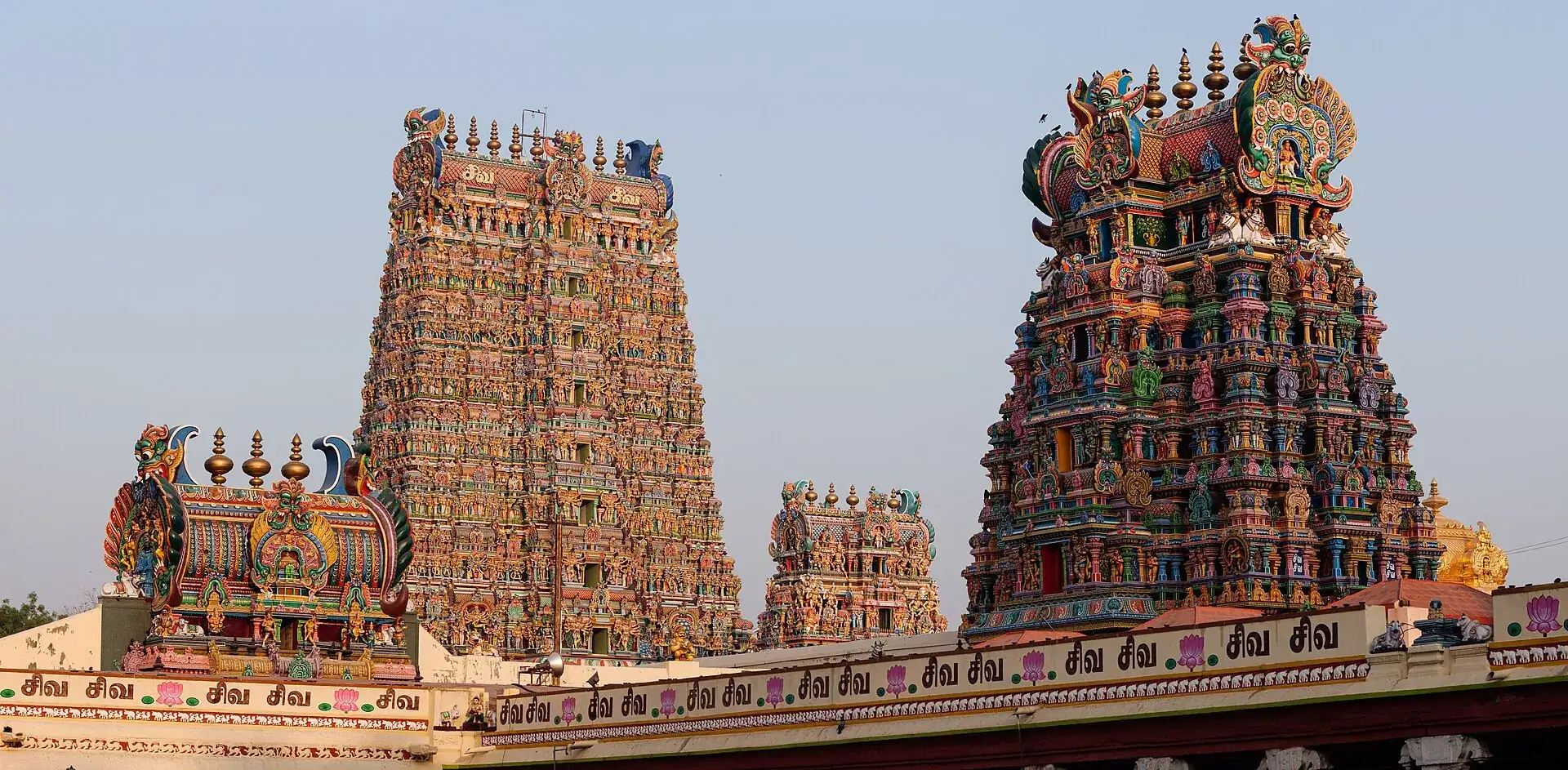 Photo: KennyOMG / Wikimedia Commons (CC BY-SA 4.0)