Cost of Living in Multan
Where this figure comes from. No cost survey covers Multan, so the $420 a month above is our own estimate rather than a measurement. On 416 of our 999 city guides the figure is built from a published Numbeo basket, a one-bedroom rent in the centre plus one person's monthly costs without rent, converted to USD; this city is not one of them. How we source everything.
Multan runs about $420 a month for one person, which makes it one of the cheapest cities anywhere on this site. A furnished one-bedroom in Gulgasht or Model Town is $90 to $170, and older parts of the city are cheaper again. Food costs very little: a plate of nihari or a seer of Multani sohan halwa is a couple of dollars, and a full restaurant meal for two rarely passes $10. There is essentially no coworking market, so budget for home internet instead. Fibre or cable broadband is $10 to $18 a month. Rickshaws are under a dollar across the centre. Utilities are the variable, since summer cooling can add $40 to $70. Electricity bills carry so much in taxes, fuel adjustments and surcharges that the units consumed are often the smaller half of the total, which is why residents talk about the bill rather than about the tariff. Piped gas reaches the older districts and is cheap, though the pressure drops in the coldest weeks when demand peaks. Rent is often asked half a year in advance and paid in cash, since a foreigner without residence will find opening a local account slow going. Almost nothing outside the newer supermarkets takes a card.
Where to Work in Multan
Multan has no meaningful coworking sector, so working here means a flat with a good connection. Fibre has reached Model Town, Gulgasht and Cantt through PTCL, Nayatel and local operators, at $10 to $18 a month, and it is the single most important thing to check before signing for a place. Mobile data from Jazz or Zong is a workable backup and cheap. Cafes exist around Bosan Road and the newer commercial strips but are social spaces rather than places to sit with a laptop. The real constraint is load shedding: scheduled power cuts are still common in summer, so a UPS or an inverter is essential rather than optional.
Getting Around Multan
Multan is flat and the old city around the shrines is walkable, though the traffic on the arterial roads is not. Autorickshaws and the Qingqi share-rickshaws cover the city for well under a dollar, and Careem and inDrive both operate. The Multan Metrobus runs a dedicated corridor across the city and costs a few cents. A motorcycle is what most residents use. The railway station puts you on the main line between Karachi and Lahore, with Lahore about four to five hours by fast train. Multan International Airport handles domestic flights plus Gulf routes to Dubai, Sharjah, Doha and Jeddah, which makes arriving from outside Pakistan reasonably simple. The motorway network reached the city in the last decade and a half, with a southbound stretch opened in 2019 that cut the run to the port cities to a single long day of driving, and the coaches that use it are air conditioned and punctual in a way the trains are not. Within the city the ring road is the way to avoid the centre entirely, and it is worth the extra distance at almost any hour. Motorcycle rickshaws take the narrow lanes of the walled city where a car simply cannot go, which is most of the historic quarter.
Sorting transport? Book an airport transfer, or compare car rental on Auto Europe and QEEQ.
Visas for Multan
Pakistan overhauled its visa system and most nationalities can now apply online through the NADRA visa portal, with tourist visas commonly issued for three months and business visas for longer. Processing is usually quick and a sponsor is no longer required for tourism from most countries. There is no digital nomad visa. Extensions are handled online but are not guaranteed. The practical constraint is not the visa but the travel advice: several governments advise against travel to parts of Pakistan, and southern Punjab is treated more cautiously than Lahore or Islamabad. Foreigners in some districts are subject to police registration and occasionally to a mandatory escort, which affects how freely you can move. Anyone with a parent or grandparent born in the country can apply for an origin card instead of a visa, which removes the entry question altogether and is the route most of the diaspora uses. A no objection certificate is needed before travelling to several districts and is applied for through the interior ministry rather than arranged locally, so a plan involving the western provinces has to be made weeks ahead. Insurance is the practical block rather than the paperwork: a policy that excludes countries under a government advisory will not pay out here at all.
Best Time to Visit Multan
November to March is the only sensible window. Winter days are mild at 20C to 25C with cold nights, and December and January bring fog that regularly disrupts flights and road travel across Punjab. April to June is extreme: Multan is one of the hottest cities in Pakistan and 45C is a normal May afternoon, with dust storms on top. The monsoon reaches here weakly in July and August, adding humidity to the heat without much relief, though it can also flood. September and October are hot but improving. Urs festivals at the shrines of Bahauddin Zakariya and Shah Rukn-e-Alam are the events worth timing around, both in the cooler half of the year. Ramadan moves through the calendar by eleven days a year, and when it lands in the hot months the whole city inverts: nothing is open in daylight, everything is open at night, and a visitor who has not planned for it will find the working day unrecognisable. The mango orchards around the city ripen in sequence through the worst of the heat, variety after variety, and the crop is the one thing that makes the hot season worth being here for. Dry heat gives way to a sticky kind once the rains arrive further east.
Pros and Cons of Multan
History and price are the reasons to come to Multan. It is one of the oldest continuously inhabited cities in South Asia, its Sufi shrines are extraordinary and the blue-tiled Multani kashi work on them is unlike anything else in the region, and the whole month costs less than a week in Western Europe. The mangoes are the best in the country. Food is superb and cheap. What is stacked against it runs long, and it runs like this: no coworking, no foreign community, summer heat that makes four months unworkable, load shedding, poor air quality, limited English outside educated circles, and travel advisories that will complicate your insurance. Alcohol is effectively unavailable and nightlife does not exist.
Who Multan Is For
An experienced traveller with a specific reason to be in southern Punjab: Sufi architecture, Pakistani history, family connections, or work in the region. It is not a place you drift into. If you have been to Pakistan before, know how the registration rules work in your district and have a flat with fibre and an inverter, the cost of living is remarkable and the city rewards attention. South Asia should be learned somewhere else first. Nobody else is working remotely here to fall in with, insurance that excludes advisory areas will not cover a stay, and April to June is a stretch nobody should choose deliberately. Lahore is the sane entry point to Pakistan for a newcomer.
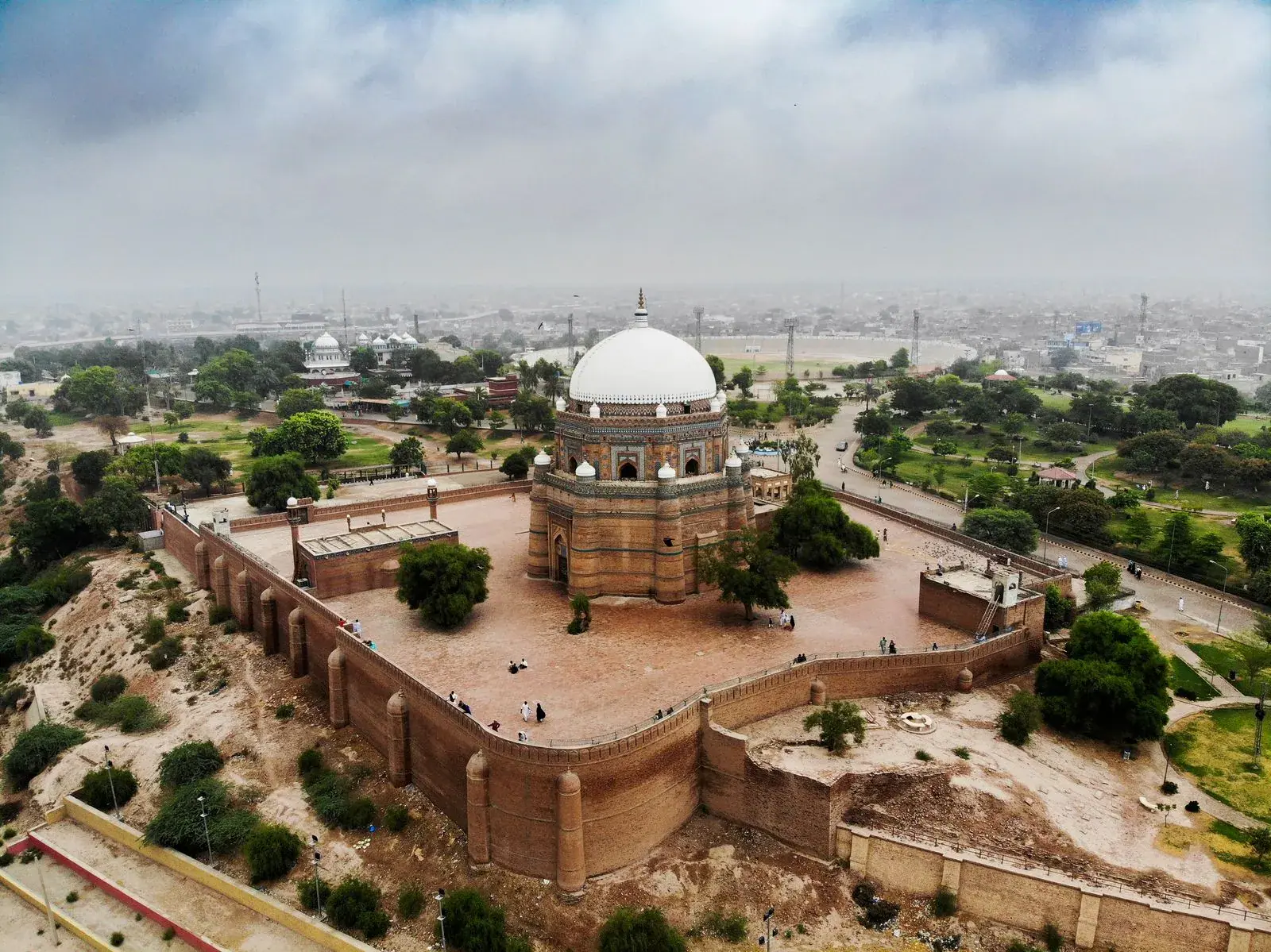 Photo: Yaarahmadd / Wikimedia Commons (CC BY-SA 4.0)