Cost of Living in Hpa-An
Where this figure comes from. No cost survey covers Hpa-An, so the $600 a month above is our own estimate rather than a measurement. On 416 of our 999 city guides the figure is built from a published Numbeo basket, a one-bedroom rent in the centre plus one person's monthly costs without rent, converted to USD; this city is not one of them. How we source everything.
Hpa-An is one of the cheapest places you could imagine basing yourself, but "cheap" here comes with heavy caveats. Living simply, most travellers spend roughly $500 to $900 a month, covering a basic guesthouse or small rented room, local meals, and getting around. The economy runs almost entirely on cash, and US dollars are widely used for larger payments, so you should carry clean, unmarked, newer-series notes. Banking infrastructure is limited and unreliable: ATMs are scarce, often out of service, and international cards frequently do not work, so plan to arrive with enough cash for your whole stay. Prices are low because infrastructure is low, not because Hpa-An is a comfortable bargain hub.
- Simple guesthouse or rented room: roughly $150 to $350 a month
- Local meals at teahouses and Karen restaurants: often $1 to $3 each
- Motorbike rental for exploring the karsts: a few dollars per day
- Carry US dollars in pristine condition; damaged notes are refused
- Budget a cash buffer, as ATMs are unreliable or absent
Where to Work in Hpa-An
Hpa-An suits a pause between work stints far better than it suits a working week built around client deadlines. There is no true coworking space, internet is slow and unreliable, and power cuts are common and sometimes last hours. A local SIM card may give you patchy mobile data, which is often the most usable connection, but speeds fluctuate and drop out entirely at times. A handful of guesthouse cafes and traveller restaurants have WiFi, though you should treat any connection as a bonus rather than a guarantee. If you must work here, download everything offline in advance, keep power banks charged, and never schedule a client call or hard deadline that you cannot afford to miss. Treat Hpa-An as a place to slow down, not to ship.
- No dedicated coworking; laptop-friendly cafes are informal at best
- Frequent power cuts; keep devices and power banks charged
- Mobile data via a local SIM is often more usable than cafe WiFi
- Download work offline and avoid time-critical calls
Getting Around Hpa-An
The town itself is small and easily walkable, with the riverside, clock tower, market, and guesthouses all close together. The classic way to see the surrounding caves and karst mountains is by motorbike if you are confident riding, or by tuktuk. Many travellers join a shared full-day tour that loops the main sights, including Sadan Cave, Kyauk Ka Lat pagoda, and the bat-cave sunset, which is a relaxed and social way to cover a lot of ground. Boats run on the Thanlwin river for scenic trips and some crossings. For longer journeys, buses and shared taxis connect Hpa-An to Yangon in roughly six to seven hours and to the Thai border at Mae Sot. There is no airport in town.
- The town center is compact and walkable
- Motorbike, tuktuk, or a shared full-day tour for the caves and karsts
- Boats on the Thanlwin river for scenic trips and crossings
- Buses and shared taxis to Yangon (~6 to 7 hours) and the Mae Sot border
- No airport in Hpa-An itself
Sorting transport? Book an airport transfer, or compare car rental on Auto Europe and QEEQ.
Visas for Hpa-An
Myanmar generally offers a tourist visa, and for many nationalities an online e-visa has been available, typically granting a stay of around 28 days. Far more important than the paperwork is the security picture. Since the 2021 military coup, Myanmar has faced ongoing conflict and instability, and Karen State in particular has seen armed clashes. Many governments advise against travel to parts of the country, and some advisories cover the whole nation. The road south-east to the Thai border carries a specific warning. It runs through Myawaddy township, home to KK Park and other compounds where scam operations have held foreigners lured across with job offers, and satellite analysis found most of them still expanding after the 2025 raids, so any work offer that involves going to Myawaddy should be treated as a trafficking risk.
- Tourist e-visa often available, commonly around a 28-day stay
- Karen State has seen armed conflict; conditions change fast
Best Time to Visit Hpa-An
The cooler dry season, roughly November to February, is the most comfortable and popular time to visit. Skies are generally clear, the karst scenery is at its best, and temperatures are manageable for cave walks and boat trips. The hot season from March to May is scorching, with intense heat and humidity that can make midday exploration exhausting. The monsoon from June to October brings heavy rain, and while the paddy fields turn a vivid green and the landscape looks dramatic, some caves and low-lying sites can become muddy, flooded, or hard to reach, and river conditions change. If your priority is easy exploring and reliable access, aim for the dry, cooler window. As the capital of Kayin State, Hpa-An also marks the Karen New Year, a public holiday set by the lunar calendar that falls in the cool season, next on 8 January 2027.
- November to February: cooler, drier, and the best all-round window
- March to May: very hot and humid, tough at midday
- June to October: lush but very wet, with some sites hard to reach
Pros and Cons of Hpa-An
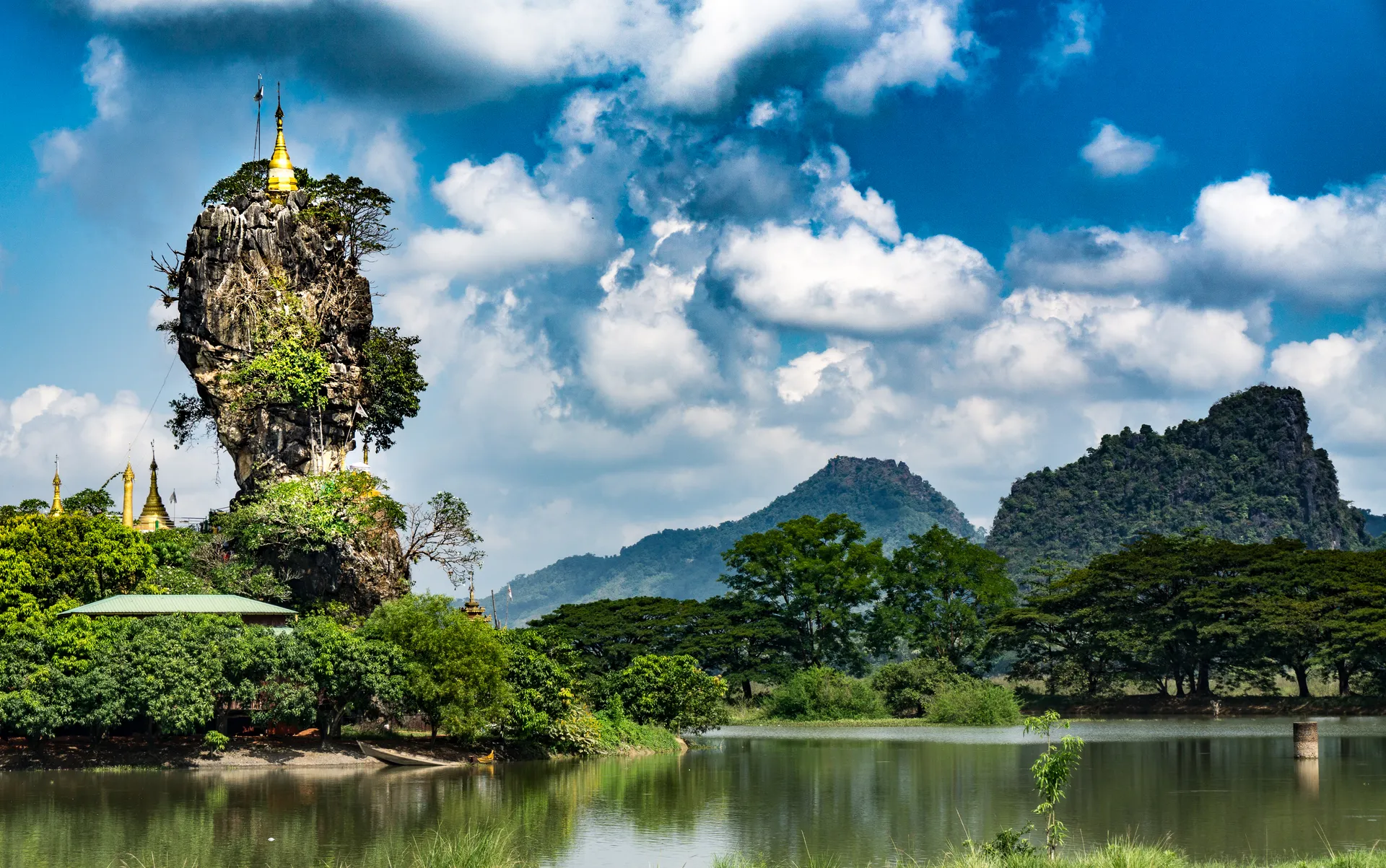
Hpa-An rewards travellers who want beauty, calm, and a genuine sense of place rather than convenience. The karst mountains, sacred caves, and river scenery are extraordinary, the pace is gentle, the cost is very low, and the Karen and wider Burmese hospitality is warm and memorable. The trade-offs are serious, though. Internet and power are unreliable, banking is difficult and cash-only in practice, English is limited outside tourism, nightlife is essentially nonexistent, and the security and political situation demands real caution. This is a place that gives a lot to slow, respectful visitors and very little to anyone needing a dependable work base or modern comforts. The karst is religious ground as well as scenery: Kyauk Kalat, the pagoda perched on a rock pinnacle in a pond outside town, belongs to a working monastery, and visitors are expected to dress as they would for any temple.
- Pros: stunning karst and cave scenery, very low cost, warm culture, tranquil pace
- Cons: slow and unreliable internet and power, cash-only economy
- Cons: limited English, near-zero nightlife, serious security and political concerns
Who Hpa-An Is For
Hpa-An suits the adaptable, low-maintenance traveller who values landscapes and quiet over connectivity and comfort. If you are an experienced independent traveller, comfortable carrying cash, riding or arranging a motorbike, and happy to unplug for days at a time, the reward is one of Southeast Asia's most beautiful and least commercial corners. It is a natural fit for a short, intentional stay: a slow week of caves, karsts, and river sunsets rather than a monthly work base. It is not for anyone who needs reliable WiFi, easy banking, active nightlife, or guaranteed stability. The visitors who stay longest tend to be walkers. Mount Zwegabin, the 722-metre limestone peak south of town, is climbed by long flights of steps to a monastery on the summit in one to two hours each way, and starting at first light, before the heat, makes it the classic Hpa-An morning.
- Great for: adaptable independent travellers seeking scenery and calm
- Great for: short, intentional visits rather than a fixed work base
- Not for: anyone needing reliable internet, banking, or nightlife