Cost of Living in Hakodate
Where this figure comes from. No cost survey covers Hakodate, so the $1,300 a month above is our own estimate rather than a measurement. On 416 of our 999 city guides the figure is built from a published Numbeo basket, a one-bedroom rent in the centre plus one person's monthly costs without rent, converted to USD; this city is not one of them. How we source everything.
Budget around $1,300 a month as a solo remote worker in Hakodate, which is low for Japan and reflects a regional city that has been losing population for decades rather than gaining it. A one-bedroom apartment runs roughly $400 to $650, which is a fraction of Tokyo for considerably more space. Food is the bargain: this is a fishing port and the seafood at the morning market costs a fraction of what the same thing does further south. Heating through a Hokkaido winter is a serious line item. This is our own estimate rather than measured data. Fibre runs about $35 to $50 a month at speeds among the world's best. Heating through a Hokkaido winter is the line that separates this from anywhere else in Japan, adding $100 to $200 a month between December and March on kerosene, which is what most older buildings here still use. Japanese rental deposits, key money and a guarantor requirement remain the main upfront obstacle for anyone staying under a year. Rents in the Goryokaku district sit below the Motomachi slopes for the same space and put you closer to the everyday city.
Where to Work in Hakodate
Hakodate has very little coworking provision and remote work happens from apartments and the cafes of the Motomachi and Goryokaku districts. Japanese fibre is excellent, widely available and cheap relative to speed, and mobile coverage is comprehensive; the practical obstacle is the paperwork rather than the infrastructure, since contracts generally require residency and a Japanese bank account. Pocket wifi rental is the standard workaround for shorter stays. English is limited outside the tourism trade, and anything administrative will require Japanese or a translation app and patience. Anyone working with Europe will find the time difference awkward, since a European morning lands in the Japanese evening. Japan runs nine hours ahead of GMT, so a European morning lands in the Hakodate evening and American work is effectively impossible, which is the structural filter on basing here. Hokkaido has run relocation and trial-stay schemes aimed at reversing depopulation, and while those target Japanese residents, the coworking and short-let stock they funded is what a visitor uses.
Getting Around Hakodate
Hakodate is compact and its tram line, one of the oldest in Japan, runs from the station past the morning market to the foot of the Motomachi slopes, which covers most of what a visitor wants. The city is walkable in its historic core, though the hills are real. The ropeway up Mount Hakodate serves the night view that draws most visitors. The Hokkaido Shinkansen reaches Shin-Hakodate-Hokuto, about twenty minutes from the city, putting Tokyo around four hours away. Onuma Quasi-National Park is half an hour by train and worth the trip. The morning market beside the station opens around five and is largely finished by lunchtime, which is worth knowing before planning a leisurely arrival. The Hokkaido Shinkansen crosses to Honshu through the Seikan tunnel, at fifty-four kilometres one of the longest rail tunnels in the world and running under the strait rather than over it. The tram runs two lines and a day pass covers both, which is the sensible purchase for anyone spending time between the market, the fort and the slopes.
Sorting transport? Book an airport transfer, or compare car rental on Auto Europe and QEEQ.
Visas for Hakodate
Japan launched a digital nomad visa in 2024, granting six months to remote workers who are citizens of countries with the relevant tax or visa agreements and who can show an annual income of ten million yen, about $63,080, a threshold fixed in yen and therefore moving with the exchange rate, which is a high bar by international standards. It is not renewable in place and carries a waiting period before reapplying. Most visitors instead use the visa waiver, which gives ninety days to citizens of around seventy countries, extendable to a hundred and eighty for some nationalities. Longer stays run through work, study or spouse categories. Private health insurance covering the entire stay is a condition of the nomad status rather than a recommendation, and dependants may accompany the holder on a matching permit. The six months cannot be extended in place, so a longer stay means leaving and waiting out the gap before reapplying.
Best Time to Visit Hakodate
May to October is the comfortable window, with mild summers that rarely pass twenty-six degrees and make Hakodate a refuge for Japanese escaping the heat further south. May brings the cherry blossom to Goryokaku's star fort, about a month later than Tokyo, and it is one of the best hanami sites in the country. Winter is long, snowy and cold, with the city under snow from December to March, which is spectacular from the mountain viewpoint and hard work at street level. Autumn colour in October is excellent and the crowds are thin. Goryokaku's blossom usually peaks in the first week of May, and the fort's star shape is best seen from the tower beside it, which is the one view that makes the geometry legible. The squid season runs from June and the ika-somen served translucent at the morning market is the local dish people travel for. Snow lies from December into April and the city clears it well, but the Motomachi slopes ice hard and are genuinely difficult on foot without proper boots.
Pros and Cons of Hakodate
Hakodate has one of the most celebrated night views in Japan from the mountain above the harbour, a Western-influenced hillside quarter left over from its years as one of the first ports opened to foreign trade, a star-shaped fort, and a morning market where the squid is pulled from the tank in front of you. It is cheap by Japanese standards. The winter is severe, the population is shrinking, English is limited, and no foreign community of any kind has formed here. Everything administrative in Japan assumes residency and rewards patience. The city also sits at the end of the Shinkansen line rather than on it, so the four hours to Tokyo is the practical floor for getting anywhere else. Hakodate was one of the first two Japanese ports opened to foreign trade under the 1854 Convention of Kanagawa, which is why the Motomachi slopes carry a Russian Orthodox church, a British consulate and a Chinese memorial hall within a few streets of each other.
Who Hakodate Is For
A small, safe, beautiful Japanese city with excellent food and none of the crowding of the main corridor, for anyone with some Japanese or the patience to muddle through. It is unusually good in summer, when the rest of the country is unbearable and this city is not. No foreign community has formed this far north and the professional network is fishing, tourism and the university. The nomad visa is the other barrier: its income threshold is set high enough to put the formal route beyond a good many of the people it was written for. Winter arrivals should understand what Hokkaido snow means. Asian and Australian working hours combine unusually well with a cold-climate base, and this is one of the few places offering both. Hokkaido delivers a proper winter and a mild summer in a country most people associate with humidity. Sapporo is the alternative, and the trade is a third of the size, considerably cheaper, and the better food.
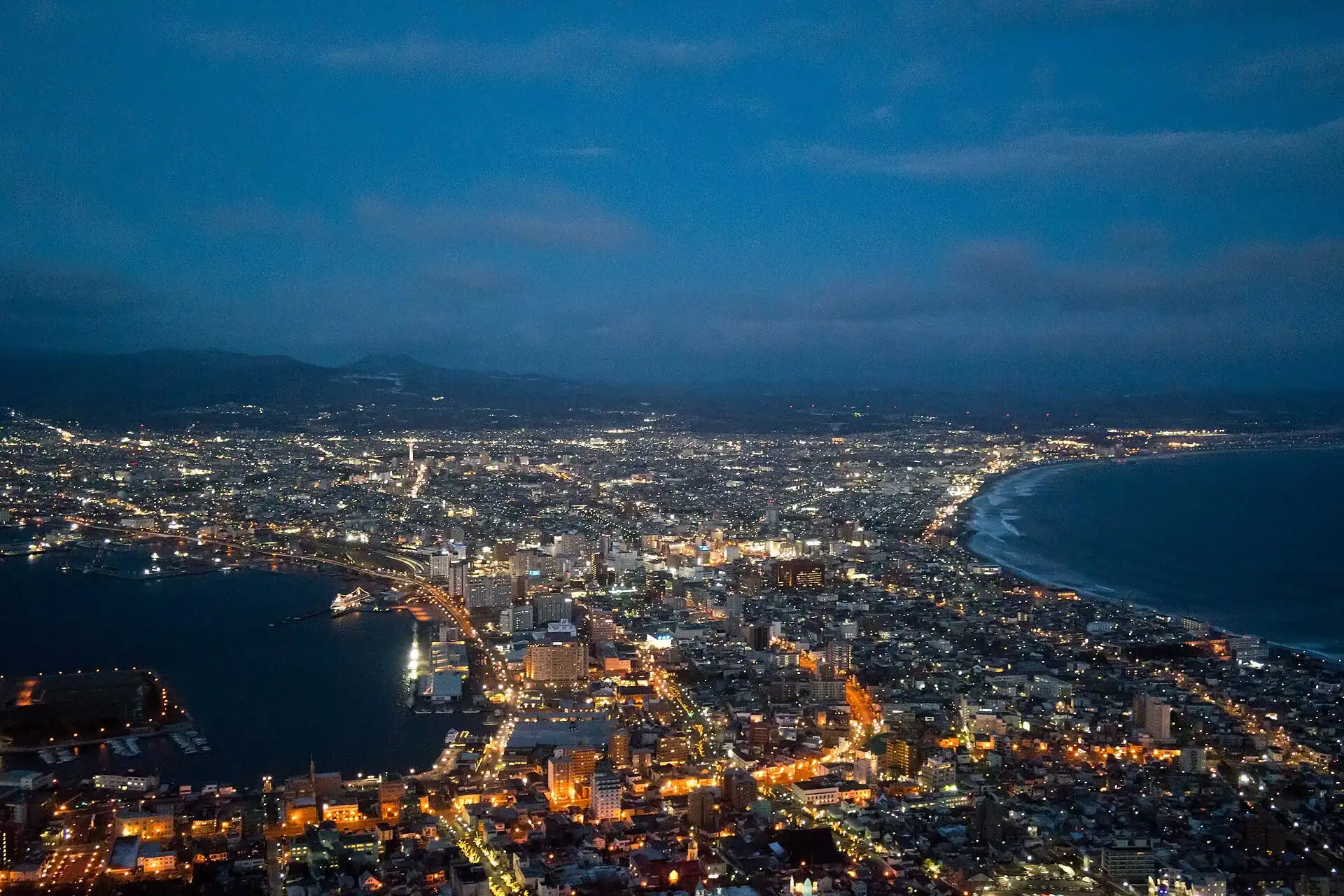 Photo: Fumikas Sagisavas / Wikimedia Commons (CC0)