Cost of Living in Bacalar
Where this figure comes from. No cost survey covers Bacalar, so the $1,200 a month above is our own estimate rather than a measurement. On 416 of our 999 city guides the figure is built from a published Numbeo basket, a one-bedroom rent in the centre plus one person's monthly costs without rent, converted to USD; this city is not one of them. How we source everything.
Bacalar is a small town whose popularity has pushed prices up, though it remains reasonable by Caribbean-Mexico standards and cheaper than Tulum or Playa del Carmen. A comfortable single-person budget runs roughly $1,000 to $1,600 a month. Long-term rentals are limited and much of the market is short-stay, so a furnished place near the lagoon typically costs about $500 to $900, with better value a little inland. Local eateries keep food cheap, while lakeside restaurants aimed at visitors charge more. These are our editorial estimates in US dollars; securing a monthly rate rather than nightly Airbnb pricing is the key to keeping costs down here. Electricity is the bill that surprises everyone. The national tariff jumps to a much higher band once a household crosses a consumption threshold, and running air conditioning through a tropical night takes a modest flat over it easily, so a place with good cross-breeze and a ceiling fan is worth more than a place with a unit in every room. Check whether the bill is included or metered separately, because a rental advertised as all-inclusive often caps the electricity. Anything beyond basic groceries comes from the town down the road, so keep a little back for the trip.
- Furnished rental near the lagoon: roughly $500 to $900 a month
- Meal at a local fonda: roughly $4 to $7
- Bicycle rental for the week: a modest few dollars a day
- Colectivo to Chetumal: a couple of dollars
Where to Work in Bacalar
Bacalar is a laid-back nature escape rather than a work hub, and its infrastructure is basic, so manage expectations. Internet is the main constraint: connections can be patchy and slower than in bigger towns, and outages happen, so test any rental's wifi carefully and keep a Telcel or AT&T SIM with a data plan as backup before committing to video-heavy work. A small number of cafes and an emerging coworking scene serve the growing trickle of remote workers, but choice is limited. Bacalar suits someone with light connectivity needs who wants a tranquil base, rather than anyone tied to constant, high-bandwidth calls. A question worth asking any landlord now is what the connection actually runs on. Satellite terminals have spread quickly through this part of the coast because the fixed lines are poor, and a house with one is a different proposition from a house on the local provider, so ask rather than reading the listing. Storms take the power down several times a season and the connection goes with it, which makes a battery and a charged phone less optional than they sound. The clock here matches the American central zone, which is convenient for most North American work.
Getting Around Bacalar
Bacalar is a small, walkable town, and many nomads get around by bicycle, which is perfect for reaching the lagoon, cenotes and the centre. Colectivos and taxis handle longer trips, and the town sits on Highway 307 with cheap, frequent connections to Chetumal, about 40 minutes south, which has the nearest airport. Access has improved dramatically with the arrival of the Tren Maya, whose Bacalar station links the town into the wider Yucatan rail network and its airports. Renting a car opens up the wider region, from Mayan ruins to the Costa Maya coast. Temper expectations about the railway. Services are far less frequent than a European or Japanese line, the station sits outside the town rather than in it, and for most journeys the long-distance coach is still quicker and more frequent. Check the timetable before planning around it. Cycling is the real local answer, but the lagoon road is unlit and used by trucks after dark, so a light and a reflective strip are not optional. Several of the best swimming spots are on private land and charge entry, which is worth knowing before setting out with only the bus fare.
Sorting transport? Book an airport transfer, or compare car rental on Auto Europe and QEEQ.
Visas for Bacalar
Most visitors enter Mexico as tourists, historically for up to 180 days, though immigration officers now set the exact length at the border and increasingly grant less than the full six months, so do not assume the maximum. For a longer, more secure stay, the Temporary Resident visa lets remote workers live in Mexico for one to four years and is applied for at a consulate abroad, usually requiring proof of income or savings. Rules and border discretion have tightened recently, so keep your entry permit safe for exit. The Belize border is forty minutes south of here, which makes it the obvious place to reset a stay and also the place where that habit is most visible to the officers who see the same passports every few months. Anyone using it repeatedly should expect questions and shorter stamps. There is also an exit fee payable when leaving by land, which is separate from anything in an airfare and is cash only at some crossings, so carry the amount rather than assuming a card will work at the window.
Best Time to Visit Bacalar
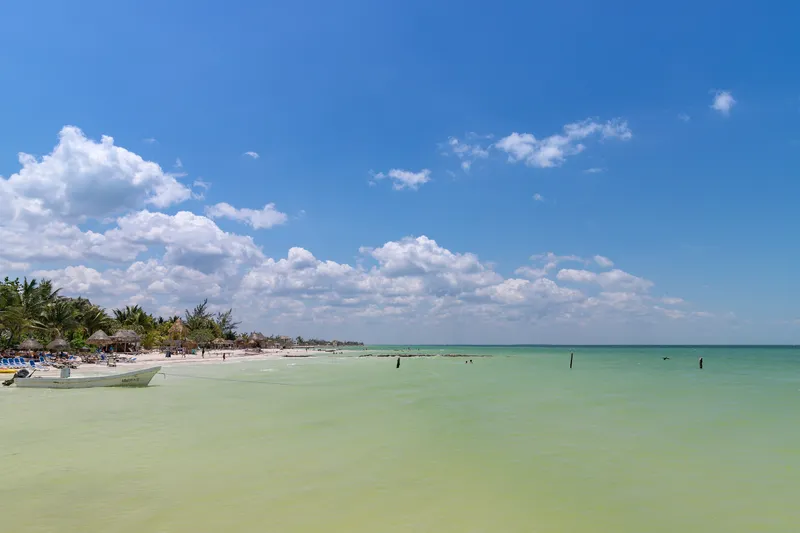
Bacalar is warm and tropical year-round, with the calendar shaped by rain and hurricane season. The best time to visit is the dry season from roughly November to April, when days are sunny, humidity is lower and the lagoon is at its most inviting turquoise. The wet season from June to November brings heat, humidity, afternoon storms and the possibility of hurricanes, which can disrupt travel and cloud the famous water. Temperatures stay warm throughout, so light clothing and sun protection are essential whenever you come. Aim for the dry months to see the Lagoon of Seven Colors at its best. A seasonal chart leaves out two local details. The seaweed that blankets the Caribbean beaches through much of the year does not reach here at all, because this is a freshwater lagoon rather than the sea, which is one of the strongest arguments for choosing this town over the coast in the summer months. And the famous colour depends on wind as much as on sun: a still morning gives the bands of blue that everyone photographs, while a windy afternoon churns the bottom and turns the whole thing flat and grey.
Pros and Cons of Bacalar
Bacalar is a tranquil natural paradise with the trade-offs of a small, remote town. Something belongs on that list that rarely makes it. The lagoon's colour comes from stromatolites, living rock formations built by microbes over thousands of years, and they are among the oldest kinds of life on earth. They are also fragile, and they are being damaged by sunscreen, by boat traffic, by construction on the shoreline and by wastewater from a town that grew far faster than its drainage. Biologists have been warning about it for years and the water has visibly changed in places. Any honest description of the town has to include the fact that its main asset is deteriorating and that visitors are part of the reason. Practically, this means using reef-safe sunscreen or none, choosing a sailing tour over a motorboat, and asking where a rental's wastewater goes. None of that is a burden, and the place is worth it.
- Pros: the stunning Lagoon of Seven Colors on your doorstep, superb kayaking, paddleboarding and sailing, nearby cenotes, a relaxed and safe small-town feel, and a genuine escape from the crowds of the bigger Caribbean resorts.
- Cons: patchy, unreliable internet, limited coworking and amenities, rising prices and a short-stay rental market, heat, humidity and mosquitoes, hurricane-season disruption, and little English, so some Spanish helps a lot.
Who Bacalar Is For
Bacalar is for the nature-loving nomad who wants a calm, beautiful lakeside base and can work comfortably with light connectivity. Anyone who dreams of finishing the day with a paddle across impossibly blue water, who values tranquillity, swimming and a slow pace over nightlife and coworking buzz, will love it. It suits those with some Spanish and flexible, low-bandwidth work. It is a poor fit for anyone who needs fast, reliable internet for constant calls, a large nomad community, or the amenities of a proper city. Come in the dry season, lock in a monthly rental, and let the Lagoon of Seven Colors be your office view. A month is the honest recommendation, two if the water keeps working on you. The town has one street of restaurants, a handful of places to swim from, and very little else, so the thing that sustains a longer stay is a routine on the water rather than anything the town provides. Couples and anyone with a project do well; a solo traveller looking for company will find the population turning over weekly. Pair it with the nearest city when you need a hospital, a hardware shop or a crowd, which is a straightforward bus ride south.