Cost of Living in Ashgabat
Where this figure comes from. No cost survey covers Ashgabat, so the $1,000 a month above is our own estimate rather than a measurement. On 416 of our 999 city guides the figure is built from a published Numbeo basket, a one-bedroom rent in the centre plus one person's monthly costs without rent, converted to USD; this city is not one of them. How we source everything.
Budget around $1,000 a month, though costs here are difficult to state plainly because Turkmenistan operates parallel exchange rates and the gap between the official and unofficial manat has been very wide. A one-bedroom runs roughly $300 to $600 at official rates. Subsidised utilities were a national policy for decades and have been progressively withdrawn. Local bazaar produce is cheap; imported goods are expensive and sometimes simply unavailable. Eating out is inexpensive by international standards. Bring cash: international cards frequently do not work and withdrawing money can be genuinely difficult. Shortages are a more useful thing to plan around than prices. Queues for subsidised staples have been a recurring feature, imported goods appear and vanish from the shelves, and what a given month costs depends heavily on what is available rather than on any published figure. Bring dollars in good condition and in reasonable quantity, since changing them is the routine mechanism and worn notes are refused. Accommodation for foreigners is generally arranged through the tour operator or an employer rather than found independently.
Where to Work in Ashgabat
Connectivity is the worst on this site. Turkmenistan has among the most restricted and slowest internet in the world, with a state monopoly, extensive filtering that blocks most social media and messaging services, and speeds that make video calls impractical. VPNs are blocked and their use is discouraged in ways that carry risk. There is no coworking. Anyone whose work requires open internet access should treat Turkmenistan as unworkable rather than difficult. The time zone is five hours ahead of GMT. Anyone with work that depends on cloud services, messaging or video should assume none of it will function reliably, and should not plan to be productive here. What organisations posted here actually do is worth stating, since it explains the gap between the country existing and being workable: embassies and international companies run their own satellite links, and everyone else accepts that the connection is not a tool they can rely on. There is no consumer route to that. A stay here is therefore either short, or supported by an institution, or unproductive, and the third of those is the one people discover after arriving rather than before.
Getting Around Ashgabat
Ashgabat is laid out on a monumental scale with wide boulevards and enormous distances between buildings, so walking is possible but slow and the summer heat makes it unpleasant. Taxis are cheap and plentiful, including informal ones, and buses cover the city. The city holds a Guinness record for the highest density of white marble buildings, and the effect is striking and strange. Ashgabat International Airport connects to Istanbul, Dubai, Moscow and a small number of other cities, with Turkmenistan Airlines operating most of them. Anyone photographing the city should also be careful, since government buildings, the presidential palace and many public monuments cannot be photographed and this is enforced. Internal travel is not free movement either. Several border regions and areas near the Caspian require separate permits arranged in advance, and the assigned guide accompanies journeys outside the capital as a matter of course rather than as an option. Distances are long and the desert roads are hard on vehicles. Within the city, the scale that looks impressive in photographs means a walk between two landmarks can take forty minutes across open marble with no shade at all.
Sorting transport? Book an airport transfer, or compare car rental on Auto Europe and QEEQ.
Visas for Ashgabat
Turkmenistan has one of the most restrictive visa regimes in the world. Independent tourism is effectively not permitted: almost every visitor needs a letter of invitation obtained through a licensed local tour operator, an approved itinerary and a state-assigned guide, and the application is frequently refused without explanation. A five day transit visa exists for those crossing between two neighbouring countries and is also frequently refused. There is no remote work visa and no realistic route to a long independent stay. Anyone applying should also allow months rather than weeks, since the letter of invitation is processed by the state migration service and the timeline is entirely unpredictable. Registration follows arrival for anyone staying beyond a few days, handled through the operator, and it is checked on departure. The transit visa deserves its own warning: it fixes both the entry and the exit point and the number of days, all of which are decided by the state rather than requested, and overstaying or deviating from the route is a serious matter rather than an administrative one. There is no mechanism anywhere in the system for extending a stay because you liked it.
Best Time to Visit Ashgabat
April to May and September to October are the only comfortable windows, warm at around twenty five degrees. Summer from June to August is severe, regularly above forty degrees in a city surrounded by the Karakum desert, and winter can drop below freezing. Rainfall is negligible year round. The Darvaza gas crater, the burning pit in the desert north of the city, is best visited in the cooler months and requires an overnight camp, which is one of the few things the tour operators reliably arrange. Anyone visiting Merv or Kunya-Urgench should note that both are a long way east and north of the capital and that internal travel is arranged through the same operator. The national calendar is worth checking against a trip, since public holidays here are elaborate state occasions that close offices and restrict movement in the capital. Melon Day in August celebrates the Turkmen melon with genuine national ceremony and is not a joke at the country's expense. Novruz in March marks the spring equinox and is the more widely observed. The desert swing between day and night is severe in the shoulder months, so a Darvaza camp needs warm clothing regardless of the afternoon temperature.
Pros and Cons of Ashgabat
There is nothing else like Ashgabat anywhere: a capital rebuilt almost entirely in white marble and gold since the 1990s, with monumental architecture, empty boulevards and a personality cult expressed in stone on every corner. Nearby Nisa is a UNESCO-listed Parthian city and Merv, further east, was once among the largest cities in the world. Everything else about it argues the other way: the visa regime, the surveillance, the internet restrictions, the heat, and a state that controls what visitors see and where they go. The Darvaza crater has also been burning since a Soviet drilling accident, and the government has repeatedly announced plans to extinguish it without doing so. The human rights position belongs in any honest account rather than in a footnote: Turkmenistan sits at or near the bottom of international press freedom and civil liberties rankings, independent journalism does not operate, and the surveillance a visitor notices is the visible part of something more thorough. That is not a reason nobody should go, and it is a reason to go informed, to be careful about what you photograph and who you put at risk by asking questions.
Who Ashgabat Is For
Turkmenistan suits determined travellers collecting difficult countries, archaeologists working on Parthian and Silk Road sites, and people posted here by an employer. Remote work is not possible here in any sense: the internet cannot carry it, and the visa regime does not allow the stay in the first place. Anyone going should understand that they will be accompanied, that photography is restricted, and that the country is among the most closed in the world. The Akhal-Teke horse is the national symbol and one of the oldest surviving breeds anywhere, and the state maintains it with a degree of ceremony that says a good deal about how this country sees itself. Uzbekistan next door is the comparison that clarifies this one: it holds Silk Road cities of the same rank at Samarkand, Bukhara and Khiva, it has opened up substantially, and it can be travelled independently and worked from. Almost anyone whose interest is the region's history rather than its strangeness should go there instead. This country rewards the traveller who specifically wants the strangeness, has time for the paperwork, and is content to see it from inside an arranged itinerary.
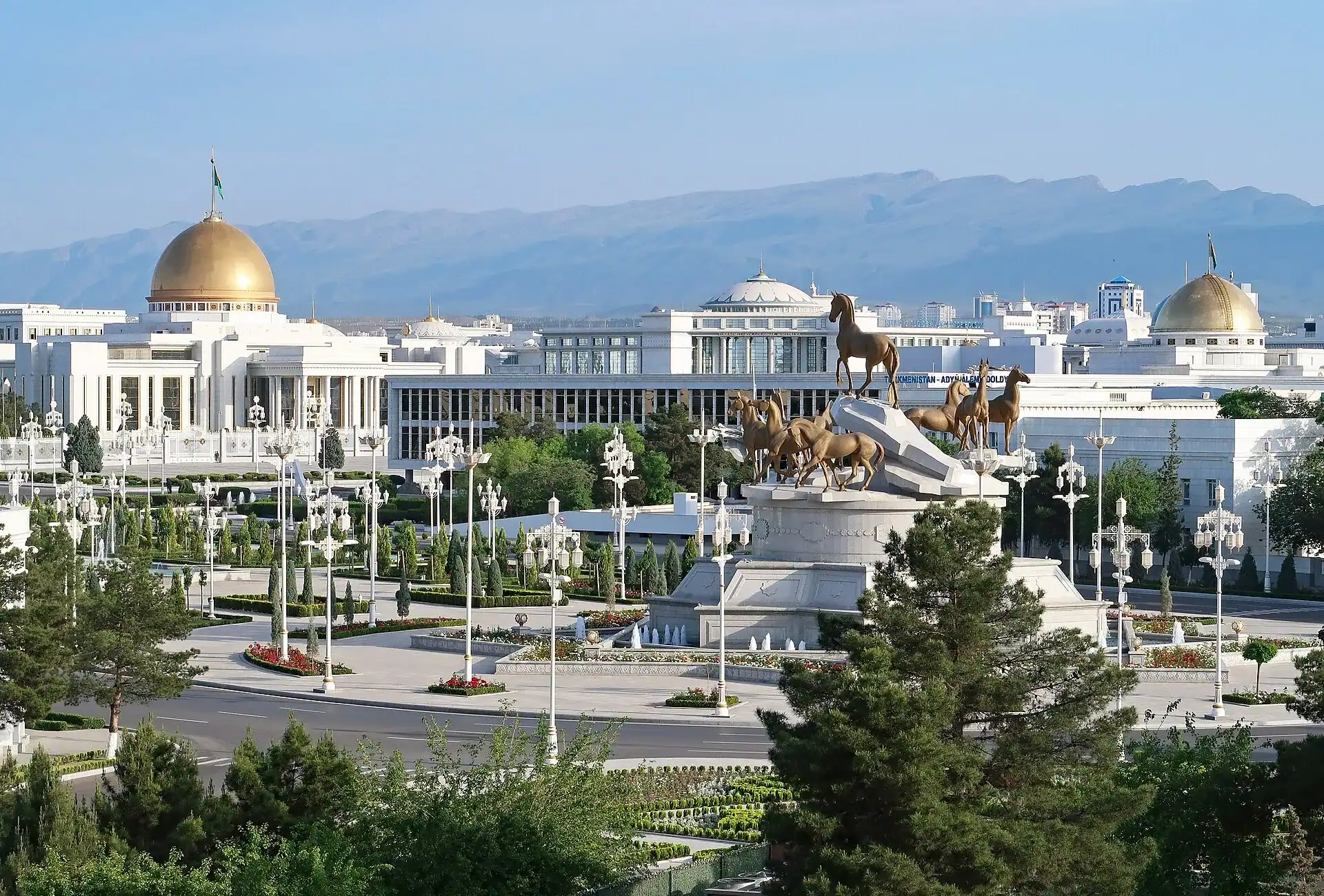 Photo: John Pavelka from Austin, TX, USA / Wikimedia Commons (CC BY 2.0)