Cost of Living in Constantine
Where this figure comes from. No cost survey covers Constantine, so the $650 a month above is our own estimate rather than a measurement. On 416 of our 999 city guides the figure is built from a published Numbeo basket, a one-bedroom rent in the centre plus one person's monthly costs without rent, converted to USD; this city is not one of them. How we source everything.
Constantine runs about $650 a month for one person, a little under Oran, and as elsewhere in Algeria the figure depends on whether you change money at the bank rate or the parallel rate that most visitors use. A furnished apartment in the newer districts is $180 to $350, and older flats in the centre less. Eating is very cheap: street food is a dollar or two and a full restaurant meal $6 to $11. There is no coworking sector to budget for. Fixed internet from Algerie Telecom costs $15 to $30 a month. The cable car and buses cost pennies, and taxis a couple of dollars. Heating is a real winter cost at this altitude. Two exchange rates have coexisted for years, the bank one and the street one, and the spread between them effectively sets two price levels inside the same city, which is why almost every foreign visitor changes money outside a bank. Bread, semolina, milk and fuel are all subsidised and cost a fraction of the same basket across the Mediterranean, which is what holds the monthly figure down even as imported goods stay dear. Rent is often paid a year in advance rather than monthly, and that arrangement surprises new arrivals more than the price does.
Where to Work in Constantine
Constantine has no coworking market to speak of, though the university, one of the largest in Algeria, has generated a small incubator scene. Practically, you work from a flat, so the fixed connection matters more than anything else: Algerie Telecom fibre reaches parts of the city at usable speeds for $15 to $30 a month, while the old copper lines are slow. Mobile 4G from Djezzy, Mobilis and Ooredoo is cheap and works well in the city, and tethering is a sensible backup. The recurring problem is international routing rather than local bandwidth, so calls to Europe can stutter at peak times even on a good line. Test before you commit to a month. The weekend falls on Friday and Saturday, so a Sunday here is an ordinary working day and a European Friday afternoon reaches nobody at all. Arabic is official, while business, engineering and most of the older professional class run in French, and English is gaining ground in the universities and almost nowhere else yet. The university is among the largest in the country by enrolment, which gives the city a young population and a bookshop trade that outlasts most of the retail around it.
Getting Around Constantine
Constantine is built on a plateau split by the Rhummel gorge, so the topography does most of the work of deciding how you move. Seven bridges cross the chasm, including the Sidi M'Cid suspension bridge of 1912 and the modern Salah Bey viaduct, and walking between them is the best way to understand the city. A cable car runs from the centre across to the hospital side and is cheap and quick. A tram line serves the newer districts, buses cover the rest, and taxis cost a couple of dollars. Mohamed Boudiaf airport is 9km south with flights to Paris, Marseille, Istanbul and the Gulf. Algiers is about four hours by road.
Sorting transport? Book an airport transfer, or compare car rental on Auto Europe and QEEQ.
Visas for Constantine
Algeria requires most nationalities to obtain a visa before travel from an embassy or consulate, supported by a hotel booking or an invitation, proof of funds and an itinerary. Processing takes weeks and refusals come without explanation. The visa on arrival introduced for tourism applies only to the Saharan south around Djanet and Tamanrasset and is of no use for Constantine. There is no digital nomad visa and no provision for remote work. Extensions go through the wilaya police and are slow. Practically, this is a destination you plan several months ahead, and the paperwork is a larger obstacle than anything you will meet once you arrive. Foreign currency above a threshold has to be declared on the arrival form, and that declaration matters on the way out, since leaving with more than you brought and no paperwork is easier to avoid than to explain. Hotel bookings are checked against the application rather than assumed, and a mismatch between the two is a common reason for refusal. Anyone invited by a company or a relative needs the invitation legalised locally before it is of any use at a consulate.
Best Time to Visit Constantine
Constantine sits at about 640m on the edge of the Tell Atlas, which gives it a genuinely continental climate rather than a Mediterranean one. April to June and September to October are the good months, with highs of 22C to 28C and clear air over the gorge. July and August are hot and dry at 33C to 35C, hotter than the coast because there is no sea breeze. Winter is the surprise: December to February brings highs of only 11C to 13C, cold nights, heavy rain and occasional snow, and older buildings are poorly heated. The gorge is at its most dramatic after winter rain, when the Rhummel actually runs. Ramadan changes the working day completely, with offices on short hours and restaurants shut until sunset, and the date moves eleven days earlier each year, so it is worth checking against the calendar before booking anything. The malouf festival brings the city's Andalusian music tradition into public for a few days a year. Snow settles on the plateau in some winters and the city handles it badly, since neither the roads nor the buildings were built with it in mind.
Pros and Cons of Constantine
Nothing about Constantine resembles anywhere else, and the setting is the whole of it. A city of half a million built on a rock, cut off from the plateau by a gorge two hundred metres deep, crossed by seven bridges, continuously inhabited since it was Cirta and the Numidian capital. The Emir Abdelkader mosque, the Ahmed Bey palace and the malouf music tradition are all here, and it costs $650 a month. The visa is a major obstacle of its own, winters are cold and wet in badly heated buildings, the international links are unreliable, neither coworking nor a foreign circle exists, English is barely spoken, and card payments are largely unusable.
Who Constantine Is For
French or Arabic, a specific interest in North African history, architecture or music, and the patience for Algerian bureaucracy. It is a spectacular place to spend a month if your work is self-contained and you do not depend on video calls. Photographers in particular will find few cities that reward walking as much. Reliable international connectivity is not available, French carries daily life and English does not, there are no other remote workers to find, and Algerian visas make short-notice travel close to impossible to arrange. If North Africa is the goal and the visa is the obstacle, Tunisia and Morocco offer most of the same appeal on arrival. A month is the right unit here, long enough to stop being a visitor in a city that takes some reading and short enough that the visa does not become the dominant fact of the stay. Anyone who arrives in winter should budget for heating that the building will not provide.
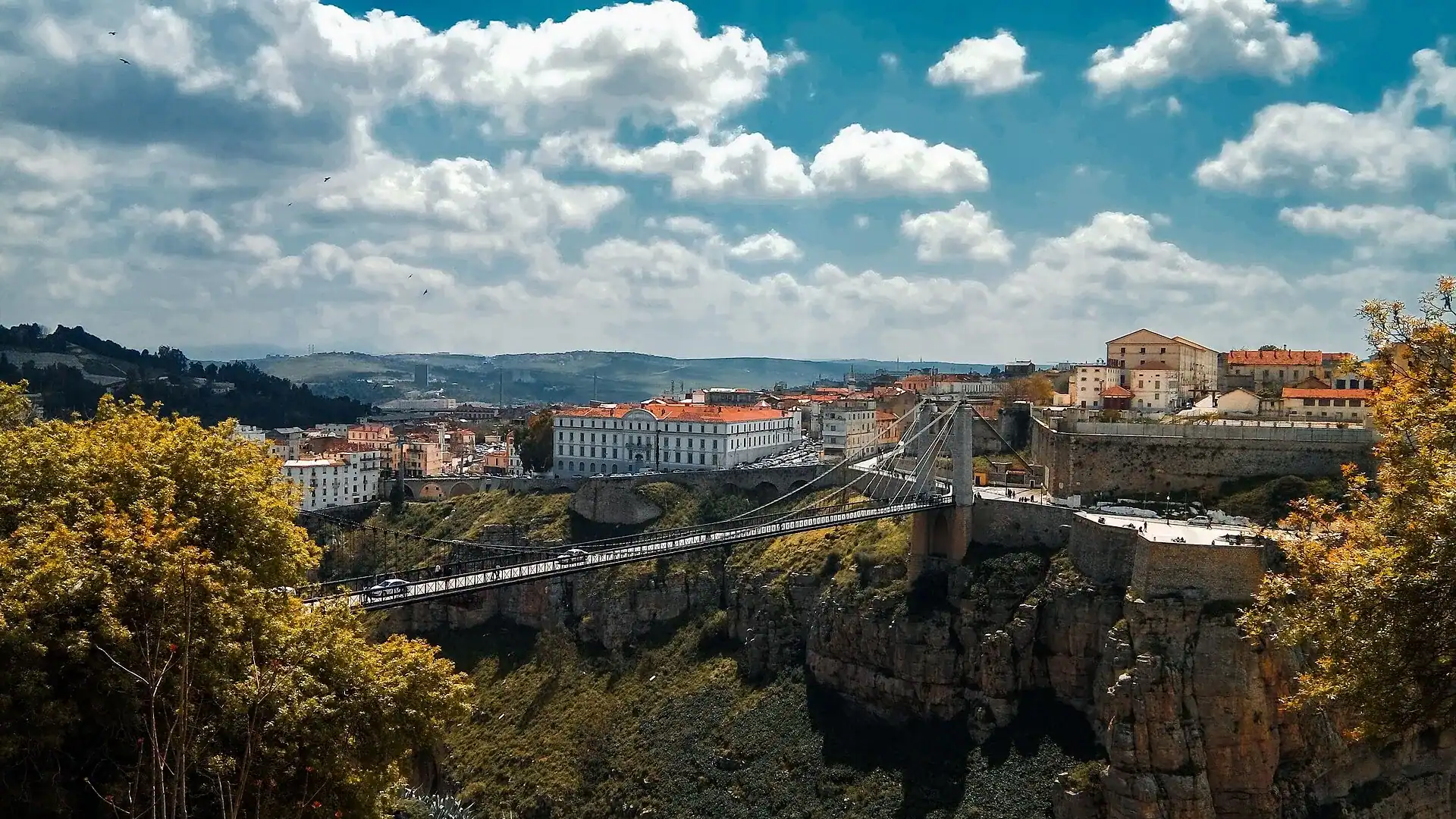 Photo: Abdousid / Wikimedia Commons (CC BY-SA 4.0)