Cost of Living in Asmara
Where this figure comes from. No cost survey covers Asmara, so the $800 a month above is our own estimate rather than a measurement. On 416 of our 999 city guides the figure is built from a published Numbeo basket, a one-bedroom rent in the centre plus one person's monthly costs without rent, converted to USD; this city is not one of them. How we source everything.
Budget around $800 a month, though as in Turkmenistan the figure needs a caveat: Eritrea has a closed economy, a fixed official exchange rate and strict currency controls, and what things cost depends heavily on which rate applies. A one-bedroom runs roughly $200 to $400 at official rates. Local produce and bread are cheap. Imported goods are expensive and often simply unavailable, which is the more relevant constraint. Eating out is inexpensive and the Italian legacy means genuinely good coffee and pasta alongside Eritrean food. Cash is essential and declaring foreign currency on arrival is compulsory. The currency itself has a history that shapes daily life: in 2015 the government replaced every nakfa banknote and capped withdrawals, a move aimed at the black market that also wiped out savings held in notes. The limits have stayed tight since. No foreign card works at any machine in the country, so everything you will spend has to be brought in and accounted for again on the way out, which means budgeting in advance rather than adjusting as you go.
Where to Work in Asmara
Connectivity is the worst in Africa and among the worst anywhere. Eritrea has the lowest internet penetration in the world, no meaningful mobile data for most of its history, and dial-up-era speeds in the internet cafes that serve as most people's access. Fibre exists in a very limited form. Power cuts are frequent. There is no coworking and no realistic way to run a remote job from here. The time zone is three hours ahead of GMT, which is academic given the connection. Anyone needing to reach clients should plan on doing so before arriving and after leaving, because the connection here cannot be relied on for anything time-sensitive. Eritrea has no independent domestic media at all, and has sat at or near the bottom of the world press freedom index since it closed the private press in 2001, with journalists held without charge since then. That context matters for a working visitor in a practical way: what you research, download or ask about is not a neutral activity here, and the constraint is on more than bandwidth.
Getting Around Asmara
Asmara is walkable and genuinely pleasant to walk, which is unusual for an African capital: the centre is compact, the streets are ordered on the Italian plan, and the altitude keeps it cool. Buses and shared taxis are very cheap. The Eritrean Railway to Massawa, built by the Italians and rebuilt by hand with original locomotives, runs occasional excursions down the escarpment. Asmara International Airport has limited connections, mainly to Cairo, Dubai and Addis Ababa since the 2018 rapprochement with Ethiopia. Anyone travelling beyond the capital should apply for the internal permit several days ahead, since it names specific destinations and is checked at posts on every road. The Italians also built a cableway from the coast up to the highlands, seventy five kilometres of it, the longest in the world when it opened in 1937 and dismantled by the British for scrap a decade later. Its concrete pylons still stand along the escarpment and are visible from the road, which is how most people first register how much engineering went into a colony of this size.
Sorting transport? Book an airport transfer, or compare car rental on Auto Europe and QEEQ.
Visas for Asmara
Eritrea requires a visa of every nationality, applied for in advance at an embassy, with an invitation or a booking and a process that is slow and frequently refused. There is no visa on arrival and no e-visa. Travel outside Asmara requires a separate internal travel permit, applied for in the capital and issued for specific destinations, and this is enforced at checkpoints. There is no remote work visa. Photography is restricted and military and government buildings must not be photographed at all. Anyone applying should also expect to be asked for a detailed itinerary, and should understand that refusal without reason is common and carries no route of appeal. The rapprochement with Ethiopia briefly opened the land border in 2018 and then closed it again, and the crossing has not been dependably open since, so no plan should rest on it. Djibouti and Sudan are the other land neighbours and neither is straightforward at present. Overstaying is treated seriously, and the exit formalities at the airport are as thorough as the entry ones.
Best Time to Visit Asmara
September to March is the best window, dry and mild at around twenty two degrees thanks to the altitude of about 2,300 metres, which makes Asmara far more comfortable than its latitude suggests. The main rains fall from June to August and are heavy but short. Nights are cool year round and a jacket is needed. The coast at Massawa is a different climate entirely and is brutally hot for most of the year, so the descent from the highlands is best made in the cooler months. Anyone visiting the Dahlak archipelago off Massawa should aim for the cooler months, since the Red Sea coast is among the hottest inhabited places on earth in summer. Rain here comes as a hard afternoon storm rather than a day of drizzle, so the wet months stay workable if the plan allows for a soaked hour around four. Independence day on the twenty fourth of May brings the whole capital onto the main avenue, and the week around it is the hardest stretch of the year in which to find a room.
Pros and Cons of Asmara
Asmara is an intact Italian modernist and Art Deco capital, built in the 1930s and barely altered in the ninety years since, and it was inscribed as a UNESCO World Heritage site in 2017 for exactly that reason. The Fiat Tagliero service station, shaped like an aeroplane, and the Cinema Impero are among the finest buildings of their period anywhere. The state is the reason so few people come: Eritrea runs indefinite national service, imposes extensive restrictions on movement and expression, and has effectively no internet for ordinary users. The city's evening passeggiata along Harnet Avenue is also a genuine daily ritual, and it is the clearest surviving trace of the Italian period in ordinary life. Against the architecture sits the emigration: Eritreans have for years been among the largest groups arriving in Europe by sea relative to the population at home, and open-ended conscription is the reason most of them give. A visitor sees a calm and orderly city, and the calm and the exodus are the same fact seen from two directions.
Who Asmara Is For
Architects and anyone drawn to twentieth century modernism, for whom the city is close to unmatched, along with travellers who want somewhere genuinely unvisited and are prepared for the constraints. It suits people with family connections. Remote work will not run on this connection, and that is only the first obstacle. Internal travel permits, checkpoints and restrictions on photography are all ordinary conditions of being here, and anybody who would find those hard to accept should not come at all, because none of it is negotiable. It also suits cyclists, since Eritrea is the most cycling-obsessed country in Africa, the Tour of Eritrea is a national event, and the sport is another Italian inheritance. Daniel Teklehaimanot rode for the polka dot jersey at the Tour de France in 2015, the first African to hold it, and he learned on these roads: the climb from the coast to the highlands gains more than two thousand metres in one ascent. It suits a photographer with patience and permission, and nobody holding only one of the two, because pointing a camera at the wrong building is a serious matter rather than an awkward one.
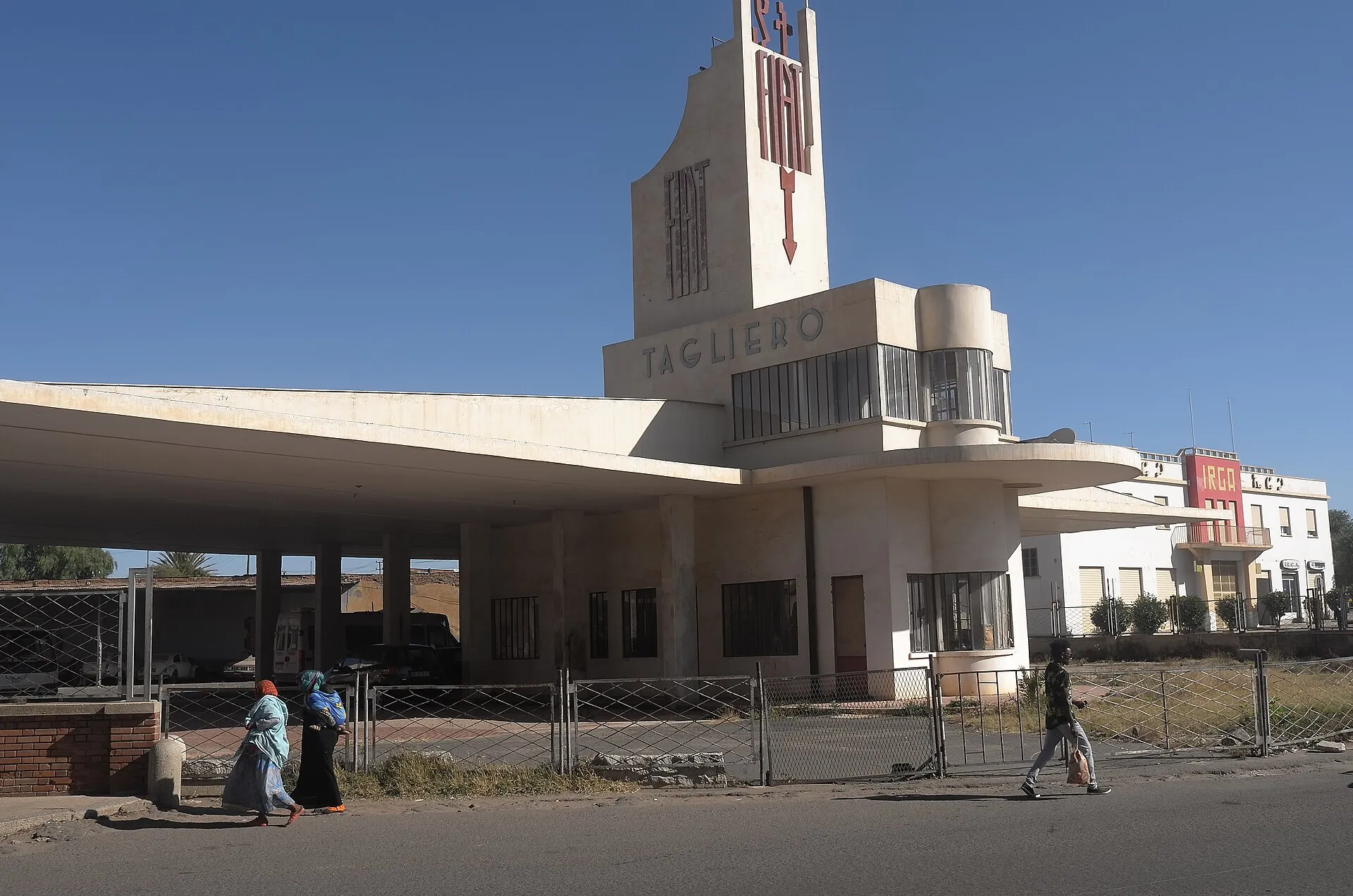 Photo: Martin Schibbye / Wikimedia Commons (CC BY-SA 4.0)