Cost of Living in Vigan
Where this figure comes from. No cost survey covers Vigan, so the $700 a month above is our own estimate rather than a measurement. On 416 of our 999 city guides the figure is built from a published Numbeo basket, a one-bedroom rent in the centre plus one person's monthly costs without rent, converted to USD; this city is not one of them. How we source everything.
Vigan is one of the Philippines' more affordable heritage destinations, and most nomads get by comfortably on roughly $600 to $900 a month. Rent is the biggest variable: a simple studio or a room in a family-run guesthouse costs far less than an apartment near the tourist core. Local food is a bargain, with a Vigan empanada or a plate of longganisa costing only a little, and the public market keeps grocery bills low. Costs rise during fiestas and peak dry-season weekends when demand spikes. The figures below are editorial estimates rather than surveyed data, so treat them as a rough planning guide. A couple of costs sit outside the usual list. Electricity in this country is among the most expensive in the region, and a room with air conditioning running through a tropical night produces a bill that can rival the rent on a cheap studio, which is why almost everyone lives with a fan and a cold shower instead. And anything imported carries heavy duty on top of the shipping, so a laptop charger or a pair of running shoes costs noticeably more here than at home; bring what you will need. Against both, a long stay negotiated directly with a family guesthouse is remarkably cheap.
- Room or small studio: roughly $180 to $320 a month
- Local meals and market groceries: roughly $150 to $260 a month
- Mobile data, SIM and cafe visits: roughly $30 to $60 a month
- Transport, kalesa rides and day trips: roughly $40 to $90 a month
Where to Work in Vigan
Vigan is a small heritage town rather than a coworking hub, so expect to build your own routine. A handful of cafes and bakeries around Calle Crisologo and Plaza Burgos offer decent seating, coffee and reliable enough connections for calls and email, though they get lively with tourists by midday. Several mid-range hotels and guesthouses provide steadier in-room wifi, which many remote workers rely on for video meetings. Fibre coverage has improved across Vigan City proper, but speeds vary and outages happen, so a mobile data plan as backup is essential. Early mornings, before the day-trippers arrive, are the calmest and most productive stretch for focused work. Whether this works as a base is decided by the clock more than by anything else. The country sits eight hours ahead of Greenwich, so the European working day only reaches you after dinner and the American one lands while you sleep, so the natural clients are in Australia, Japan and Singapore. Anyone tied to a Western schedule will be working nights. The other national condition is weather: typhoons cross this coast several times a year between June and November, and a direct hit takes power and connectivity out for days rather than hours, which is a category of risk rather than an inconvenience.
Getting Around Vigan
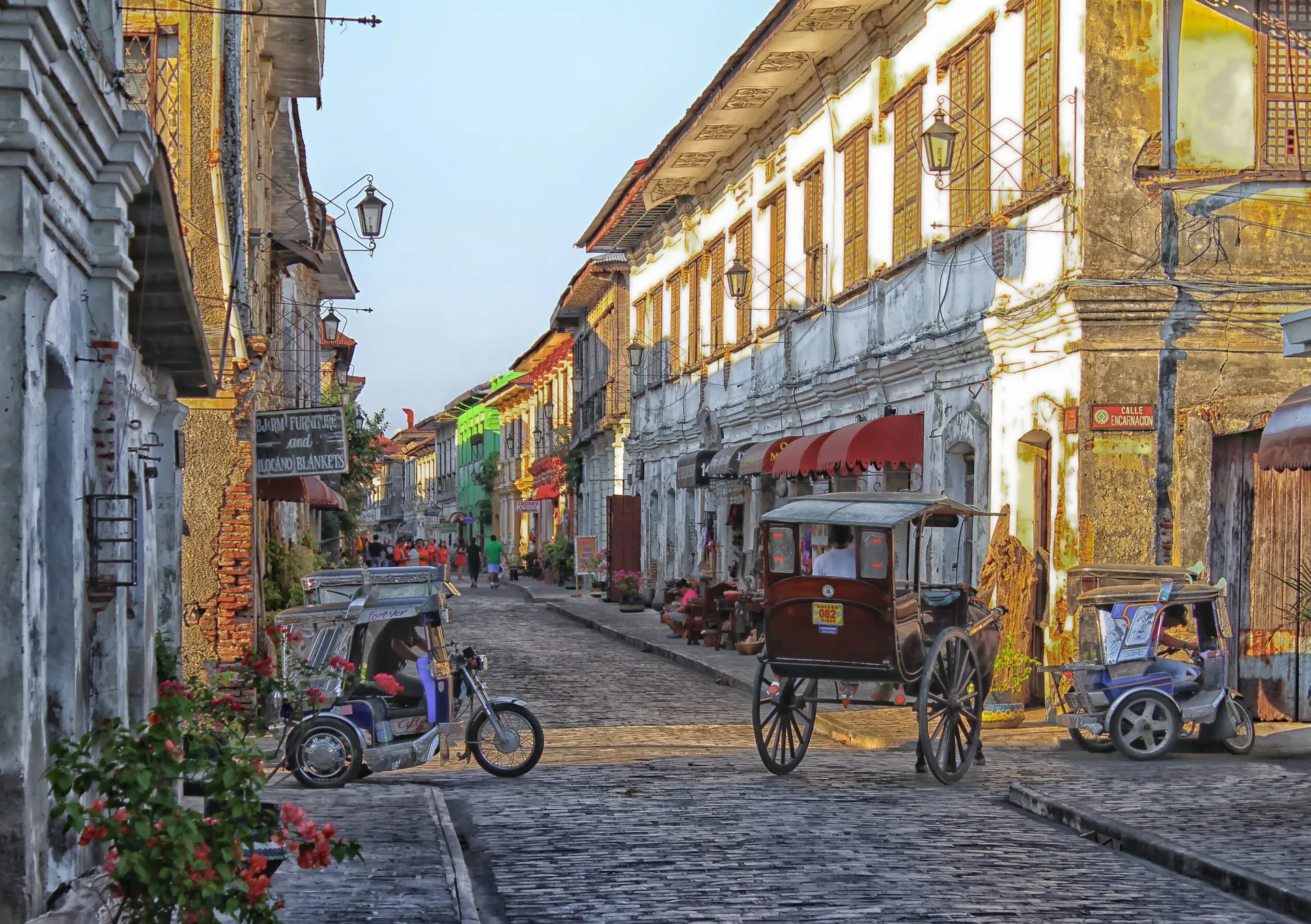
Vigan's historic core is wonderfully walkable, and the cobblestoned Calle Crisologo is closed to most traffic, so you can explore the bahay-na-bato mansions on foot. The town's signature transport is the kalesa, a horse-drawn carriage that still plies the streets and makes for an atmospheric, if touristy, tour. For everyday trips, tricycles are cheap and everywhere, ferrying you to the public market, the bus terminals or nearby Bantay across the river. Jeepneys connect Vigan to surrounding towns in Ilocos Sur. Distances within the city are short, so many residents simply walk or hop a quick tricycle rather than owning a vehicle. The horse carriages deserve a word beyond the photograph. The animals work long days on hard cobbles in heat, welfare standards vary widely between operators, and a visitor who cares about that should look at the horse before taking the ride rather than after. Several operators are noticeably better than others and the drivers will tell you which. For the long haul, an overnight coach up from the capital takes eight to ten hours and is how most people arrive, since the nearest airport with useful flights is a couple of hours down the coast and the schedules are thin.
Sorting transport? Book an airport transfer, or compare car rental on Auto Europe and QEEQ.
Visas for Vigan
The Philippines grants many nationalities 30 days visa-free on arrival for tourism. This is extendable in-country through the Bureau of Immigration, and short-stay nomads commonly renew in blocks to string together several months without leaving. Extensions involve a fee and some paperwork, and the nearest immigration offices are in larger cities, so plan a trip to arrange them. If you intend a longer stay, look into the specific extension caps and whether an emigration clearance certificate applies to you. Worth being precise about that clearance, because it catches long-stayers on the way out. Anyone who has been in the country continuously for six months or more on a tourist status needs a certificate from the immigration bureau before they can board an outbound flight, and it is obtained in advance rather than at the airport. People discover this at check-in and miss flights over it. The extension ladder itself is well worn: the first renewal is longer than the rest, each one has a fee, and the total a tourist can accumulate is capped, after which you leave and start again.
Best Time to Visit Vigan
Vigan has a tropical savanna climate with a distinct dry and wet season. The dry months, roughly November to April, bring the most reliable sunshine and are the sweetest time to wander Calle Crisologo, though this is also the busiest tourist window and hotel prices climb. The wet season, roughly June to October, is hotter and more humid with heavier afternoon downpours and an outside chance of typhoons sweeping through Ilocos Sur. Shoulder months such as May and November often strike a fine balance of fewer crowds and manageable weather. If you can, avoid arriving during a major fiesta unless the festivities are precisely what you came to see. On the fiesta point, the one that transforms the town is its own week-long festival in early summer, with street dancing, a carriage parade and every room in the province taken. It is worth seeing once and impossible to work through. A quieter seasonal note: the cool months bring a light morning mist off the river that photographs beautifully and burns off by nine, which is the reason the dawn hour on the old street is worth setting an alarm for even on a working day.
Pros and Cons of Vigan
Vigan rewards nomads who value character over convenience. As a UNESCO World Heritage town with an exceptionally preserved Spanish colonial core, it offers a sense of place that few work bases can match, plus warm Ilocano hospitality, standout local food and genuinely low living costs. The trade-offs are real, though: it is a small town without a nomad scene, faster internet or lively nightlife, and it sits a long way from Manila. Weigh what matters most to your work and lifestyle before committing to a longer stint here. A reason the core survived is worth knowing, because it explains the place. The town escaped the bombing that destroyed almost every other Spanish colonial centre in the country during the war, and the result is several hundred ancestral houses standing where elsewhere there are none. That is why a small provincial town holds a listing that larger and richer cities do not. What it does not have is anything else. No university scene, no industry open to a foreigner, nobody else doing your kind of work, and several hours of road between here and any real city. The heritage is the entire proposition, which is fine for a month and thin for a year.
- Pros: unique heritage setting, low cost of living, excellent local food, very walkable core, widely spoken English
- Cons: small and quiet with little nomad community, variable wifi, limited nightlife, long haul from Manila
Who Vigan Is For
Vigan suits the independent, self-motivated remote worker who is happy with their own company and craves atmosphere over amenities. History lovers, photographers, writers and slow-travellers will feel right at home among the ancestral mansions, plazas and kalesa-lined streets, and food-focused nomads will relish the empanada, longganisa and bagnet. It is a poor fit for anyone who needs a ready-made coworking community, dependable high-speed fibre or a buzzing after-dark scene. Think of Vigan as a characterful base for a focused month or two, ideally paired with reliable mobile data and an easygoing attitude toward small-town rhythms and the occasional connectivity hiccup. A practical route: fly into the capital, take the overnight coach up, and give it four to six weeks. That is long enough to have the old street at dawn a dozen times and to run out of restaurants, which is roughly when most people are ready to move on. Pair it with the coast an hour north or the mountain province inland, both of which are more interesting to spend a second month in. And take the heat seriously; this is the hottest lowland part of the country in April and May, and a room without cooling in those weeks is not workable.