Cost of Living in Suva
Real market data
Source: Numbeo · August 2026
$1,250/moSolo nomad1-bed centre + living costs
$1,530/moCoupleshared 1-bed + costs
$650/moLean / localcheaper area + costs
- 1-bed rent, city centre$890FJD 1,992
- 1-bed rent, outside centre$300FJD 666
- Monthly costs excl. rent (1 person)$350FJD 780
- Meal, inexpensive restaurant$6FJD 13
- Monthly transit pass$22FJD 50
- Buy price, per m² (centre)$1,350FJD 3,000
Prices are from Numbeo (August 2026), converted to USD at $1 = 2.23 FJD (01 Aug 2026). The monthly living-costs figure is our transparent one-person basket, groceries, a few meals out, utilities, phone, internet, transport and essentials, priced from those figures. Solo adds central rent; couple and lean are estimates from the same numbers. The guide below quotes its own monthly range, which is a different measurement rather than a competing one: this table prices a defined basket at the figures above, while that range is a judgement about how somebody actually lives here.
Suva is cheaper than most Southeast Asian nomad hubs but more expensive than you might expect for the Pacific. A comfortable monthly budget runs roughly $1,530-2,520 depending on your standards.
- Rent, central Suva (1BR): $630-810/month. Think Samabula or near the CBD.
- Rent, cheaper suburbs: $405-585/month in areas like Raiwaqa or Nabua, though these require reliable transport.
- Groceries: $180-270/month for a single person cooking at home. Imported goods carry a premium; local produce and Indo-Fijian staples are affordable.
- Eating out: $3.50-6.50 at a local Indo-Fijian curry house; $16-27 at a sit-down Western restaurant.
- Coworking hot desk: Approximately $180/month at Greenhouse Coworking, the main dedicated space in the city.
- Local transport (taxis, buses): $22-54/month if you rely on taxis and city buses daily.
- Mobile data (10 GB): Around $10/month.
- Total monthly range: USD 1,200-2,000 on the lean side; USD 2,000-2,800 with more comfort.
Note that tap water is not safe to drink, so budget for bottled water or a filter. Fiji dollars (FJD) trade at roughly 2.2 to the US dollar.
Where to Work
Suva has one established dedicated coworking space: Greenhouse Coworking at 11 Burton Place (near the corner of Des Voeux Road and McGregor Road). It offers private meeting rooms, high-speed Wi-Fi, personal lockers, showers, and unlimited coffee. Hours are Monday to Friday, 8:30 am to 5:30 pm. Book in advance as it fills up.
Beyond Greenhouse, the cafe culture is developing but uneven. Lazy Beans Cafe on Renwick Road and Ginger Kitchen inside Thurston Gardens are the two most cited laptop-friendly spots, offering decent seating and reliable enough Wi-Fi for light tasks. Mana Coffee is good for morning work sessions. Expect inconsistency: a cafe that works well one day may have slow speeds the next.
The real Wi-Fi situation is honest: fixed broadband and 4G in central Suva can reach reasonable speeds, but typical connections are slow and upload speeds are often the bottleneck. Video calls work most of the time from a coworking space; from a cafe, treat it as a backup. Download a local SIM from Vodafone Fiji or Digicel on arrival for mobile data as a fallback.
Getting Around
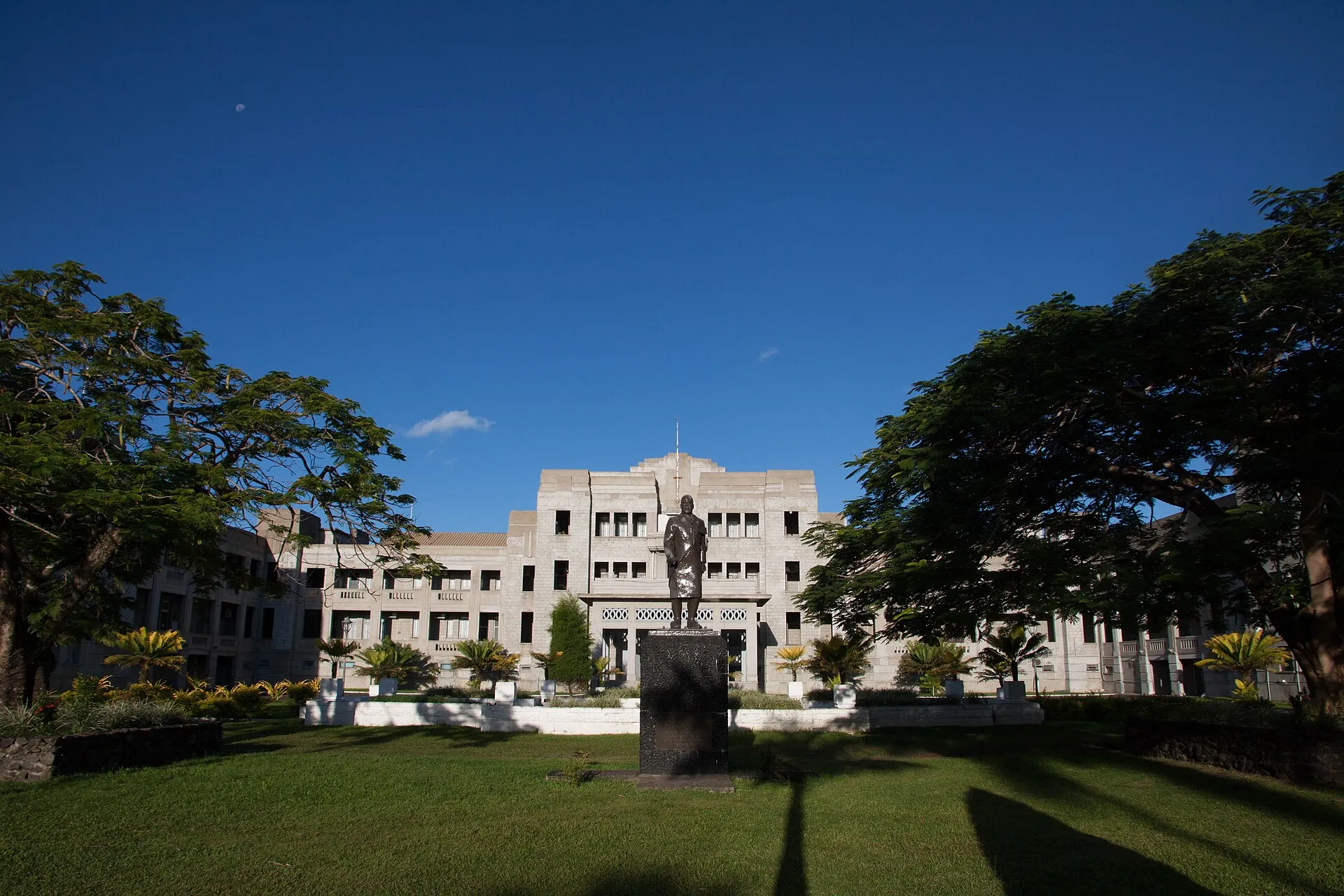
Suva's central city is walkable. The main government buildings, markets, shops, and several restaurants cluster within a 20-minute walk of the CBD. You can do most daily errands on foot if you stay centrally.
For longer trips, metered taxis are the default. Flag fall is $0.50 plus roughly $0.50 per kilometre. Always confirm the meter is running or agree on a flat rate before you depart. A typical in-city ride costs $2-4.50. Grab does not operate in Fiji, so you are flagging taxis on the street or calling a number from your hotel.
Public buses are cheap ($0.50-1 per ride within the city) and run from the main bus station at Suva Municipal Market, but they run on Fijian time rather than a precise schedule. They are fine for non-urgent trips.
The airport serving Suva is Nausori International Airport, about 23 km northeast of the city. A taxi from the airport to central Suva costs $18-27 and takes 30-45 minutes. There is no direct airport bus. If you fly into Nadi (the main international hub), expect a 5-hour express bus ride or a roughly 3.5-hour taxi along the Queens Road; budget $110-155 for a taxi from Nadi.
Sorting transport? Book an airport transfer, or compare car rental on Auto Europe and QEEQ.
Visas and Staying Long-Term
Citizens of over 100 countries, including the USA, UK, Australia, New Zealand, Canada, most EU nations, Japan, Singapore, and South Korea, receive a free entry permit on arrival valid for up to four months. You need a passport valid for at least six months beyond your departure date, an onward ticket, and proof of sufficient funds.
Fiji does not currently offer a dedicated digital nomad visa. Most remote workers enter on this tourist entry permit and work for clients abroad. Each extension must be arranged through the Department of Immigration; you can typically extend up to six months total, though this is at an officer's discretion. For stays beyond that, the most practical legal route is the investor permit, which requires a minimum $22,460 investment.
Best Time to Visit
Suva sits on the wet side of Viti Levu and is the rainiest capital city in the Pacific. That is important context: rain here is not a rare event, it is a regular one.
The dry season runs from May through October. June, July, and August are the most comfortable months, with average temperatures of 25-27°C, lower humidity, and the best chance of consistent sunshine. Rainfall still occurs but is significantly reduced compared to the wet season. This is the window most suited to productive remote work, with more reliable power and fewer weather disruptions.
The wet season (November through April) brings heavier rain, higher humidity, and the real risk of tropical cyclones from November to April. Cyclones can knock out power and internet for days and occasionally disrupt flights in and out. If you plan to work remotely and need reliable connectivity, avoid December through March unless you are comfortable with that risk.
October and May are shoulder months that offer a good balance of price and weather.
Pros and Cons
- Genuine capital city: Real infrastructure, good restaurants, a university town vibe, government agencies, and expat services all in one place
- English is widely spoken and signage is in English throughout
- Four-month visa-free stay for most Western passports with no advance application
- Affordable local food and a diverse culinary scene shaped by Fijian and Indo-Fijian traditions
- Compact and walkable city centre with low taxi fares
- Safe compared to other Pacific capitals, with a genuine expat and NGO community already present
- Internet is unreliable outside dedicated coworking; typical speeds are tight for video-heavy work
- Suva is very wet, receiving around 3,000 mm of rain per year; the wet season is genuinely disruptive
- Coworking options are thin: one proper space means no backup if Greenhouse is full or closed
- No nomad visa and limited pathways for stays beyond six months without significant investment
- Getting here is a commitment: Nadi is the main international hub, adding 5 hours of travel to reach Suva
- The nomad community is very small; you will not walk into a packed coworking scene or regular meetups
Who Suva Is Best For
Suva works well for remote workers who want a genuine off-the-beaten-path Pacific experience without sacrificing city conveniences entirely. If you are drawn to cultural depth, a real local life, good food, and the novelty of working from a Pacific capital, Suva delivers that authentically. It suits people on longer trips who are comfortable with slower internet and value stability over nightlife or a big nomad tribe. Researchers, writers, consultants, and anyone in low-bandwidth roles will cope better than developers on video-heavy standups.
Suva is a harder sell if fast, reliable internet is a daily requirement, if you need a strong coworking community or regular nomad events, or if you are coming for the classic Fiji beach holiday. Visitors expecting Bali-level digital infrastructure or Southeast Asia pricing will be disappointed. It also rewards those who arrive during the dry season and struggle to justify the journey if they can only stay for a few weeks.