Cost of Living in Roatan
Where this figure comes from. No cost survey covers Roatan, so the $1,100 a month above is our own estimate rather than a measurement. On 416 of our 999 city guides the figure is built from a published Numbeo basket, a one-bedroom rent in the centre plus one person's monthly costs without rent, converted to USD; this city is not one of them. How we source everything.
Budget around $1,100 a month as a solo remote worker on Roatan, which makes it one of the cheapest Caribbean islands anywhere and by a distance the cheapest with diving of this quality. A one-bedroom place runs roughly $400 to $700, with West End and West Bay at the top of that and the eastern half of the island considerably below. Food from the mainland keeps grocery costs reasonable, though imported goods carry a markup. Honduras uses the lempira, but Roatan runs substantially on United States dollars and most prices are quoted in them. This is our own estimate rather than a reconciliation against measured data. Electricity is the line that surprises people: Roatan's power is among the most expensive in Central America and running air conditioning through the night can add $150 to $250 a month on its own, which is why many long-stay rentals quote rent and utilities separately. Diving is the other structural cost and the reason most people are here, with a fun dive around $35 and a full Open Water certification $300 to $400, the cheapest anywhere. Water is trucked to much of the island and is billed accordingly.
Where to Work in Roatan
Roatan's connectivity is the weak point and it is the reason people either love the island or leave it. Fibre has reached West End and parts of the developed western half at speeds that work, but coverage is uneven, and power cuts are frequent enough that most established places run on an inverter or a generator. Mobile data from Tigo and Claro is the fallback. There is a small coworking presence in West End that grew out of the diving community. Anyone with a call-heavy schedule should test a specific property for a week before committing to a month. Starlink has changed the picture materially in the last two years and a number of rentals and dive shops now advertise it, which is worth looking for specifically because it sidesteps the island's cable and its outages. The island runs on Central Standard Time with no daylight saving, which puts it level with Chicago in winter and an hour behind in summer, giving a good North American overlap and an impractical European one.
Getting Around Roatan
Roatan is a long thin island, about fifty kilometres end to end, with one main road running its length. West End is walkable and is where most visitors base themselves, a single street of dive shops and restaurants along the water. Collectivo taxis run the main road cheaply and are the standard way to move; private taxis cost several times more and the difference is worth understanding before getting in. Scooters and rented cars work for the eastern half. The airport is near Coxen Hole with direct flights to Houston, Miami and mainland Honduras, plus a ferry to La Ceiba. The collectivo and private taxi distinction is worth learning on day one: a collectivo along the main road costs a dollar or two and a private taxi ten times that for the same journey, and drivers will assume the latter unless you say otherwise. The road east past French Harbour deteriorates, and the far end of the island around Camp Bay is genuinely remote. Scooter hire runs about $25 a day.
Sorting transport? Book an airport transfer, or compare car rental on Auto Europe and QEEQ.
Visas for Roatan
Honduras has no remote work visa. British citizens need a visa arranged in advance through a Honduran embassy and receive a 30-day entry stamp on arrival, which can be extended at an immigration office in the country. For US, Canadian and most EU passports, Honduras belongs to the CA-4 agreement with Guatemala, El Salvador and Nicaragua, which grants ninety days across all four countries combined rather than ninety days in each, a detail that catches out anyone planning a regional loop. Extensions of up to ninety further days can be applied for in Roatan or on the mainland. Leaving to Belize or Costa Rica resets the clock; leaving to Guatemala does not. Anyone planning a long stay should understand the CA-4 rule properly before arriving. Extensions are handled at the immigration office in Coxen Hole and are routine rather than difficult, but they must be applied for before the ninety days expire rather than after. The CA-4 rule catches people repeatedly: a trip to Guatemala or Nicaragua does not reset anything, and the only nearby resets are Belize, Costa Rica or Mexico, all of which mean a flight or a long overland day.
Best Time to Visit Roatan
March to September is the drier half and the best for diving, with calm water, visibility often over thirty metres and daytime temperatures around thirty-one. October to February is the wet season, with heavier rain and occasional cold fronts from the north that stir up the sea. The Atlantic hurricane season runs June to November and Roatan is exposed; Hurricane Mitch in 1998 and the 2020 storms Eta and Iota all affected the island. Whale sharks pass Utila, the next island west, between roughly February and April, which is the trip most divers here add. Sargassum has become a seasonal factor on the eastern and southern shores between roughly May and August, though the West End and West Bay beaches on the sheltered side are far less affected. September and October are the quietest months on the island and the cheapest to rent in, with the trade-off that the weather is least reliable then.
Pros and Cons of Roatan
Roatan sits on the Mesoamerican Barrier Reef, the second-largest in the world, and is the cheapest place on earth to get a diving certification, which is why a diving community has grown here rather than a nomad one. Costs are very low, English is widely spoken because of the island's Bay Islands history, and the water is exceptional. The internet here is genuinely unreliable, Honduras itself has one of the higher homicide rates in the Americas even though Roatan itself is far calmer than the mainland, and the island's development has been fast and largely unplanned. Roatan is also a Bay Islands community with its own history: English-speaking, part Garifuna and part descended from British settlers, and culturally distinct from mainland Honduras in a way that is immediately obvious. Cruise ships dock at Coxen Hole and Mahogany Bay several times a week, which floods the western half for a few hours and then empties it again.
Who Roatan Is For
A diver on a budget whose work survives a patchy connection, and anyone who would rather spend three months getting qualified than three days. The community around the dive shops in West End is real and easy to join, which is unusual in the Caribbean. Island bandwidth and a demanding call schedule pull against each other every day, there is no city here in any sense, and the CA-4 rule catches out anybody planning a long Central American loop who assumed four countries meant four separate allowances. The reef is the reason to be here and it is worth the compromises. Working up to a dive instructor qualification is one of the few things this island does better than almost anywhere. The concentration of shops means the whole ladder from Open Water to instructor can be climbed without leaving, at a cost that would be impossible in the Mediterranean or off Australia.
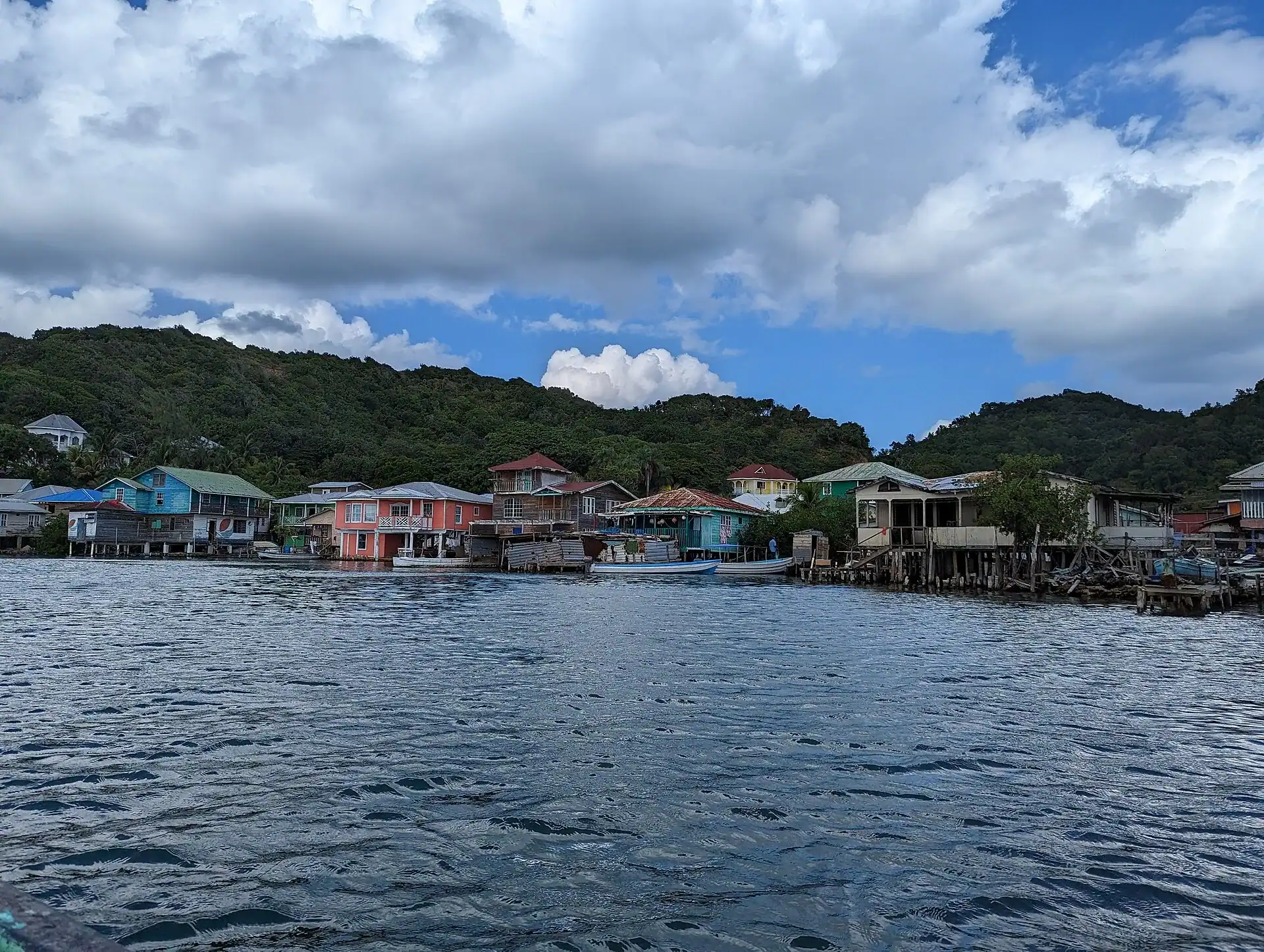 Photo: Cory Doctorow / Wikimedia Commons (CC BY-SA 2.0)